My Recollection of the 1920 Peggs Tornado
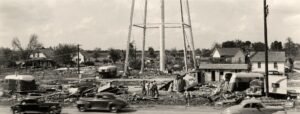
Tornado damage in Peggs, Oklahoma, May 1920

Walter Neel’s firsthand recollection of the 1920 Peggs cyclone describes the storm’s deadly impact on Peggs, Oklahoma, and nearby families. He recounts the warning signs, the destruction of homes and businesses, the loss of friends and relatives, and the grim work of helping identify bodies and dig graves in the aftermath.
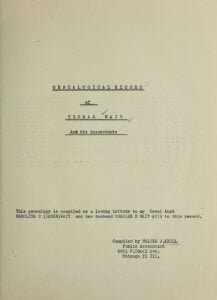
Genealogical Record of Thomas Wait and his descendants

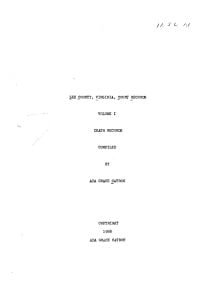
Genealogical record of Thomas Wait and his descendants

Genealogical Record of Thomas Wait and his descendants looks at the genealogy of Thomas Wait (1601-1677) who was from Wethersfield Parish, Essex, England. On his arrival in America, landing in Rhode Island, he applied for a lot on which to build,and was granted it on 7/1/1639. On 3/l6/l641 he became a Freeman in Newport R. I. He died in Portsmouth R. I., before April 1677 intestate. This Thomas Wait was a cousin to the Richard Waite of Watertown Mass., who was a large land owner. This unpublished manuscript provides the descendants of this family.

Moravian Massacre at Gnadenbrutten

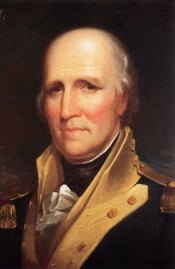
George Rogers Clark

In 1763, Moravian missionaries established missions among the Tuscarawa Indians. Despite maintaining neutrality during the Revolutionary War, they were perceived as threats by both American settlers and British allied Indians. In March 1772, a group of American frontiersmen, led by David Williamson, deceived and massacred 96 Moravian Indians—men, women, and children—at Gnadenbrutten. This brutal act was marked by a lack of empathy among the assailants, highlighting the brutal interactions between white settlers and Native Americans during this period of conflict.

The Discovery Of This Continent: It’s Results To The Natives

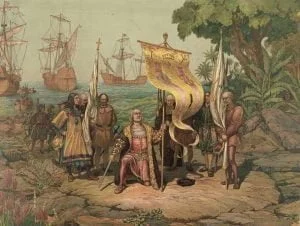
Columbus Landing on Hispaniola

In 1470, Christopher Columbus married Dona Felipa, daughter of a renowned navigator, and settled in Porto Santo, where they shared dreams of discovering lands to the West. Their ambitions fueled Columbus’s determination, leading to his 1492 voyage that resulted in the European discovery of the Americas. However, this event marked the beginning of devastation for native peoples, introducing warfare, disease, and colonization that would decimate their populations and cultures, ultimately transforming their rich, diverse societies into shadows of their former selves.

Genealogy of the Cherokee Wilkerson Family

Tornado damage in Peggs, Oklahoma, May 1920

This genealogy compiles the Cherokee Wilkerson family using Starr’s History of the Cherokee Indians and Native American rolls, tracing descendants of Edward (John) Wilkerson and Coo-ta-ya through multiple generations. It lists marriages, children, and approved Guion-Miller applications, while also noting disputed online family links and clarifying Starr’s original representation of the family tree.

Montgomery Co., Ky

In Montgomery County, Kentucky, enslaved individuals lived primarily on farms, provided with log houses, food, and clothing made under the supervision of white mistresses. Most sales of slaves were considerate, often keeping families together. Religious instruction was common among enslaved people, who created a vibrant community life. Notably, the county did not experience significant slave trading or the Underground Railroad. Records reflect a structured yet complex social dynamic, where enslaved individuals were regarded as human beings, despite the harsh realities of slavery.

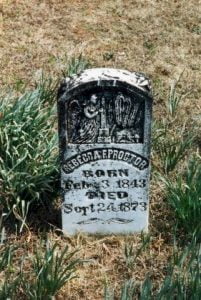
Hodgen Cemetery, Hodgen, LeFlore County, Oklahoma

Hodgen Cemetery, LeFlore County, Oklahoma

Hodgen Cemetery, located just south of Hodgen, Oklahoma, is the town’s active burial ground and the subject of this extensive online cemetery record. Compiled from headstone inscriptions, the listing preserves names, dates, family relationships, and military service details for generations of local residents, with thanks to Paula Doyle-Bicket for the submission.

Slave Narrative of Bert Luster

Bert Luster, born in 1853 in Watson County, Tennessee, recalls his life as a slave under Masters Astern. He details the daily tasks and the relative kindness of his owners compared to others who faced harsher treatment. Luster describes his post-slavery life, including marrying and raising children, along with his success as a farmer in Oklahoma. He reflects on his experiences with the Ku Klux Klan and emphasizes the importance of education, faith, and community while expressing gratitude for the end of slavery.

Slave Narrative of Charlotte Martin

In an interview with Alfred Farrell, Charlotte Martin recounts her life as a slave on Judge Wilkerson’s plantation in Sixteen, Florida. Born to Shepherd and Lucinda Mitchell, Charlotte experienced harsh treatment and witnessed her brother’s death from a beating for participating in secret religious gatherings. The plantation prioritized breeding strong slaves for sale. After emancipation, Charlotte developed a reputation for her herbal remedies and later settled in Live Oak, where she continued farming and caring for others, despite personal challenges in her family.

Biography of Robert A. Wilkerson

Robert A. Wilkerson, born on January 30, 1884, in Tennessee, has been a distinguished member of the Oklahoma bar since establishing his law practice in Pryor in 1915. He graduated from Cumberland University and has achieved significant success in his legal career through dedication and effort. Wilkerson is actively engaged in local governance as the chairman of the Mayes County Democratic Central Committee and is involved in community organizations like the Pryor Commercial Club. He also served during World War I and is affiliated with various fraternal and legal associations.

Biography of Oliver C. Wilkerson

Oliver C. Wilkerson, born on March 5, 1899, in Claremore, Oklahoma, is a prominent young businessman in Washington County, residing with his parents near Dewey. He hails from a family with deep Cherokee roots; his father, Richard Wilkerson, was successful in farming and land development. Oliver is focused on his agricultural pursuits, owning valuable land with producing oil wells. Currently a student planning to attend the University of Oklahoma, he aims to enhance his education and management skills. He served in World War I, reflecting his dedication to his community and heritage.

C. C. Wilkerson

Sergt. 1st Class Wilkerson, of the Medical Corps in the 81st Division, was born to W. A. and Mrs. Mary P. Wilkerson in Durham County. He enlisted on October 5, 1917, and underwent training at Camp Jackson and Camps Mills before deploying to France on August 8, 1918. After his service, he returned to the United States on June 13, 1919, and was officially mustered out at Camp Lee, Virginia, on June 21, 1919.

List 3, Cherokees

List of Cherokees and Cherokee Freedmen whose names were omitted from final rolls because no application was made or by reason of mistake or oversight. Shows the names of 125 Cherokees by blood and 2 Cherokee freedmen all except 5 being minors, and most of them less than 4 years of age March 4, 1906.

Peggs Cyclone of May 2, 1920

Tornado damage in Peggs, Oklahoma, May 1920

The Peggs Cyclone of May 2, 1920, devastated Peggs, Oklahoma, following a skipping, bouncing path that destroyed the town center and continued eastward. This detailed account reconstructs the tornado’s track, documents dozens of deaths and injuries, and recounts survivor stories, including a miraculous birth amid the storm’s destruction and the loss of Dr. Israel Hill.

Rough Riders

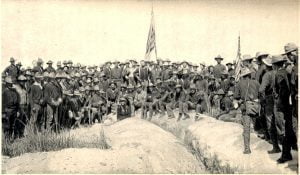
Rough Riders

The compiled military service records of 1,235 Rough Riders, including Theodore Roosevelt, have been digitized. Each record features individual jackets detailing the soldier’s name, organization, rank, and medical records. The records also contain personal information and documentation descriptions. Discharges occurred for various reasons, such as age, ability, discipline issues, or hardship. This initiative provides significant insights into the personnel of the 1st U.S. Volunteer Cavalry during the Spanish-American War.

Buying and Selling Slaves

In the Purchase Region during slavery, slave trading occurred irregularly, primarily at owners’ homes, with prices influenced by the age and health of the slaves, sometimes reaching up to $1,000 for strong young males. Sales often resulted in heartbreaking separations of families, particularly between mothers and children. Living conditions varied widely among slaves, reflecting the dispositions of their owners. Additionally, relationships between white owners and enslaved women were not uncommon, complicating familial ties. Following emancipation, some former slaves chose to remain with their owners rather than face the uncertainties of freedom.