
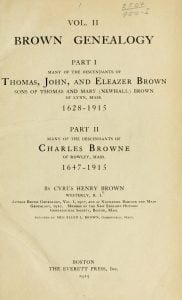
Brown Genealogy

Brown Genealogy

In 1895, Cyrus Henry Brown began collecting family records of the Brown family, initially with the intention of only going back to his great-grandfathers. As others became interested in the project, they decided to trace the family lineage back to Thomas Brown and his wife Mary Newhall, both born in the early 1600s in Lynn, Massachusetts. Thomas, John, and Eleazer, three of their sons, later moved to Stonington, Connecticut around 1688. When North Stonington was established in 1807, the three brothers were living in the southern part of the town. Wheeler’s “History of Stonington” contains 400 records of early descendants of the Brown family, taken from the town records of Stonington. However, many others remain unidentified, as they are not recorded in the Stonington town records. For around a century, the descendants of the three brothers lived in Stonington before eventually migrating to other towns in Connecticut and New York State, which was then mostly undeveloped. He would eventually write this second volume of his Brown Genealogy adding to and correcting the previous edition. This book is free to search, read, and/or download.
Families of Ancient New Haven

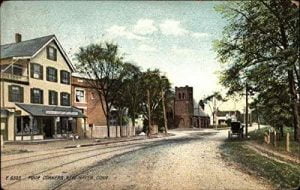
Four Corners New Haven Connecticut

The Families of Ancient New Haven compilation includes the families of the ancient town of New Haven, covering the present towns of New Haven, East Haven, North Haven, Hamden, Bethany, Woodbridge and West Haven. These families are brought down to the heads of families in the First Census (1790), and include the generation born about 1790 to 1800. Descendants in the male line who removed from this region are also given, if obtainable, to about 1800, unless they have been adequately set forth in published genealogies.

History of Minneapolis and Hennepin County, Minnesota

History of Minneapolis and Hennepin County, Minnesota

The aim of this history was to present in a permanent form the key incidents in the history of Minneapolis, from its earliest settlement to its publication in 1895. The primary facts and events recounted were mostly obtained from living witnesses and participants. It was rare for a city with more than two hundred thousand inhabitants to have so many of its first settlers still alive. The city’s growth had been so extraordinary and unprecedented that many of its earliest settlers remained. Some information was also gleaned from the notes left by now-deceased writers who witnessed the events described. Great care was taken to verify the accuracy of all facts and incidents mentioned. While it might have been too much to hope that the work was entirely free from errors, it was confidently believed that any such errors were few and insignificant.

Baldwin County Georgia Marriages 1806-1850

This index compiles 1,352 Baldwin County, Georgia marriage records from court documents covering 1806 to 1850. It lists groom, bride, and marriage date entries in chronological order, offering a valuable genealogical resource for tracing family history, local relationships, and early county residents across more than four decades.

Stillman’s Defeat

In May, General Whitesides authorized Major Stillman to lead a scouting mission of nearly 300 mounted militia to Black Hawk’s camp. Unaware of the encampment’s location, the troops inadvertently killed a flag bearer during parley, leading to a surprise attack by Black Hawk’s small force. The militia panicked and retreated to Dixons Ferry, despite their superior numbers. This chaotic engagement escalated tensions and prompted Illinois and federal authorities to mobilize for what became a significant conflict, marking the beginning of a war that could have been avoided.

Biography of E. D. Stillman

E.D. Stillman, born in New York in 1828, was a skilled mechanic who traveled to Oregon in 1849 as a wheelwright for mounted riflemen. He worked for General Joe Lane, managing the McLoughlin sawmill and witnessing significant events, including the execution of Cayuse Indians. After a decade in the Siskiyou mines, he settled in Milton, Oregon, where he operated a fruit farm while also practicing his trade in Pendleton. His life reflects the dynamic and often tumultuous history of early Oregon settlement.