
Phillips
Biographical Sketch of McCagha Phillips
McCagha Phillips, a native of Moultrie County, Illinois, was born on January 7, 1856. He is the son of early Coles County settler Calvin Phillips. McCagha operates a 136-acre farm valued at $4,500. He married Mary A. Gilmer, born on April 27, 1856, in Russell County, Virginia, on June 10, 1877. The couple has one child, Leon.
Phillips, Dave “Shorty” – Obituary
Dave “Shorty” Phillips, 74, passed away on April 29, 2005, in Prineville, Oregon. Born on October 10, 1930, in Emmett, Idaho, he worked in the mill after his family moved to Kinzu. A U.S. Army veteran, he lived in Prineville, Baker City, and returned to Prineville. Shorty had a career in lumber, retiring in 1993, and was a passionate outdoorsman. He was predeceased by two wives, and is survived by his children, grandchildren, and siblings. No public service was held.
Phillips, Lavern A. Hindman Mrs. – Obituary
Lavern A. Phillips, 83, of Baker City, passed away on February 24, 2005, at St. Elizabeth Health Care Center. A memorial service was held on March 1 at Gray’s West Co. She was born on July 2, 1921, in Baker City and had a notable career as New Account’s Manager for the First National Bank of Oregon. Lavern was married to Thomas B. Harper and later to Fred A. Phillips II. She is survived by her husband, children, and extended family.
Phillips, Ila Marie Stephenson Mrs. – Obituary
Ila Marie Phillips, 71, of Prineville and former resident of Baker City, passed away on November 19, 2004, at home. Born January 8, 1933, in West Plains, Missouri, she was raised in Prineville after her family’s move. Ila married Allen Phillips, and together they raised a family, known for her culinary skills and love for crossword puzzles. She is survived by her husband, children, siblings, and 12 grandchildren. A memorial service is scheduled for 2 p.m. Tuesday at the Veterans Club in Prineville.
More Victims of Anti-Slavery Act – Fugitive Slave Law
In 1852, a series of arrests and violent encounters involving alleged fugitive slaves unfolded across various states, highlighting the harsh realities of the Fugitive Slave Law. William Smith was shot by a marshal during an escape attempt, while James Phillips was returned to slavery after over a decade of freedom. Other cases included multiple arrests and court decisions that enforced the return of people to slavery, often amidst violent confrontations. These incidents reflect the law’s brutal enforcement and the desperate resistance of those affected.
Surnames Paddy to Polk
This document contains genealogical statements regarding various individuals and families of Creek, Choctaw, Chickasaw, and Mississippi Choctaw descent who sought recognition and enrollment in tribal rolls. The records, primarily from 1909 reports, detail claimants’ ancestry, enrollment issues, and tribal affiliations. Many individuals were denied enrollment due to factional disputes, legal technicalities, or failure to apply within deadlines. The document includes references to official reports and affidavits, offering insights into the complexities of Native American citizenship and land rights during the early 20th century.
List 3, Cherokees
List of Cherokees and Cherokee Freedmen whose names were omitted from final rolls because no application was made or by reason of mistake or oversight. Shows the names of 125 Cherokees by blood and 2 Cherokee freedmen all except 5 being minors, and most of them less than 4 years of age March 4, 1906.
Biographies of the Cherokee Indians
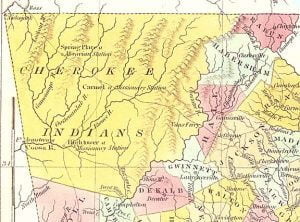
The Cherokee Indians, primarily from the Southeastern U.S., have a rich history marked by their early adoption of a written language and a government structure similar to that of the United States. Despite their forced relocation to Oklahoma in the 1830s, they maintained significant genealogical ties, often intermarrying with Whites. Emmet Starr’s “History of the Cherokee Indians and Their Legends and Folklore” emphasizes personal biographies and genealogies, providing insights into the lives and connections of many Cherokee families across generations, thereby enriching their cultural narrative.
Biographical Sketch of J. L. Phillips
J. L. Phillips, born on May 7, 1841, in Mercer County, Kentucky, is the son of John and Rowena Phillips. He began his career as a teacher at sixteen and later worked for the St. Louis South-Eastern Railroad before joining the Louisville Nashville Railroad in 1860. Over the past five years, he has served as an agent for the company. Married in 1857 to Calpumia Powell, he has three children: Powell, Willard, and Bettie. Powell also works for the railroad.