Wintergreen Cemetery, Port Gibson, Mississippi

Wintergreen Cemetery, Port Gibson, Mississippi

This survey of Wintergreen Cemetery, Port Gibson, Mississippi, was completed in 1956 by Mr. Gordon M. Wells and published by Joyce Bridges the same year. It contains the cemetery readings Mr. Wells was able to obtain at that date. It is highly likely that not all of the gravestones had survived up to that point, and it is even more likely that a large portion of interred individuals never had a gravestone.

1st Mississippi Light Artillery

The 1st Mississippi Light Artillery, also known as Withers’ Light Artillery, comprised several companies raised across Mississippi, participating in key battles during the Civil War. Initially assembled in May 1862, the regiment played a crucial role in the defense of Vicksburg against Union forces, with notable contributions at Chickasaw Bayou and the Vicksburg campaign. Throughout its service, the artillery faced significant casualties and challenges, ultimately surrendering at Vicksburg in July 1863. Afterward, surviving members regrouped as infantry before continuing their service in various capacities.

The Lucketts of Portobacco

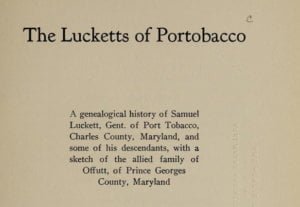
The Lucketts of Portobacco

A genealogical history of Samuel Luckett, Gent, of Port Tobacco, Charles County, Maryland, and some of his descendants, with a sketch of the allied family of Ofifutt, of Prince Georges County, Maryland.

Adams, Adderton, Addison, Alexander, Applebaugh, Ashby, Atkisson, Baggett, Bainbridge, Baldwin, Barnes, Barney, Bartlett, Battle, Beale, Beall, Beatty, Beaven, Belt, Benson, Bethel, Blair, Borden, Bottrell, Bowie, Bradford, Brazier, Brengle, Briscoe, Brocke, Brogdon, Brown, Bryan, Burgess, Campbell, Cantwell, Carr, Carroll, Cave, Chiswell, Clapman, Clements, Clephane, Contee, Cooke, Cooper, Cope, Cox, Creek, Cumming, Dade, Davis, Delahay, Dent, Doling, Dorry, Dorsey, Douglas, Drone, Duval, Eagler, Earle, Edelen, Edmonston, Elms, Evans, Fendall, Ferguson, Field, Fink, Floyd, Fouch, Franklin, Galford, Gladden, Glahn, Glenn, Godfrey, Goodrick, Gracey, Graham, Gray, Green, Griffin, Gulick, Haddox, Hall, Hamill, Hamilton, Hanson, Harding, Harris, Harrison, Harrold, Hawkins, Haynie, Hobbs, Hobson, Holton, Hussey, Jamieson, Jenifer, Jenkins, Jett, Johnson, Jones, Jordan, Kalbfleisch, Keith, Kennedy, Kenner, Kerrick, Kybert, Langworth, Lawson, Lennarts, Lewis, Lilley, Lowe, Luckett, Lynn, Maddox, Magruder, Mantz, Manzy, Markham, Marlow, Martin, Marye, Mastin, Matthews, McCane, McCauley, Metcalf, Middleton, Miller, Minor, Mooney, Moore, Morehead, Morris, Mudd, Muir, Murray, Neale, Nelson, Nesbit, Nichnow, Nichollas, Odom, Offord, Offutt, Oldham, ORea, Orrell, Parker, Parnell, Patton, Payne, Perry, Peters, Peyton, Posey, Price, Ramsey, Rankin, Rasbury, Ratliff, Reed, Robey, Robinson, Roxborough, Sage, Sargeant, Sayles, Scott, Sewell, Seydel, Shaw, Shrive, Sidener, Skinner, Smith, Smoot, Sprigg, Spriplin, Steel, Stone, Sugar, Swansted, Swearingen, Taylor, Theobald, Thickpenny, Thompson, Tolson, Tongue, Trundle, Tyler, Venom, Wall, Wallace, Ware, Watkins, West, Westman, Wheadon, Wheeler, White, Whiting, Wickliff, Willcoxen, Williams, Withers, Witt, Wood, Woods, Woodward, Yates, Yost.

1860 Census West of Arkansas – Creek Nation

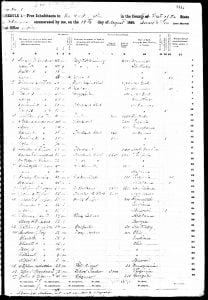
1860 Free Inhabitants Creek Nation Page 1

The 1860 census for the Creek Nation, located west of Arkansas, reveals a diverse array of free inhabitants, including Native Americans from Creek and Seminole tribes. This listing indicates that many individuals either renounced their tribal affiliations or were never granted citizenship. Several entries mark those who married Native individuals but were still denied citizenship, suggesting a complex social structure within the community. The presence of individuals identified by racial categories reflects the intricate interplay of identities during this period.

Biographies of Western Nebraska

History of Western Nebraska and its People

A historical overview of western Nebraska and its pioneer settlers, this volume highlights the men who helped build counties across the Nebraska Panhandle, including Cheyenne, Box Butte, Deuel, Garden, Sioux, Kimball, Morrill, Sheridan, Scotts Bluff, Banner, and Dawes. It also points readers to biographies, history volumes, and a gallery of 143 photographs.

Captivity and Escape of Mary Inglis (Ingles) – Indian Captivities

Mary Draper Ingles Chimney Plaque

The captivity of Mary Draper Inglis (Ingles) is a third person account of her captivity and eventual escape. Mary was captured by Shawnee Indians along with her two sons, and sister-in-law from Draper’s Meadow in 1755. She eventually made her escape, along with another dutch woman, a few months later. This is her story.

Biography of Hon. Rezin Davidge

Hon. Rezin Davidge was a distinguished early lawyer in Christian County, known for his legal expertise, compelling speaking, and integrity. Born in Maryland around 1770, he moved to Kentucky post-statehood and became the first Commonwealth’s Attorney in Hopkinsville. Though appointed as a Judge of the Court of Appeals during a turbulent political period, his tenure was contentious. Davidge later served on the Circuit bench and spent his final years in Hopkinsville. He was married twice, fathering five sons and three daughters.

Life and travels of Colonel James Smith – Indian Captivities

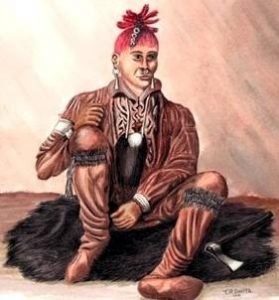
An Artists rendition of James Smith

James Smith, pioneer, was born in Franklin county, Pennsylvania, in 1737. When he was eighteen years of age he was captured by the Indians, was adopted into one of their tribes, and lived with them as one of themselves until his escape in 1759. He became a lieutenant under General Bouquet during the expedition against the Ohio Indians in 1764, and was captain of a company of rangers in Lord Dunmore’s War. In 1775 he was promoted to major of militia. He served in the Pennsylvania convention in 1776, and in the assembly in 1776-77. In the latter year he was commissioned colonel in command on the frontiers, and performed distinguished services. Smith moved to Kentucky in 1788. He was a member of the Danville convention, and represented Bourbon county for many years in the legislature. He died in Washington county, Kentucky, in 1812. The following narrative of his experience as member of an Indian tribe is from his own book entitled “Remarkable Adventures in the Life and Travels of Colonel James Smith,” printed at Lexington, Kentucky, in 1799. It affords a striking contrast to the terrible experiences of the other captives whose stories are republished in this book; for he was well treated, and stayed so long with his red captors that he acquired expert knowledge of their arts and customs, and deep insight into their character.

Ridgelawn Memorial Cemetery – Oxford Michigan

This cemetery record from Oxford, west of Burdick Street, lists hundreds of burials collected in September 2001 by Christopher Schnur. The transcription includes names, birth and death dates, military service, family relationships, and epitaphs, offering a detailed historical snapshot of local families, veterans, children, and spouses buried in the cemetery.

Biographical Sketch of Jacob Patton

Jacob Patton and his wife, Rebecca Barnett, moved to Loutre Island, Montgomery County in 1810, raising four children: James, Thomas, Mary, and Rebecca. James’s family included several children, with Jesse residing in Boone County and Amelia a widow in Callaway County. Thomas tragically died in 1816 from hydrophobia after being bitten by a mad wolf. His widow lived until 1867. Rebecca married John Gibson, while Mary wed Thomas Patton, who also had numerous descendants.

Biography of Hon. James Patton, Q. C.

James Patton, born June 10, 1824, in Prescott, Ontario, was educated at U.C. College and began his legal career in 1840. He established a successful law practice in Barrie and contributed to journalism as the proprietor of the Barrie Herald. As a lawyer, he held various positions including Solicitor-General and was elected a Bencher of the Law Society. In politics, he served in the Legislative Council and was involved in significant legal reforms. Patton married Martha Marietta in 1853 and served as Vice-Chancellor of the University of Toronto from 1860 to 1864.

Biography of Rev. Henry Patton

Rev. Henry Patton, D.C.L., an influential Archdeacon in the Diocese of Ontario, died on April 30, 1874. Born in Chelmsford, Essex, in 1806, he immigrated to Canada in 1816 and was ordained in Quebec in 1829. He dedicated 17 years to the Kemptville mission and later served in Cornwall and Belleville. Appointed Archdeacon of Ottawa and Prolocutor of the Provincial Synod, he was known for his tireless work and moderate views. Patton was twice married and left a legacy that continues to be honored.

Biography of Major Andrew Patton

Major Andrew Patton, born in 1771 in Scotland, came from a distinguished military lineage. He began his military career in the British Army at a young age, rising through the ranks to become a Major in the 45th Regt. He participated in significant campaigns, including the Irish Rebellion, battles in Holland, and the Egyptian campaign, demonstrating exceptional bravery at Mandora. After retiring from active service, he settled in Canada, becoming an Ordnance Storekeeper and later a Barrackmaster. Patton was revered for his integrity and kindness, passing away in 1838.

Biography of Benjamin Patton

Benjamin Patton was a pioneering settler in what is now Cabarrus County, known for his steadfast courage and commitment to liberty. A descendant of Covenanters, he represented the people at the Provincial Congress in Newbern in 1774, a significant event predating the national declaration of independence. Despite his age, he walked approximately 300 miles to attend. Appointed Major of the second Continental regiment in 1775, Patton served on the Committee of Safety for Mecklenburg County and passed away near Concord, buried without a monument to mark his legacy.

Surnames Paddy to Polk

This document contains genealogical statements regarding various individuals and families of Creek, Choctaw, Chickasaw, and Mississippi Choctaw descent who sought recognition and enrollment in tribal rolls. The records, primarily from 1909 reports, detail claimants’ ancestry, enrollment issues, and tribal affiliations. Many individuals were denied enrollment due to factional disputes, legal technicalities, or failure to apply within deadlines. The document includes references to official reports and affidavits, offering insights into the complexities of Native American citizenship and land rights during the early 20th century.

Biography of Hon. Thomas Patton

Hon. Thomas Patton, born on March 19, 1829, in Ohio, is a respected figure in Oregon’s history. He moved West in 1851 and quickly established himself in Salem, where he engaged in various public roles, including county judge and state legislator. His contributions to society extend to his leadership within the Masonic fraternity. Patton served as U.S. consul in Japan from 1884 to 1887 and was noted for his business acumen. He faced personal tragedy with the death of his wife in 1866 and is a devoted Republican and Congregationalist.