1932 New Hampshire Notables

1892 Map of New Hampshire

New Hampshire Notables,” published by the Concord Press in 1932, is a biographical compilation that follows a previous work by Henry H. Metcalf. It contains 474 brief sketches of notable individuals, both natives and residents of New Hampshire, recognized for their contributions across various fields such as public life, business, and education. This edition focuses on living subjects as of 1932, with an alphabetical index for easy reference. While not exhaustive, it serves as a valuable resource for researchers and libraries, preserving important biographical data.

History of New Boston New Hampshire

Map of New Boston, New Hampshire

In 1864, Rev. Elliott Colby Cogswell compiled a comprehensive history of New Boston, New Hampshire, in honor of the town’s Centennial. This undertaking, prompted by a community vote during the July 4, 1863, celebrations, aimed to preserve the town’s rich history, including its civil, ecclesiastical, and educational development, as well as biographical accounts of early settlers. Funded by local subscriptions, the volume documented the events of the Centennial and served as an important record of the town’s first hundred years.

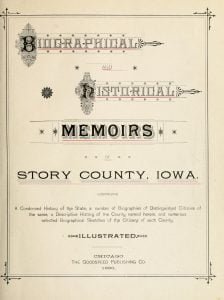
Biographical and Historical Memoirs of Story County, Iowa

Title Page for Biographical and Historical Memoirs of Story County, Iowa

This manuscript offers a broad survey of Iowa’s development and the individuals who shaped it. It opens with a concise history of the state, followed by a series of biographical sketches highlighting notable Iowans whose careers influenced law, politics, commerce, and community life. A substantial section is devoted to Story County, providing a descriptive account of its formation, settlement patterns, and early growth. This county history is supplemented by an extensive collection of personal profiles documenting the lives of its leading residents.

History of Natrona County, Wyoming

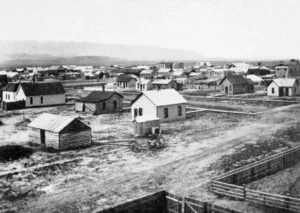
Casper Wyoming in 1894

For individuals researching ancestors who lived in Natrona County between 1888 and 1922, this book offers valuable context and potential leads. It includes names of county officials, war veterans, pioneers, and individuals involved in notable local events, as well as detailed accounts of institutions such as schools, churches, newspapers, and civic organizations. Descriptions of towns, industries, and public records provide insight into the communities where ancestors may have lived or worked. While not a genealogical record in and of itself, the book’s extensive local detail can help place family histories within the broader social and economic framework of the time. And who knows, perhaps your ancestor was one of the more colorful citizens portrayed…

History of Blaine Washington, 1884-1959

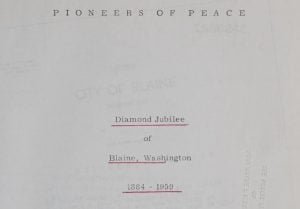
Pioneers of peace - diamond jubilee anniversary, Blaine, Washington, 1884-1959

“History of Blaine Washington, 1884-1959” offers a comprehensive and engaging exploration of Blaine, Washington’s rich history and cultural heritage. Published in 1959 to commemorate the diamond jubilee of Blaine, this book captures the essence of a community that has thrived on the principles of peace and cooperation. Situated in Whatcom County, Blaine’s unique geographical location near the Canadian border plays a pivotal role in its identity, an aspect vividly illustrated through the symbol of the International Peace Arch.

Brown Genealogy

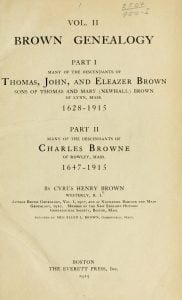
Brown Genealogy

In 1895, Cyrus Henry Brown began collecting family records of the Brown family, initially with the intention of only going back to his great-grandfathers. As others became interested in the project, they decided to trace the family lineage back to Thomas Brown and his wife Mary Newhall, both born in the early 1600s in Lynn, Massachusetts. Thomas, John, and Eleazer, three of their sons, later moved to Stonington, Connecticut around 1688. When North Stonington was established in 1807, the three brothers were living in the southern part of the town. Wheeler’s “History of Stonington” contains 400 records of early descendants of the Brown family, taken from the town records of Stonington. However, many others remain unidentified, as they are not recorded in the Stonington town records. For around a century, the descendants of the three brothers lived in Stonington before eventually migrating to other towns in Connecticut and New York State, which was then mostly undeveloped. He would eventually write this second volume of his Brown Genealogy adding to and correcting the previous edition. This book is free to search, read, and/or download.

Families of Ancient New Haven

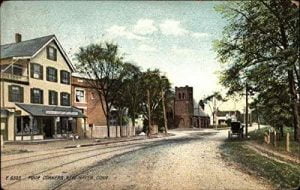
Four Corners New Haven Connecticut

The Families of Ancient New Haven compilation includes the families of the ancient town of New Haven, covering the present towns of New Haven, East Haven, North Haven, Hamden, Bethany, Woodbridge and West Haven. These families are brought down to the heads of families in the First Census (1790), and include the generation born about 1790 to 1800. Descendants in the male line who removed from this region are also given, if obtainable, to about 1800, unless they have been adequately set forth in published genealogies.

Record of the Smith family descended from John Smith

Record of the Smith family descended from John Smith

This book contains the history of the descendants of John Smith, born in Ireland in 1686, died in Uwchlan, Chester County, Pennsylvania, December 19, 1765; and his wife, Susanna, born in Ireland in 1691, died in Uwchlan, Chester County, Pennsylvania, December 24, 1767.

Lowell Massachusetts Genealogy

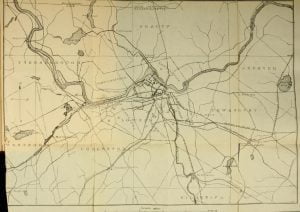
1894 Map of Lowell

Tracing ancestors in Lowell, Massachusetts online and for free has been greatly enhanced by the University of Massachusetts in Lowell which provided digitized version of a large quantity of the Lowell public records. Combined with the cemetery and census records available freely online, you should be able to easily trace your ancestors from the founding of Lowell in 1826 through 1940, the last year of available census records. To add color to the otherwise basic facts of your ancestors existence we provide free access to a wide range of manuscripts on the history of Lowell, it’s manufactures and residents.

1860 Census West of Arkansas – Creek Nation

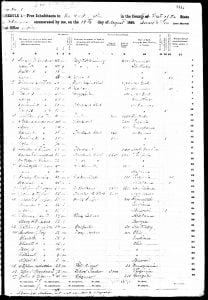
1860 Free Inhabitants Creek Nation Page 1

The 1860 census for the Creek Nation, located west of Arkansas, reveals a diverse array of free inhabitants, including Native Americans from Creek and Seminole tribes. This listing indicates that many individuals either renounced their tribal affiliations or were never granted citizenship. Several entries mark those who married Native individuals but were still denied citizenship, suggesting a complex social structure within the community. The presence of individuals identified by racial categories reflects the intricate interplay of identities during this period.

Contributions of the Old Residents’ Historical Association, Lowell MA

Historical Association of Lowell Mass

The Lowell Historical Society published six volumes documenting the history of Lowell, Massachusetts, primarily during the late 19th and early 20th centuries. Contributions include memoirs, biographies, and accounts from notable residents and events, highlighting the city’s development, industries, and community life. Key topics cover early manufacturing, educational institutions, local governance, and personal recollections from various citizens. These volumes serve as a vital resource for understanding Lowell’s historical landscape and the contributions of its residents.

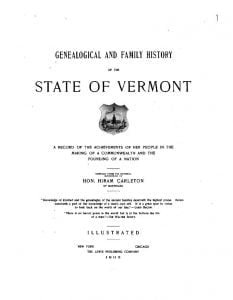
Genealogical and Family History of Vermont

Genealogical and Family History of the State of Vermont vol 1

Hiram Charlton took on the publication of the Genealogical and Family History of the State of Vermont for Lewis Publishing. In it, he enlisted the assistance of living residents of the state in providing biographical and genealogical details about their family, and then he published all 1104 family histories in two distinct volumes.

Journey of Bartram Through Alabama

History of Alabama and incidentally of Georgia and Mississippi, from the earliest period

William Bartram traveled through the Creek Nation and Mobile, where he observed a town with a mix of inhabited and abandoned structures, primarily occupied by the French and British settlers. He noted the prominent Indian trade conducted by Swanson and McGillivray and described the well-managed plantations along the Tensaw River. In Pensacola, Bartram received warm hospitality from local officials. His journey also included visits to various plantations and Indian towns, culminating with his return to Mobile and further travels into the Creek territory with a caravan of traders.

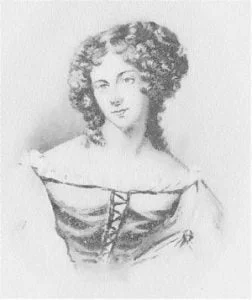
Cora Livingston, Mrs. Thomas Pennant Barton

Cora Livingston

Cora Livingston was born on June 16, 1806, in New Orleans to Edward Livingston and Louise Moreau. Despite lacking conventional beauty, she became a celebrated belle from 1820 to 1830, known for her grace and charm. Cora was deeply integrated into the political and social life of her era, often associated with notable figures, including President Andrew Jackson. In 1831, she married Thomas Pennant Barton, and after her parents’ passing, she lived at Montgomery Place. Cora passed away on May 23, 1873, remembered as a distinguished woman of her time.

Biographical Sketch of Newt Livingston

Newt Livingston, a native of Missouri, moved to Oregon with his family as an infant and resided in Douglas County until 1886. He then settled in Willow precinct on Granite Creek, where he established a homestead and engaged in stock raising. In 1896, he was elected Sheriff of Grant County as a nominee of the Populist Party and has since been recognized as a capable and popular officer. He married M. E. Newsman in 1875, and they have four children together.

Biographical Sketch of James Livingston

James Livingston, born on November 29, 1838, in Kilbride, Scotland, immigrated to Ontario in 1856, where he transitioned from weaving to agriculture and flax cultivation. He partnered with his brother John in Wellesley, significantly expanding their operations to encompass 3,000 acres and establishing a successful linseed oil business. Active in local politics, Livingston served as reeve of Wilmot and was elected to the Ontario Legislature. A Reformer and Mason, he married Louisa Liersch, raising eight children.

Biography of Thomas Livingston

Thomas Livingston, a prominent pioneer of southwest Missouri, was born on April 2, 1831, in Indiana. After moving to Missouri in 1855, he farmed in Howell County and later settled in Douglas County. Married to Susan J. Alsup, they had ten children, with three surviving. A Republican and active community member, Livingston serves as postmaster at Falling Springs and is known for his honorable character. His family has deep roots in American history, with connections to the Revolutionary War and significant local contributions.