History of Rindge New Hampshire

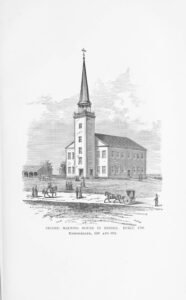
Second Meeting House in Rindge New Hampshire

The History of the Town of Rindge, New Hampshire by Ezra S. Stearns, was published in 1875, and covers the period from the original Rowley Canada grant or Massachusetts charter through the year 1874. Stearns traces the legal, territorial, and institutional development of Rindge, beginning with colonial land grants and boundary disputes and proceeding through settlement, incorporation into a town and development into a small manufacturing hub. More than half the volume is devoted to genealogical material. The genealogical register of Rindge families includes thousands of names compiled from a wide range of sources and assisted by contributions from residents and researchers beyond the town.
History of Shelburne Massachusetts

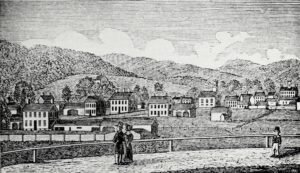
Southeastern View of Shelburne Falls Village Before 1835

The “History and Tradition of Shelburne, Massachusetts” is an account of the town’s development, initiated by a community effort in 1944. The project culminated in 1958 after various committees worked to collect and organize information across multiple aspects, including geology, early settlement, and cultural life. The book, intentionally topical rather than genealogical, features contributions from numerous writers and serves as a reference for understanding Shelburne’s heritage, institutions, and notable figures.

History of Francestown New Hampshire

Map of Francestown New Hampshire

History of Francestown, New Hampshire is a historic and genealogical record of the town from its first settlement in 1758 through the beginning of 1891. It records Francestown’s settlement, civic growth, religious and educational institutions, military participation, industries, and social customs, followed by an extensive genealogical register of families associated with the town.

Vital Records of Bellingham, Massachusetts

Vital Records of Bellingham Massachusetts to the year 1850

Alphabetical indexes to the vital records of Bellingham, Massachusetts, up to the year 1850, supplemented by information from bible records, church registers, cemetery inscriptions and other private sources to include the diary kept by Samuel Wight and his daughters.

Medway Massachusetts vital records

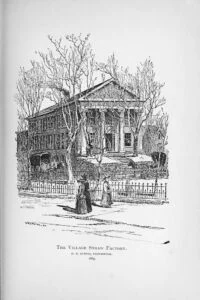
Medway Village Straw Factory

Alphabetical indexes to the vital records of Medway, Massachusetts, up to the year 1850, supplemented by information from church registers, cemetery inscriptions and other private sources to include Rev. Dr. Jacob Ide’s account of Marriages and Deaths, 1814-1849.

History and Genealogy of Medfield, Massachusetts

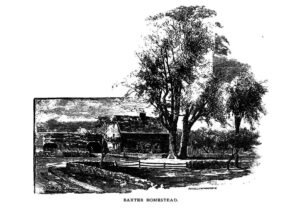
Baxter Homestead in Medfield

The History of Medfield, Massachusetts written by William Tilden in 1887 is a complete history of the town up to publishment. It is arranged chronologically, beginning with the lands of Chickatabot and the early settlement known as Boggestow, and continuing through colonial life, King Philip’s War, the Revolution, and the town’s nineteenth-century development. The genealogical section traces families residing in Medfield from 1650 to 1850, with attention to removals and corrections to earlier published errors, relying heavily on original town and probate records. Read or download the PDF for free.

Essex County Massachusetts Probate Records 1675-1681

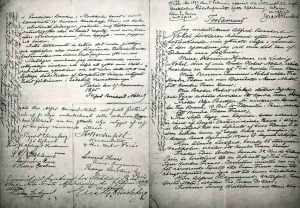
Sample Last Will and Testament

The “Governor and Company of Massachusetts Bay” established a judicial system in 1628, with a General Court in Boston and quarterly courts in major towns like Salem and Ipswich by 1635. These courts managed probate matters, and after Essex County’s formation in 1643, individual probate courts were later established in 1692. These are the probate records from 1675 to 1681, sourced from various original documents, including detailed wills and estate settlements.

Essex County Massachusetts Probate Records 1665-1674

Sample Last Will and Testament

The “Governor and Company of Massachusetts Bay” established a judicial system in 1628, with a General Court in Boston and quarterly courts in major towns like Salem and Ipswich by 1635. These courts managed probate matters, and after Essex County’s formation in 1643, individual probate courts were later established in 1692. These are the probate records from 1665 to 1674, sourced from various original documents, including detailed wills and estate settlements.

Vanderburgh County Indiana Will Abstracts, 1821-1873

Sample Last Will and Testament

Abstracts of over 600 wills for Vanderburgh County, Indiana, extracted by Mrs. Arthur C. Bitterman. Book A was typed by Mrs. James A. Gentry, book B typed by Mrs. Marvin J. Huff, and published as one by the Vanderburgh Chapter of the DAR. Book A primarily covers wills written or filed within the time period of 1823-1849 and book B includes the years of 1849-1873. In both cases there are wills that fall outside those dates.

Southborough Massachusetts vital records

Vital records of Southborough, Massachusetts, to the end of the year 1849 title page

The list of vital records of Southborough, Massachusetts, comprised in this volume includes all which were entered in the Town Books during the period from the earliest date there found to the end of the year 1849. Some additions and corrections of names and dates have been made from the records of the First Church, these being indicated in each instance by proper reference. There are a total of 6,267 births, marriages, and deaths recorded. This book is free to read or download.

Brown Genealogy

Brown Genealogy

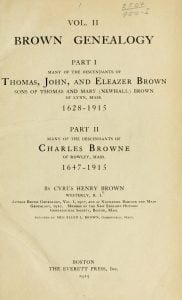
In 1895, Cyrus Henry Brown began collecting family records of the Brown family, initially with the intention of only going back to his great-grandfathers. As others became interested in the project, they decided to trace the family lineage back to Thomas Brown and his wife Mary Newhall, both born in the early 1600s in Lynn, Massachusetts. Thomas, John, and Eleazer, three of their sons, later moved to Stonington, Connecticut around 1688. When North Stonington was established in 1807, the three brothers were living in the southern part of the town. Wheeler’s “History of Stonington” contains 400 records of early descendants of the Brown family, taken from the town records of Stonington. However, many others remain unidentified, as they are not recorded in the Stonington town records. For around a century, the descendants of the three brothers lived in Stonington before eventually migrating to other towns in Connecticut and New York State, which was then mostly undeveloped. He would eventually write this second volume of his Brown Genealogy adding to and correcting the previous edition. This book is free to search, read, and/or download.

The Amidon Family of Rehoboth, MA

The Amidon Family

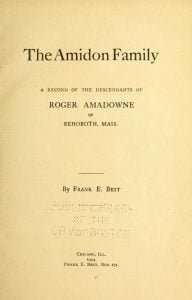
The Amidon Family genealogy book details the lineage of Roger Amadowne, a French Huguenot who fled to England and later to America after the revocation of the Edict of Nantes. Documented in Salem, Massachusetts in 1637, variations of his surname include Amadon, Amidown, and Ammidon. The work, organized with biographical sketches and two helpful indexes, presents the family’s history and is richly illustrated. Originally published in 1904, it serves as a valuable resource for descendants and historians alike.

Abbe-Abbey Genealogy

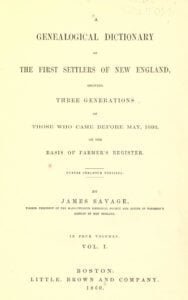
A genealogical dictionary of the first settlers of New England vol 1

The “Abbe-Abbey Genealogy” serves as a comprehensive and meticulously compiled homage to the heritage of the Abbe and Abbey families, tracing its roots back to John Abbe and his descendants. Initiated by the life-long passion of Professor Cleveland Abbe, this genealogical exploration began in his youth and expanded throughout his illustrious career, despite numerous challenges. It encapsulates the collaborative efforts of numerous family members and researchers, including significant contributions from individuals such as Charles E. Abbe, Norah D. Abbe, and many others, each bringing invaluable insights and data to enrich the family’s narrative.

The Hazard family of Rhode Island 1635-1894

The Hazard family of Rhode Island 1635-1894

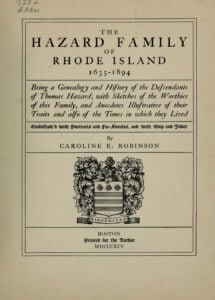
The Hazard family of Rhode Island 1635-1894 – Being a genealogy and history of the descendants of Thomas Hazard, with sketches of the worthies of this family, and anecdotes illustrative of their traits and also of the times in which they lived.

Weymouth ways and Weymouth people

Weymouth ways and Weymouth people

Edward Hunt’s “Weymouth ways and Weymouth people: Reminiscences” takes the reader back in Weymouth Massachusetts past to the 1830s through the 1880s as he provides glimpses into the people of the community. These reminiscences were mostly printed in the Weymouth Gazette and provide a fair example of early New England village life as it occurred in the mid 1800s. Of specific interest to the genealogist will be the Hunt material scattered throughout, but most specifically 286-295, and of course, those lucky enough to have had somebody “remembered” by Edward.

Descendants of Alexander Bisset Munro of Bristol, Maine

Munro Family

Alexander Bisset Munro was born 25 Dec. 1793 at Inverness, Scotland to Donald and Janet (Bisset) Munro. Alexander left Scotland at the age of 14, and lived in Dimecrana in the West Indies for 18 years. He owned a plantation, raising cotton, coffee and other produce. He brought produce to Boston Massachusetts on the ship of Solomon Dockendorff. To be sure he got his money, Solomon asked his to come home with him, where he met Solomon’s sister, Jane Dockendorff. Alexander went back to the West Indies, sold out, and moved to Round Pond, Maine, and married Jane. They had 14 children: Janet, Alexander, Margaret, Nancy, Jane, Mary, Solomon, Donald, John, William, Bettie, Edmund, Joseph and Lydia.

People and Buildings of the Choctaw Nation

The Choctaw Nation demonstrated a remarkable moral framework, emphasizing respect for elders, integrity, and a deep reverence for their ancestors. Missionaries, such as Cyrus Kingsbury, noted the Choctaws’ eagerness for education and spirituality, leading to the establishment of schools and churches that fostered significant advancements in literacy and practical skills. Despite the challenges of relocation, the Choctaws’ commitment to civic and moral development led to a flourishing educational system, supported by community contributions and the resolute efforts of self-sacrificing missionaries.

Missionaries Among the Choctaw

In 1832, the Choctaw gathered in despair at Hebron, led by missionary Calvin Cushman, before their forced removal westward. Their sorrow, evident in their mournful cries, reflected the profound anguish of a community facing loss of homeland and identity. While most missionaries returned home, Cushman and a few others remained committed to aiding the Choctaw, enduring their suffering and striving for their moral and intellectual uplift. The narrative also highlights the integrity of the missionaries, exemplified by Mr. Bardwell’s honorable horse trade, demonstrating their ethical commitment amidst challenging circumstances.

Death of Cyrus Kingsbury

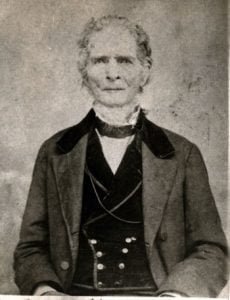
Rev. Cyrus Kingsbury

Adam Hodgson, an English traveler, visited the Elliot mission in 1820 and was impressed by the Choctaw people and their educators, particularly Rev. Cyrus Kingsbury. Hodgson emphasized the benevolence and intelligence of the Choctaws, contrasting them with prevailing stereotypes of Native Americans. He described his warm reception at the mission and the humility and dedication of the missionaries. The establishment of schools among the Choctaws, supported by Kingsbury and others, marked a significant step towards education and moral improvement in the community. Rev. Kingsbury continued his work until his death in 1871.

The Meeting of Folsom and Nittakachih

The council convened to distribute the annuity ended in chaos, revealing deep-seated animosities between two chiefs, Nittakachih and Amosholihubih, foreshadowing potential civil war. As tensions escalated, both factions prepared for conflict, yet a moment of profound silence arose as Nittakachih approached, signaling a desire for peace. Through dialogue, misunderstandings were cleared, leading to a restoration of friendship and trust, thus averting a civil war. This episode highlights the leadership of Colonel David Folsom and the complex dynamics of the Choctaw Nation during a pivotal moment in their history.