Spokane Story

Spokane Story

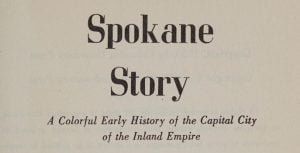
“Spokane Story: A Colorful Early History of the Capital City of the Inland Empire” by Lucile Foster Fargo offers readers an evocative journey through the formative years of Spokane, Washington. Published in 1957 by Northwestern Press in Minneapolis, this work seeks to straddle the realms of history and storytelling, presenting a narrative that is neither entirely factual history nor pure fiction. Fargo accepts the challenging task of depicting Spokane’s cultural and developmental evolution from its fur trade beginnings to its emergence as a municipal entity in the early twentieth century.
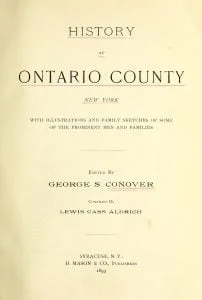
History of Ontario County, New York, part 2

History of Ontario County, New York

The History of Ontario County, New York genealogical section provides an extensive array of surnames, indicating the comprehensive nature of the section in Part 2. These genealogies not only serves as a reference for individuals researching family histories but also reflects the diverse settler and immigrant populations that have contributed to the fabric of Ontario County. Each surname represents a family’s journey, struggles, and contributions to the county’s development over centuries.

Brown Genealogy

Brown Genealogy

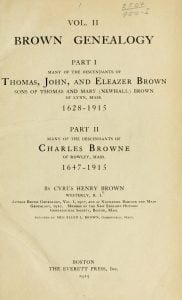
In 1895, Cyrus Henry Brown began collecting family records of the Brown family, initially with the intention of only going back to his great-grandfathers. As others became interested in the project, they decided to trace the family lineage back to Thomas Brown and his wife Mary Newhall, both born in the early 1600s in Lynn, Massachusetts. Thomas, John, and Eleazer, three of their sons, later moved to Stonington, Connecticut around 1688. When North Stonington was established in 1807, the three brothers were living in the southern part of the town. Wheeler’s “History of Stonington” contains 400 records of early descendants of the Brown family, taken from the town records of Stonington. However, many others remain unidentified, as they are not recorded in the Stonington town records. For around a century, the descendants of the three brothers lived in Stonington before eventually migrating to other towns in Connecticut and New York State, which was then mostly undeveloped. He would eventually write this second volume of his Brown Genealogy adding to and correcting the previous edition. This book is free to search, read, and/or download.

The Descendants of Franklin Mary Noyes Rowe of Humboldt County, Iowa

Home of Franklin and Mary Noyes Rowe 1887-1905

This book, “The Descendants of Franklin Mary Noyes Rowe of Humboldt County, Iowa, with Some Notes on Their Ancestors,” authored by Velma Rowe Coffin in Storm Lake, Iowa, in 1955, is a meticulously researched genealogical record spanning 87 pages. It traces the lineage of Franklin Rowe, born December 30, 1836, in Onondaga County, New York, and provides insights into his ancestry and descendants. Free to read or download.

Biography of Rev. Patrick Joseph Kane

Rev. Patrick Joseph Kane, originally from Ireland, served as pastor of the Church of Our Holy Redeemer in Webster Groves for over thirty years. After his ordination in 1882, he notably revitalized the parish in St. Marys, Missouri. Assigned to Webster Groves in 1887, he overcame challenges to restore harmony within the church and diligently worked to eliminate its debts. Under his leadership, a new church building was completed in 1897, alongside a school in 1910, reflecting his commitment to both community and faith.

Biography of James F. Kane

James F. Kane, born on April 3, 1858, in Joliet, Illinois, was raised in a Catholic family of eight children. After farming in Nebraska, he worked as a traveling salesman and assistant bookkeeper in New York City. In 1890, he moved to Pocatello, Idaho, where he initially worked for the Oregon Short Line Railroad before founding a successful grocery business. Married to Myra L. Hollingsworth, they had three children and were well-regarded in their community. Kane was active in local fraternal organizations.

Biographical Sketch of Paul Kane

Paul Kane, born in 1810 in York (now Toronto), was a significant Canadian artist who died in 1871. After studying in Europe, he traveled among Indigenous tribes in the Canadian West from 1845 to 1848, creating numerous paintings of their cultures and landscapes. Over a hundred of his works are housed in the Museum at Toronto, with additional pieces in the Public Archives of Canada. His experiences and artworks were later published in his 1859 book, “Wanderings of an Artist.

Biography of Daniel Kane

Daniel Kane, born on November 27, 1854, in Geneva, New York, has served as the Chief of Police there for over twenty years. His career began in 1882 as a patrolman, where his dedication and skill led to rapid advancement. Renowned for his efficiency in policing and detective work, Kane played a pivotal role in numerous criminal apprehensions, including a notable bank robbery case. A respected community member, he was active in local fraternal organizations and was married to Elizabeth Tannian, with whom he had six children.

Rough Riders

Rough Riders

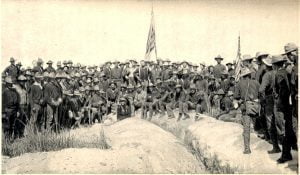
The compiled military service records of 1,235 Rough Riders, including Theodore Roosevelt, have been digitized. Each record features individual jackets detailing the soldier’s name, organization, rank, and medical records. The records also contain personal information and documentation descriptions. Discharges occurred for various reasons, such as age, ability, discipline issues, or hardship. This initiative provides significant insights into the personnel of the 1st U.S. Volunteer Cavalry during the Spanish-American War.