Aleck Brown, Chickasaw

The case of Aleck Brown et al. v. Chickasaw Nation involved the application for enrollment of Aleck Brown and Sibbie (or Seber) Johnson as Chickasaw citizens by blood. Both applicants were children of Temene (or Tamena), a full-blood Chickasaw woman whose other children were listed on the final Chickasaw rolls. Despite evidence of their Chickasaw ancestry and residency, the Dawes Commission denied their enrollment on February 26, 1907, citing their absence from tribal rolls. The decision was upheld by the Department of the Interior on March 4, 1907, despite arguments that they were entitled to recognition under tribal law.
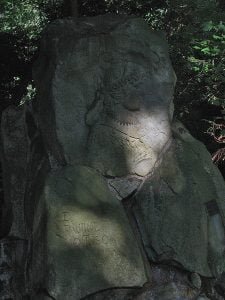
Sir William Johnson, Johnstown, New York

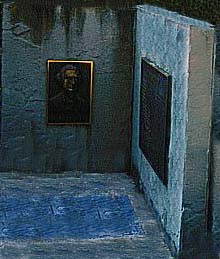
Sir William Johnson Grave

Sir William Johnson, a key British representative to the Iroquois Confederacy, earned respect through his engagement with the Mohawk people, fluency in their language, and promotion of fair dealings. Appointed Superintendent of Six Nation Affairs, he was honored with the Mohawk name W-re i-ya-ge. Johnson advocated for the welfare of the Indian people, particularly in farming and education. He died on July 11, 1774, during a council addressing treaty violations, leaving a lasting legacy in Johnstown, New York.

Emily Pauline Johnson, Mohawk Poetess, Six Nation Country

Pauline Johnson Monument

Emily Pauline Johnson, known as Tekahionwake, was a notable Mohawk poetess and daughter of a Mohawk chief, born in 1862 near Brantford, Ontario. Celebrated for her contributions to Canadian literature, she combined her Indigenous heritage with poetry, sharing the traditions and injustices faced by her people. Johnson gained acclaim through public recitations, including performances in England, where she interacted with royalty. After her death in 1913, she was cremated, and a monument in Stanley Park, Vancouver, commemorates her legacy.

1910 Census of Fort Shaw Industrial Indian School

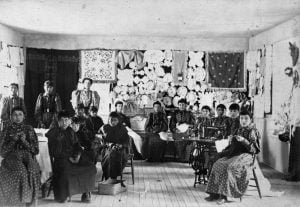
Girls at the Fort Shaw Indian School

Fort Shaw Industrial Indian Boarding School, established in Montana in 1891, ceased operations on June 30, 1910, due to decreasing enrollment. Known for its 1904 girls basketball team, which won a championship at the St. Louis World’s Fair, the school played a significant role in Indigenous education during its tenure. The 1910 census was compiled under the Department of the Interior to record enrolled students as part of Circular #448. Relevant records are preserved in the National Archives and the Family History Library.

How Red Jacket Got His Name

The name Red Jacket originated during the American Revolution when he was gifted a scarlet jacket by a British officer due to his swift execution of tasks and charisma. Proudly wearing this distinctive garment, he became widely recognized by the name. Born Oti-ti-ani and later known as Sa-go-ye-wat-ha, Red Jacket was an eloquent speaker who opposed involvement in the war, advocating for peace, which brought him criticism from some peers who labeled him a coward despite his moral courage.

Biographies of the Cherokee Indians

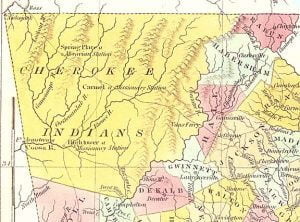
1830 Map of Cherokee Territory in Georgia

The Cherokee Indians, primarily from the Southeastern U.S., have a rich history marked by their early adoption of a written language and a government structure similar to that of the United States. Despite their forced relocation to Oklahoma in the 1830s, they maintained significant genealogical ties, often intermarrying with Whites. Emmet Starr’s “History of the Cherokee Indians and Their Legends and Folklore” emphasizes personal biographies and genealogies, providing insights into the lives and connections of many Cherokee families across generations, thereby enriching their cultural narrative.

World War 1 Gold Star Men of Ida County Iowa

A list of Gold Star men from Ida County Iowa. Gold Star soldiers were men who gave the ultimate sacrifice to their country, their life. This provides the name of the soldier, their home town, date of death as well as location and circumstances of it.

Rough Riders

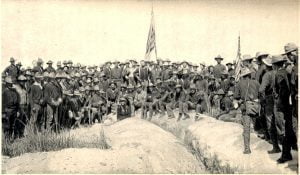
Rough Riders

The compiled military service records of 1,235 Rough Riders, including Theodore Roosevelt, have been digitized. Each record features individual jackets detailing the soldier’s name, organization, rank, and medical records. The records also contain personal information and documentation descriptions. Discharges occurred for various reasons, such as age, ability, discipline issues, or hardship. This initiative provides significant insights into the personnel of the 1st U.S. Volunteer Cavalry during the Spanish-American War.

Biographical Sketch of Honorable George W. Johnson

Honorable George W. Johnson was born on October 9, 1857, in Henry County, Illinois. Raised on a farm, he developed a strong work ethic and a dedication to education. After marrying Caroline F. Hogg in 1882, he pursued a business career, starting in Orion and later relocating to Moline to enter real estate and manage the Moline Furniture Co. A committed Republican, he served two terms in the Illinois House of Representatives. He and Caroline had four children, three of whom survived into adulthood.

Biography of Walter Johnson

Walter Johnson, who died on November 23, 1903, was a prominent figure in Rock Island, serving as the editor of the Daily Union for 27 years. Born in London on April 27, 1843, he emigrated to the U.S. and contributed significantly to local journalism and civic life. Johnson’s editorial approach emphasized integrity and community values, rejecting sensationalism. He was an active member of the Public Library board and served briefly as surveyor of customs. A devout Episcopalian, he was dedicated to his parish and is remembered for his strong moral character.

Biography of Daniel Johnson

Daniel Johnson, born in 1812 in Massachusetts, emerged as a notable figure among Oregon’s pioneers. After relocating to New York, he became skilled in masonry and later moved to Indiana, where he married Elsina Perkins in 1844. The couple set out for Oregon in 1845, journeying with ox teams and enduring various hardships, including a desperate buffalo hunt. After arriving in Oregon City, they claimed land near the Yamhill River, raising eight children and establishing a significant homestead. Johnson is remembered for his generosity and resilience.

Biography of Frank Johnson

Frank Johnson, born in Holland in 1844, emigrated to New York with his mother in 1852 and began his career as a carpenter in Buffalo. He served valiantly in the Civil War and later trained under architect Frederick Scott. In 1880, seeking a new life in the West, he settled in Washington Territory and established a successful contracting business. Johnson gained renown for his craftsmanship, overseeing significant projects including military quarters and local buildings, becoming a respected figure in Spokane Falls for his integrity and skill.

Biography of James Johnson

James Johnson, born in 1814 in Massachusetts, became a pioneer in Oregon in 1844 after years of seeking adventure and opportunity. He married Juliet Perkins in 1839 and worked as a carpenter and pork-packer before embarking on the perilous journey west. Johnson’s caravan encountered numerous challenges, including harsh weather and dwindling supplies, but he persevered to reach Oregon City. He settled in Yamhill County and balanced farming with construction work. Johnson and his wife raised eleven children, contributing to Oregon’s early development.

Biography of Thomas Johnson

Thomas Johnson, born in Canada in 1839, significantly contributed to the development of Goldendale, Ellensburgh, and Cle-Elum in Washington. Arriving in 1862, he initially operated a ferry and later ventured into cattle ranching and farming. In Goldendale, he laid out the city, established the first store, gristmill, and a bank. After a devastating fire in Ellensburgh, he rebuilt and expanded his business ventures. Johnson served in various public roles, prioritizing community growth and development. He resides in Cle-Elum with his wife and four children.

Biographical Sketch of B. D. Johnson

B. D. Johnson was born on November 18, 1832, on his family farm in Jessamine County, Kentucky. He is the son of Samuel and Margaret Johnson, who settled in the area in 1815. After his father’s death in 1861, B. D. inherited 275 acres and cultivated about 200 acres. He married Helen Hollins in January 1863, and they have two children, Ida and Richard. B. D. Johnson and his wife are active members of the Christian Church.