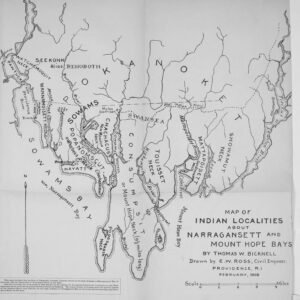
Sowams

1908 Map of Indian Localities about Narragansett and Mount Hope Bays

Sowams,” authored by Thomas Williams Bicknell in 1908, delves into the history of the ancient proprietary known as Sowams, encompassing Native leadership under Massassoit and early colonial settlement dynamics that shaped Barrington, Rhode Island, and surrounding areas. Drawing from over forty years of research, Bicknell includes primary records from the proprietary, showcasing the region’s governance, land ownership, and the founding of the First Baptist Church of Massachusetts. This comprehensive work serves as a vital resource for lawyers, historians, and general readers interested in colonial life and legal frameworks of the time.

New Hampshire Men

1892 Map of New Hampshire

New Hampshire Men presents 407 biographical sketches, with portraits, of men who were active in commercial, professional, and political life in New Hampshire in 1893.

New Hampshire Men of Progress

1892 Map of New Hampshire

New Hampshire Men of Progress contains 289 biographical sketches and portraits of leaders in business and professional life in and of the state of New Hampshire. It was edited by the staff of the Manchester Union under the supervision of Richard Herndon.

Abington Massachusetts Marriage and Death Records

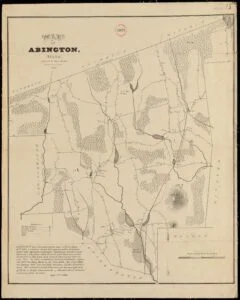
1830 Map of Abington, Massachusetts

Volume 2 of the Abington, Massachusetts vital records compiles marriage and death records up to 1850, complementing Volume 1, which contains birth records. Established in 1712, Abington’s boundaries have shifted, affecting historical jurisdiction. Extensive research from town records, cemeteries, and family Bibles ensured comprehensive documentation, including the identification of Black families recorded by given names. The volume is organized alphabetically by marriages and deaths.

History of Windham New Hampshire

Residence of William H Anderson of Windham, New Hampshire

Leonard A. Morrison’s *The History of Windham, New Hampshire*, published in 1883, chronicles the town’s evolution from early settlements in the 18th century to the late 19th century. It highlights Windham’s roots in the Scotch-Irish Londonderry community and examines various aspects of local life, including land grants, education, and political developments. The work also documents significant historical events and includes extensive genealogies of the area’s early settlers and their descendants, drawing from comprehensive local records and archives.

Medway Massachusetts vital records

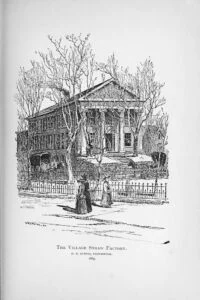
Medway Village Straw Factory

Alphabetical indexes to the vital records of Medway, Massachusetts, up to the year 1850, supplemented by information from church registers, cemetery inscriptions and other private sources to include Rev. Dr. Jacob Ide’s account of Marriages and Deaths, 1814-1849.

Essex County Massachusetts Probate Records 1665-1674

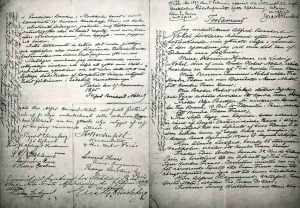
Sample Last Will and Testament

The “Governor and Company of Massachusetts Bay” established a judicial system in 1628, with a General Court in Boston and quarterly courts in major towns like Salem and Ipswich by 1635. These courts managed probate matters, and after Essex County’s formation in 1643, individual probate courts were later established in 1692. These are the probate records from 1665 to 1674, sourced from various original documents, including detailed wills and estate settlements.

Pioneers of Elk Valley, Del Norte County, California

Pioneers of Elk Valley, Del Norte County, California

In the heart of Northern California lies a hidden gem steeped in history and natural beauty: Elk Valley in Del Norte County. This manuscript, titled “Pioneers of Elk Valley, Del Norte County, California: Fifty Years in the History of Elk Valley from 1850 to the Turn of the Century,” authored by Frances Turner McBeth, embarks on a vivid journey through the transformation of this enchanting valley over half a century. From the early days of exploration and settlement to the bustling activity of the turn of the century, McBeth’s narrative weaves together the lives of the pioneers who braved the unknown to establish a community in one of California’s most picturesque landscapes.

Stephenson County Illinois World War 1 Veterans

Honor roll of the Great War, Stephenson County, 1917-1919

This small booklet contains all the known men and women who participated in World War 1 and claimed their home of record as Stephenson County, Illinois. By participation, this record does not limit this to soldiers, but also contains the records of those men and women who served the Red Cross, Y.M.C.A., and other non-fighting positions. This book is free to read or download.

Brown Genealogy

Brown Genealogy

In 1895, Cyrus Henry Brown began collecting family records of the Brown family, initially with the intention of only going back to his great-grandfathers. As others became interested in the project, they decided to trace the family lineage back to Thomas Brown and his wife Mary Newhall, both born in the early 1600s in Lynn, Massachusetts. Thomas, John, and Eleazer, three of their sons, later moved to Stonington, Connecticut around 1688. When North Stonington was established in 1807, the three brothers were living in the southern part of the town. Wheeler’s “History of Stonington” contains 400 records of early descendants of the Brown family, taken from the town records of Stonington. However, many others remain unidentified, as they are not recorded in the Stonington town records. For around a century, the descendants of the three brothers lived in Stonington before eventually migrating to other towns in Connecticut and New York State, which was then mostly undeveloped. He would eventually write this second volume of his Brown Genealogy adding to and correcting the previous edition. This book is free to search, read, and/or download.

The Amidon Family of Rehoboth, MA

The Amidon Family

The Amidon Family genealogy book details the lineage of Roger Amadowne, a French Huguenot who fled to England and later to America after the revocation of the Edict of Nantes. Documented in Salem, Massachusetts in 1637, variations of his surname include Amadon, Amidown, and Ammidon. The work, organized with biographical sketches and two helpful indexes, presents the family’s history and is richly illustrated. Originally published in 1904, it serves as a valuable resource for descendants and historians alike.

History of Littleton New Hampshire

1895 Map of Littleton New Hampshire

The History of Littleton New Hampshire is comprised of three volumes, two volumes of history, and a final volume of genealogies. Considered one of the best examples of local history written in the early 20th century, is your ancestors resided in Littleton then you need these books. Read and download for free!

Early Records of Londonderry, Windham, and Derry, NH

Early Records of Londonderry, Windham, and Derry, N.H. 1719-1762, Vol. 1 title page

The sources from which the Early Records of Londonderry, Windham, and Derry, N.H. have been drawn are Volumes I and II of the old town books. These old town books include minutes, ear markings, surveyors and homestead records, tax lists, inventory lists, accounts, school records and other miscellaneous records.

Abbe-Abbey Genealogy

A genealogical dictionary of the first settlers of New England vol 1

The “Abbe-Abbey Genealogy” serves as a comprehensive and meticulously compiled homage to the heritage of the Abbe and Abbey families, tracing its roots back to John Abbe and his descendants. Initiated by the life-long passion of Professor Cleveland Abbe, this genealogical exploration began in his youth and expanded throughout his illustrious career, despite numerous challenges. It encapsulates the collaborative efforts of numerous family members and researchers, including significant contributions from individuals such as Charles E. Abbe, Norah D. Abbe, and many others, each bringing invaluable insights and data to enrich the family’s narrative.

History of Minneapolis and Hennepin County, Minnesota

History of Minneapolis and Hennepin County, Minnesota

The aim of this history was to present in a permanent form the key incidents in the history of Minneapolis, from its earliest settlement to its publication in 1895. The primary facts and events recounted were mostly obtained from living witnesses and participants. It was rare for a city with more than two hundred thousand inhabitants to have so many of its first settlers still alive. The city’s growth had been so extraordinary and unprecedented that many of its earliest settlers remained. Some information was also gleaned from the notes left by now-deceased writers who witnessed the events described. Great care was taken to verify the accuracy of all facts and incidents mentioned. While it might have been too much to hope that the work was entirely free from errors, it was confidently believed that any such errors were few and insignificant.

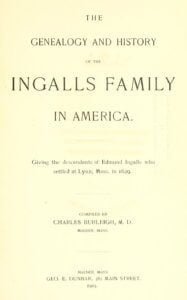
The genealogy and history of the Ingalls family in America

The genealogy and history of the Ingalls family in America

Edmund Ingalls, son of Robert, was born about 1598 in Skirbeck, Lincolnshire, England. He immigrated in 1628 to Salem, Massachusetts and with his brother, Francis, founded Lynn, Massachusetts in 1629. He married Ann, fathered nine children, and died in 1648.

French Genealogy of Fall River Massachusetts

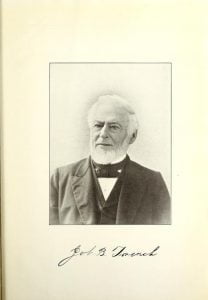
Job B. French

The French family has significantly influenced Fall River’s history since its founding, tracing their roots to Rollo, Duke of Normandy. Notable figures include Hon. Enoch French and his descendants, who were involved in various trades, notably tanning and shoemaking. Enoch established the first boot and shoe store in Fall River and contributed to local governance and community organizations. His sons, including Job B. French, also played vital roles in business and civic life. The family’s legacy continues through their active involvement in the First Baptist Church and local affairs.

Howard Genealogy of Bridgewater and New Bedford Mass.

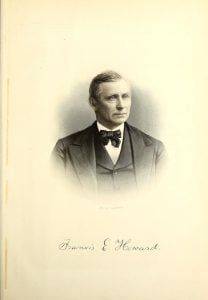
Frances E. Howard

The Howard family, prominent in the history of Bridgewater and New Bedford, Mass., traces its lineage back to John Howard, an early settler. Key figures include Capt. Benjamin Beal Howard, founder of Howard Seminary and known for his philanthropic deeds, and his son, Francis Edward Howard, an influential public servant and community leader. Both men embodied the family’s commitment to education and civic duty, contributing significantly to the community’s development and welfare, leaving a lasting legacy through their charitable efforts and public service.