Genealogies of Pembroke New Hampshire

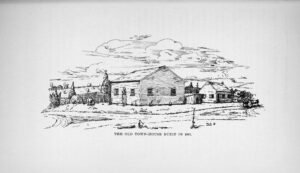
Old Pembroke NH Town House, built 1811

The “Genealogies of Pembroke, New Hampshire” is derived from the town’s second historical volume, and documents the connections of early settler families through the nineteenth century. It emphasizes families of the first settlers and families who resided in Pembroke over a long period of time. Organized alphabetically by surname, the genealogies use a consistent numbering system for easy reference. Carter draws from diverse sources, including town records and personal accounts of Pembroke’s citizens, while acknowledging possible inaccuracies in both their memory and the collection of information. However, by preserving these family lineages, Carter enhances the town’s historical narrative, complementing the first volume’s historical content. Supplementing this volume of genealogies is a compilation of marriage records which occurred in Pembroke, New Hampshire, from 1739 through 1895.
History of Rindge New Hampshire

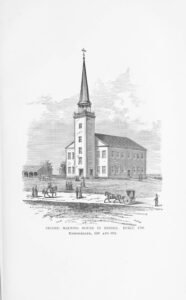
Second Meeting House in Rindge New Hampshire

The History of the Town of Rindge, New Hampshire by Ezra S. Stearns, was published in 1875, and covers the period from the original Rowley Canada grant or Massachusetts charter through the year 1874. Stearns traces the legal, territorial, and institutional development of Rindge, beginning with colonial land grants and boundary disputes and proceeding through settlement, incorporation into a town and development into a small manufacturing hub. More than half the volume is devoted to genealogical material. The genealogical register of Rindge families includes thousands of names compiled from a wide range of sources and assisted by contributions from residents and researchers beyond the town.

Samuel Lane’s Journal, 1739-1803

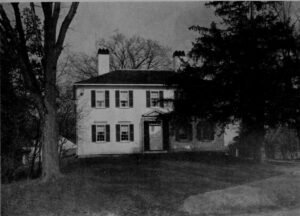
Jabez Lane House

Samuel Lane’s journal, covering 1739 to 1803, chronicles the life of a New Hampshire resident who experienced the colonial, Revolutionary, and early national periods. Lane transitioned from farming to various professions, including tanner and shoemaker, while actively participating in community roles. His meticulously kept journal captures local and national events, personal reflections, and societal changes. Edited by Charles Lane Hansen in 1937, it serves as a crucial primary source, offering insights into the daily life, hardships, and resilience of 18th-century New England.

Abington Massachusetts Marriage and Death Records

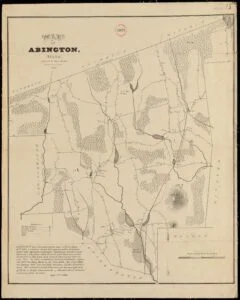
1830 Map of Abington, Massachusetts

Volume 2 of the Abington, Massachusetts vital records compiles marriage and death records up to 1850, complementing Volume 1, which contains birth records. Established in 1712, Abington’s boundaries have shifted, affecting historical jurisdiction. Extensive research from town records, cemeteries, and family Bibles ensured comprehensive documentation, including the identification of Black families recorded by given names. The volume is organized alphabetically by marriages and deaths.

Abington Massachusetts Birth Records

1830 Map of Abington, Massachusetts

Volume 1 of the Abington, Massachusetts vital records details births recorded in the town up to 1850, featuring comprehensive research from town records, cemeteries, and church documents. Established in 1712, Abington’s jurisdictional changes may affect genealogical searches. The records also include separate listings for Black families, primarily by given names. Additionally, various surnames are cataloged, emphasizing the need to consider alternate spellings. For marriages and deaths, researchers should consult Volume 2.

Genealogies of the Town of Goffstown New Hampshire

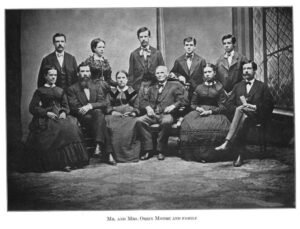
Orrin Moore and family of Goffstown, New Hampshire

The genealogical record of Goffstown, New Hampshire, was a substantial undertaking, hampered by the extinction of early families and the widespread scattering of descendants. Efforts to gather vital statistics necessitated considerable travel and correspondence, often revealing discrepancies in recorded dates across various sources. Despite challenges, contributions from former works and assistance from individuals proved invaluable in compiling this record. The comprehensive index reflects the depth of research involved in documenting the town’s heritage.

History of Francestown New Hampshire

Map of Francestown New Hampshire

History of Francestown, New Hampshire is a historic and genealogical record of the town from its first settlement in 1758 through the beginning of 1891. It records Francestown’s settlement, civic growth, religious and educational institutions, military participation, industries, and social customs, followed by an extensive genealogical register of families associated with the town.

History of Amherst New Hampshire

Residence of Isaac Brooks in Amherst New Hampshire

The history of Amherst, New Hampshire, unfolds from its 1675 land grant to veterans of the Narraganset War, marking the impetus for settlement along the Souhegan River. From its early governance and incorporation in 1760 to territorial adjustments that birthed Mont Vernon and Milford, this narrative encompasses local geography, economy, and Indigenous presence. Key military engagements, civic institutions, and genealogical records are explored up to 1882, offering a comprehensive view of the town’s evolution and its prominent figures.

Bassett-Preston Ancestors

Bassett-Preston Ancestors

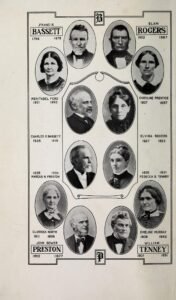
Miss Belle Preston initiated her ancestry research in 1898 in Hinsdale, Illinois, later tracing the Bassett lineage after moving to Brooklyn. Using various libraries as resources, she documented numerous New England colonial immigrants from both families, including six Mayflower ancestors. The book details eighty-nine Bassett and ninety-two Preston ancestors in the ninth generation. Belle’s connection to New England relatives is highlighted, noting an impending loss of that intimate knowledge as family members pass away. Read and download the PDF.

Records of Ingham County Michigan Pioneer Families

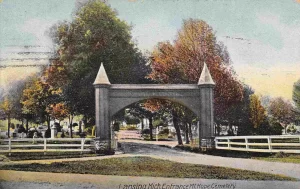
Entrance to Mt Hope Cemetery, Lansing, Michigan

These records were typed from manuscript copies of the original records made by George L. Hammell, which were willed to the Michigan State Library by Mr. Hammell of E. Lansing, Mich. who died Sept. 26, 1952. They consist of a variety of typed sources including Bible records, cemetery records, family records, and probate records for early families of Ingham County, Michigan.

Early Settlers of Ralls County, Missouri

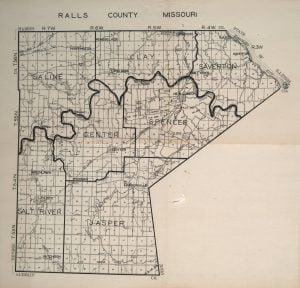
1930 Map of Ralls County, Missouri

The manuscript “Early Settlers of Ralls County, Missouri” compiled by Eunice Moore Anderson in 1951 serves as a valuable resource for those tracing their family genealogy in Ralls County. Divided into three parts, the compilation focuses on documenting early settlers prior to 1878, drawing from sources such as county atlases and historical records spanning Marion, Ralls, Pike Counties, and beyond. While not aiming to provide a comprehensive history, Anderson’s work catalogues pioneer families, offering insights into their origins, migration dates to Ralls County, and family connections. This structured approach, supplemented by an alphabetical index, aids researchers in navigating through ancestral records and locating further detailed information within related historical volumes.

Marriages of Charlotte County Virginia, 1784-1815

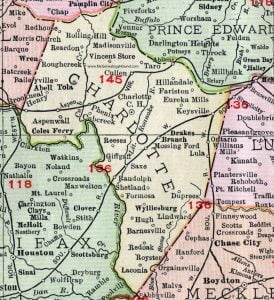
1911 Map of Charlotte County Virginia

This volume, “Marriages of Charlotte County, Virginia, 1784-1815,” compiles the marriage bonds and minister’s returns from Charlotte County during the specified period. The original work was painstakingly copied by Catherine Lindsay Knorr and published in 1951. The book spans 119 pages and includes a wealth of historical data on marriages that took place in this Virginia county. This publication presents several challenges for readers. Some pages are slightly tattered and torn, and the manuscript features irregular pagination. Additionally, there are tight or nonexistent margins, particularly at the bottom of the pages, and one page is typed on different paper than the rest.

Vanderburgh County Indiana Will Abstracts, 1821-1873

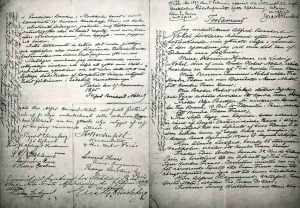
Sample Last Will and Testament

Abstracts of over 600 wills for Vanderburgh County, Indiana, extracted by Mrs. Arthur C. Bitterman. Book A was typed by Mrs. James A. Gentry, book B typed by Mrs. Marvin J. Huff, and published as one by the Vanderburgh Chapter of the DAR. Book A primarily covers wills written or filed within the time period of 1823-1849 and book B includes the years of 1849-1873. In both cases there are wills that fall outside those dates.

Southborough Massachusetts vital records

Vital records of Southborough, Massachusetts, to the end of the year 1849 title page

The list of vital records of Southborough, Massachusetts, comprised in this volume includes all which were entered in the Town Books during the period from the earliest date there found to the end of the year 1849. Some additions and corrections of names and dates have been made from the records of the First Church, these being indicated in each instance by proper reference. There are a total of 6,267 births, marriages, and deaths recorded. This book is free to read or download.

Brown Genealogy

Brown Genealogy

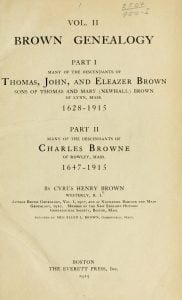
In 1895, Cyrus Henry Brown began collecting family records of the Brown family, initially with the intention of only going back to his great-grandfathers. As others became interested in the project, they decided to trace the family lineage back to Thomas Brown and his wife Mary Newhall, both born in the early 1600s in Lynn, Massachusetts. Thomas, John, and Eleazer, three of their sons, later moved to Stonington, Connecticut around 1688. When North Stonington was established in 1807, the three brothers were living in the southern part of the town. Wheeler’s “History of Stonington” contains 400 records of early descendants of the Brown family, taken from the town records of Stonington. However, many others remain unidentified, as they are not recorded in the Stonington town records. For around a century, the descendants of the three brothers lived in Stonington before eventually migrating to other towns in Connecticut and New York State, which was then mostly undeveloped. He would eventually write this second volume of his Brown Genealogy adding to and correcting the previous edition. This book is free to search, read, and/or download.

The Amidon Family of Rehoboth, MA

The Amidon Family

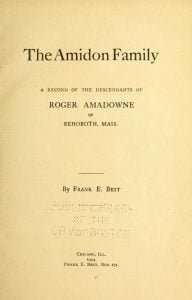
The Amidon Family genealogy book details the lineage of Roger Amadowne, a French Huguenot who fled to England and later to America after the revocation of the Edict of Nantes. Documented in Salem, Massachusetts in 1637, variations of his surname include Amadon, Amidown, and Ammidon. The work, organized with biographical sketches and two helpful indexes, presents the family’s history and is richly illustrated. Originally published in 1904, it serves as a valuable resource for descendants and historians alike.

Families of Ancient New Haven

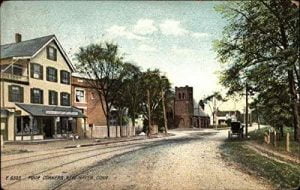
Four Corners New Haven Connecticut

The Families of Ancient New Haven compilation includes the families of the ancient town of New Haven, covering the present towns of New Haven, East Haven, North Haven, Hamden, Bethany, Woodbridge and West Haven. These families are brought down to the heads of families in the First Census (1790), and include the generation born about 1790 to 1800. Descendants in the male line who removed from this region are also given, if obtainable, to about 1800, unless they have been adequately set forth in published genealogies.

Abbott Genealogical Register

Abbott Genealogical Register

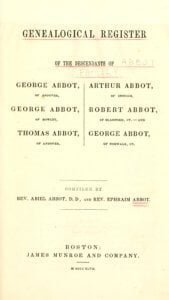
In 1847, Abiel Abbot and Ephraim Abbot compiled a comprehensive genealogical record titled “Abbott Genealogical Register,” detailing the lineage of several Abbott families originating from early New England settlers. Initially aimed to document the descendants of George Abbot, Sr. of Andover, the scope expanded to include numerous branches such as George Abbot, Jr., Thomas Abbot of Andover, Arthur Abbot of Ipswich, Robert Abbot of Branford, Ct., and George Abbot of Norwalk, Ct., among others. This volume, published by J. Munroe and Company in Boston, Massachusetts, integrates meticulously gathered data, revealing the expansive and intertwined genealogies of the Abbott families. The authors’ painstaking research and dedication to accuracy, despite challenges in data completeness, provide a valuable resource for anyone tracing the Abbott lineage or studying early American familial structures.

Descendants of Thomas Morris of Connecticut

Title page to Genealogy of the Morris family : Descendants of Thomas Morris of Connecticut

In 1911, Lucy Ann Morris Carhart published the “Genealogy of the Morris Family: Descendants of Thomas Morris of Connecticut,” providing a thorough historical account of the Morris family lineage starting from Thomas Morris, a notable shipbuilder and Puritan who immigrated from England in the 17th century. The book traces the family’s settlement in New Haven, Connecticut, detailing their significant land holdings and their expansion into other parts of Connecticut and New York. Published by A.S. Barnes Co. in New York, this work not only highlights the genealogical connections of the Morris family but also delves into the broader historical context, exploring the lives and legacies of successive generations. This comprehensive record serves as a valuable resource for descendants and historians alike, offering detailed insights into the family’s evolution and its contributions to American history.