
1899 Directory for Middleboro and Lakeville Massachusetts
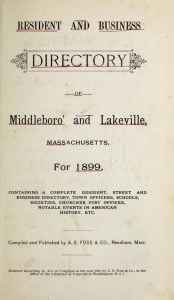
1899 Middleboro and Lakeville Massachusetts Directory Cover

The 1899 Directory for Middleboro and Lakeville, Massachusetts, compiled by A. E. Foss & Co., provides a comprehensive list of residents and businesses, alongside town officers, schools, churches, and societies. It includes notable historical events and offers a detailed account of the local community, featuring numerous surnames from both towns. This directory serves as an essential resource for understanding the demographics and social structure of Middleboro and Lakeville during that period.
Genealogical and Family History of Vermont

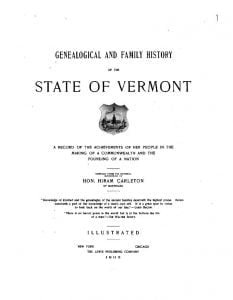
Genealogical and Family History of the State of Vermont vol 1

Hiram Charlton took on the publication of the Genealogical and Family History of the State of Vermont for Lewis Publishing. In it, he enlisted the assistance of living residents of the state in providing biographical and genealogical details about their family, and then he published all 1104 family histories in two distinct volumes.

Norwich Vermont in the Civil War

During the Civil War, Norwich, Vermont, contributed 185 soldiers to the Union Army, representing over ten percent of its population of 1,759. Of these, 27 men died in service. The town provided substantial bounties totaling around $32,000 to support its troops. Although the community largely supported the war effort, some residents expressed disloyalty, yet over time, many reconciled their past by honoring the fallen soldiers on Memorial Days. Overall, Norwich’s commitment to the Union cause reflected a broader dedication seen throughout Vermont.

Norwich Vermont in the Revolutionary War

Norwich, Vermont provided modest participation in the Revolutionary War, highlighted by its formation of a Committee of Safety in March 1777. Evidence suggests a militia was established as early as 1774. The town contributed to regiments under Colonels Warner and Bedell. Local militias organized for defense amid threats from British forces in 1776, further demonstrating Norwich’s involvement. Despite lacking comprehensive records, the enlistment of local soldiers was significant, along with efforts to protect the community from loyalist activities and contribute to the war effort.

Church History of Norwich Vermont

The first generation of Norwich settlers accomplished a significant community milestone by constructing a meeting house for public worship within a decade of settlement. This project involved the entire community, showcasing their determination despite limited resources. A committee ultimately selected the location after significant debate, with the cornerstone laid in 1778. Delays due to the Revolutionary War slowed progress, but by 1785, the building was completed and became a site for various civic activities, including sessions of the Vermont Legislature. The meeting house served the town until 1817 when a new structure was erected due to growing needs.

The Ministerial Act of Vermont

The Ministerial Act, enacted by Vermont’s legislature in October 1783, mandated local taxation for building meeting houses and supporting ministers. In 1785, Norwich decided to assume the cost of its meeting house via taxation, raising £694 from its citizens. This tax, payable in various forms, equalized expenses for all, regardless of prior contributions. The meeting house became a town property, leading to new seating arrangements based on age and contribution. The Act remained until 1801, fostering a unified religious practice among Norwich’s residents.

List of the Principal Pioneer Settlers in Norwich Vermont

In 1771, the population of Norwich, Vermont, was recorded at 206 people in forty families, highlighting its growth since being chartered by New Hampshire. The town was part of Gloucester County after 1772, previously belonging to Cumberland County. The census showed a predominance of youth, with 92 children under sixteen. The list of pioneer settlers includes notable names such as Daniel Baldwin, Ebenezer Ball, and Medad Benton, many of whom contributed to the establishment of the community by clearing land and building essential structures.

First Settlements in Norwich Vermont

The early settlement of Norwich, Vermont, began in 1762 when Samuel Slafter’s son, John, explored the area, reporting its fertile land and water sources. In 1763, after receiving his father’s rights, he commenced clearing lots but faced challenges, as his initial choice proved unsuitable. By 1765-66, a few families settled permanently, including the Hutchinsons and Manns, establishing homes and farms. Pioneers endured various hardships, yet they built foundations for a thriving community, characterized by a homogeneous population primarily from Connecticut.

Biographical Sketch of David W. Goodrich

David W. Goodrich, born to George and Lucinda Goodrich and a descendant of early English settlers, moved to Chesterfield, Massachusetts, from Gill around 1810. Initially a cloth dresser, he later pursued farming. He married Salome Wheeler in 1813 and had eight children, many of whom became notable citizens. Goodrich passed away on March 22, 1857. His children included Lucinda, who married twice, and George W., a flour manufacturer in Minneapolis. The family’s influence extended across various locations.

Biography of Samuel Goodrich

Samuel Goodrich, born September 6, 1788, in Fitchburg, Massachusetts, married Hannah Cain in 1811 and settled in Chesterfield around 1813. He served as selectman on several occasions and was a dedicated member of the Methodist church despite his deafness. Goodrich’s children included Sarah, Hannah, and Joseph C., who also became involved in local governance. The Goodrich family has notable historical roots in England and has produced prominent figures in American history, such as Elizur Goodrich and Samuel Griswold Goodrich.

Biography of C. B. Goodrich

C. B. Goodrich, a dedicated and unassuming individual, passed away in 1910 at sixty-six. Born in Sarnia, Canada, he was raised in Kankakee, Illinois, and served as a private in the Civil War with the 159th Illinois Volunteer Infantry. In 1879, he moved to Kansas, where he thrived as a farmer before settling in Topeka and later Lawrence. Goodrich, known for his loyalty and intelligence, preferred a life away from public spotlight, yet left behind a legacy of admirable achievements.

Rough Riders

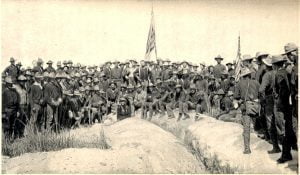
Rough Riders

The compiled military service records of 1,235 Rough Riders, including Theodore Roosevelt, have been digitized. Each record features individual jackets detailing the soldier’s name, organization, rank, and medical records. The records also contain personal information and documentation descriptions. Discharges occurred for various reasons, such as age, ability, discipline issues, or hardship. This initiative provides significant insights into the personnel of the 1st U.S. Volunteer Cavalry during the Spanish-American War.