History of Newport New Hampshire

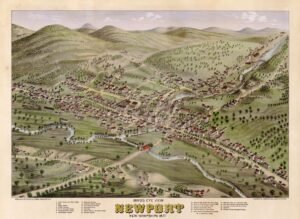
Bird's Eye View of Newport New Hampshire 1877

The History of Newport, New Hampshire, from 1766 to 1878 is a record of Newport’s growth from its early settlement through the close of the nineteenth century. It opens with the original charter and proprietary arrangements and follows the development of Newport’s physical setting, transportation routes, and economy. Particular attention is given to mills, banks, hotels, manufacturing, and the coming of the railroad, all of which shaped the town’s commercial life. The concluding genealogical section identifies families connected with Newport and other chapters provide biographical details that might otherwise be lost.

New Hampshire Men

1892 Map of New Hampshire

New Hampshire Men presents 407 biographical sketches, with portraits, of men who were active in commercial, professional, and political life in New Hampshire in 1893.

New Hampshire Men of Progress

1892 Map of New Hampshire

New Hampshire Men of Progress contains 289 biographical sketches and portraits of leaders in business and professional life in and of the state of New Hampshire. It was edited by the staff of the Manchester Union under the supervision of Richard Herndon.

1932 New Hampshire Notables

1892 Map of New Hampshire

New Hampshire Notables,” published by the Concord Press in 1932, is a biographical compilation that follows a previous work by Henry H. Metcalf. It contains 474 brief sketches of notable individuals, both natives and residents of New Hampshire, recognized for their contributions across various fields such as public life, business, and education. This edition focuses on living subjects as of 1932, with an alphabetical index for easy reference. While not exhaustive, it serves as a valuable resource for researchers and libraries, preserving important biographical data.

History of Francestown New Hampshire

Map of Francestown New Hampshire

History of Francestown, New Hampshire is a historic and genealogical record of the town from its first settlement in 1758 through the beginning of 1891. It records Francestown’s settlement, civic growth, religious and educational institutions, military participation, industries, and social customs, followed by an extensive genealogical register of families associated with the town.

Medway Massachusetts vital records

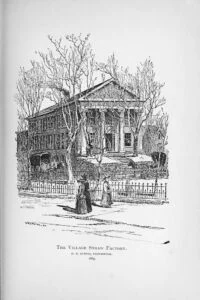
Medway Village Straw Factory

Alphabetical indexes to the vital records of Medway, Massachusetts, up to the year 1850, supplemented by information from church registers, cemetery inscriptions and other private sources to include Rev. Dr. Jacob Ide’s account of Marriages and Deaths, 1814-1849.

The history of Medway Massachusetts

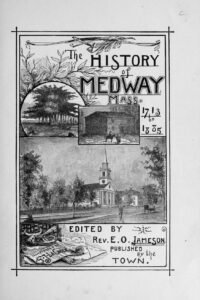
History of Medway title page

The History of Medway, Massachusetts, 1713–1885, covers the entire period of local history, embracing two hundred and twenty-five years, from 1660 to 1885; or, from the first appearance of a white settler within the territory, to the recent date of the incorporation of the town of Millis. The book is divided into ten sections, and gives, in consecutive order, an account of the first settlement, the municipal doings, the churches, the schools and other institutions, the industries, the military service, the miscellaneous matters, the cemeteries, the biographies of many persons, and the genealogies of numerous families.

History and Genealogy of Medfield, Massachusetts

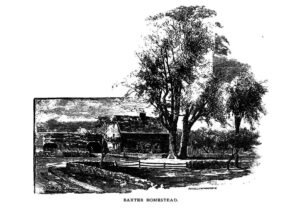
Baxter Homestead in Medfield

The History of Medfield, Massachusetts written by William Tilden in 1887 is a complete history of the town up to publishment. It is arranged chronologically, beginning with the lands of Chickatabot and the early settlement known as Boggestow, and continuing through colonial life, King Philip’s War, the Revolution, and the town’s nineteenth-century development. The genealogical section traces families residing in Medfield from 1650 to 1850, with attention to removals and corrections to earlier published errors, relying heavily on original town and probate records. Read or download the PDF for free.

History of Fairgrove Michigan

Fairgrove Centennial

This document provides a history of Fairgrove Township, Michigan, from its beginnings as unsettled land to its development as a community by 1956. It uses stories of individual families to show how the community of Fairgrove grew and changed over time.

History of Littleton New Hampshire

1895 Map of Littleton New Hampshire

The History of Littleton New Hampshire is comprised of three volumes, two volumes of history, and a final volume of genealogies. Considered one of the best examples of local history written in the early 20th century, is your ancestors resided in Littleton then you need these books. Read and download for free!

Abbe-Abbey Genealogy

A genealogical dictionary of the first settlers of New England vol 1

The “Abbe-Abbey Genealogy” serves as a comprehensive and meticulously compiled homage to the heritage of the Abbe and Abbey families, tracing its roots back to John Abbe and his descendants. Initiated by the life-long passion of Professor Cleveland Abbe, this genealogical exploration began in his youth and expanded throughout his illustrious career, despite numerous challenges. It encapsulates the collaborative efforts of numerous family members and researchers, including significant contributions from individuals such as Charles E. Abbe, Norah D. Abbe, and many others, each bringing invaluable insights and data to enrich the family’s narrative.

The genealogy and history of the Ingalls family in America

The genealogy and history of the Ingalls family in America

Edmund Ingalls, son of Robert, was born about 1598 in Skirbeck, Lincolnshire, England. He immigrated in 1628 to Salem, Massachusetts and with his brother, Francis, founded Lynn, Massachusetts in 1629. He married Ann, fathered nine children, and died in 1648.

Weymouth ways and Weymouth people

Weymouth ways and Weymouth people

Edward Hunt’s “Weymouth ways and Weymouth people: Reminiscences” takes the reader back in Weymouth Massachusetts past to the 1830s through the 1880s as he provides glimpses into the people of the community. These reminiscences were mostly printed in the Weymouth Gazette and provide a fair example of early New England village life as it occurred in the mid 1800s. Of specific interest to the genealogist will be the Hunt material scattered throughout, but most specifically 286-295, and of course, those lucky enough to have had somebody “remembered” by Edward.

Clifford Family of New Bedford, MA

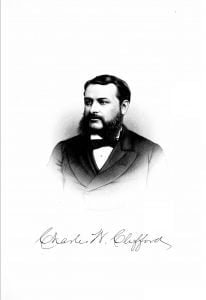
Charles Warren Clifford

The Clifford family of New Bedford, MA, has played a significant role in southern Massachusetts law for nearly a century. Beginning with Timothy Gardner Coffin and John H. Clifford, who became influential figures in the Commonwealth, the firm evolved through various partnerships, reflecting generations of legal expertise. John H. Clifford, deeply involved in public service, served as attorney general and governor, while his descendants continued the family legacy in law and civic duty. This rich lineage traces back to George Clifford, an early settler from England, linking the family’s esteemed heritage to significant historical figures.

Richard Dexter Genealogy, 1642-1904

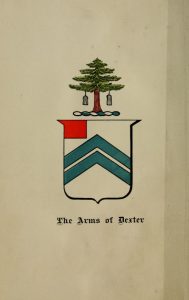
Arms of Dexter

Being a history of the descendants of Richard Dexter of Malden, Massachusetts, from the notes of John Haven Dexter and original researches. Richard Dexter, who was admitted an inhabitant of Boston (New England), Feb. 28, 1642, came from within ten miles of the town of Slane, Co. Meath, Ireland, and belonged to a branch of that family of Dexter who were descendants of Richard de Excester, the Lord Justice of Ireland. He, with his wife Bridget, and three or more children, fled to England from the great Irish Massacre of the Protestants which commenced Oct. 27, 1641. When Richard Dexter and family left England and by what vessel, we are unable to state, but he could not have remained there long, as we know he was living at Boston prior to Feb. 28, 1642.

Gallery of Western Nebraska’s People

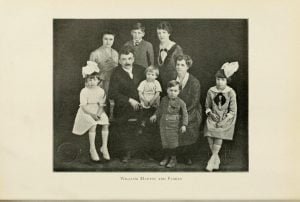
William Maupin and Family

143 full page photographs of families, couples, group photographs, individual people, and homesteads found within the manuscript History Of Western Nebraska & It’s People, Volume 3.

Biographies of Western Nebraska

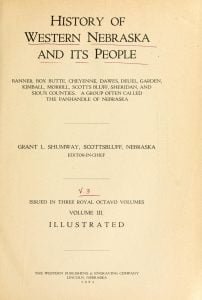
History of Western Nebraska and its People

A historical overview of western Nebraska and its pioneer settlers, this volume highlights the men who helped build counties across the Nebraska Panhandle, including Cheyenne, Box Butte, Deuel, Garden, Sioux, Kimball, Morrill, Sheridan, Scotts Bluff, Banner, and Dawes. It also points readers to biographies, history volumes, and a gallery of 143 photographs.

Muster Roll of Captain Hiram Burnham’s Company

Title page to the Aroostook War

Muster Roll of Captain Hiram Burnham’s Company of Light Infantry in the Detachment of drafted Militia of Maine, called into actual service by the State, for the protection of its Northeastern Frontier, from the third day of March, 1839, the time of its rendezvous at Calais, Maine, to the sixth day of April, 1839, when discharged or mustered.

Political Parties in Norwich Vermont

In Norwich, Vermont, political parties have historically maintained a close balance, with elections often fiercely contested. Initially aligned with the Federalists, the town shifted towards the Republicans following the formation of the party in the mid-1850s. Prior to this, Democratic candidates generally enjoyed a stronghold, particularly from 1833 to 1854, despite significant competition. The rise of anti-slavery sentiment led to a decline in the Whig Party and a shift toward the Republican Party, culminating in significant support for Abraham Lincoln in 1860, marking a turning point in local political history.