A Brief History of Norwich University

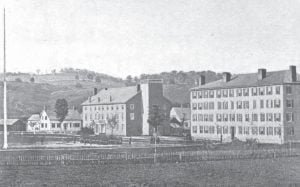
Norwich University 1862 - North Barracks South Barracks

In 1835, the American Literary, Scientific, and Military Academy was incorporated as Norwich University in Vermont. Established by Captain Alden Partridge, the institution was notable for its secular education, free from sectarian influence. It aimed to develop patriotic and educated citizens, emphasizing moral principles and religious respect without imposing specific beliefs. Throughout its early years, Norwich University contributed significantly to the training of military leaders during the Civil War, producing numerous distinguished officers for both the Army and Navy.

North Oxford Cemetery Oxford, Oakland County, Michigan

North Oxford Cemetery Oxford, Oakland County, Michigan

A detailed transcription of Oxford Cemetery in Oxford, likely in Michigan, with directions to the site and a long list of gravestone inscriptions recorded in September 2001. The collection includes names, dates, family relationships, military service notes, and epitaphs, offering a historical snapshot of local families and veterans buried there.

Everett Genealogy

The letter from Edward E. Hale reflects on the Everett genealogy, highlighting inaccuracies in the records compiled after Edward F. Everett’s death. It traces the lineage, focusing on Samuel5, Ebenezer5, Isaac6, and Joel7 Everett, detailing their lives and military service, particularly during the American Revolution. Isaac Everett’s hardships are emphasized, notably his injuries at Lexington and later endeavors supporting Washington’s army. The narrative provides glimpses into family dynamics, showcasing the deep connections and legacies of the Everett line in Dedham.

Baldwin County Georgia Marriages 1806-1850

This index compiles 1,352 Baldwin County, Georgia marriage records from court documents covering 1806 to 1850. It lists groom, bride, and marriage date entries in chronological order, offering a valuable genealogical resource for tracing family history, local relationships, and early county residents across more than four decades.

Slave Narrative of Sam and Louisa Everett

Sam and Louisa Everett, now aged 86 and 90, recall their harrowing experiences of slavery near Norfolk, Virginia, where they endured the brutality of the McClain plantation. They were married under cruel circumstances orchestrated by their master, Big Jim, who exploited the slaves mercilessly. Both faced grueling labor, often under threat and violence, until they were freed in 1865. Afterward, they settled in Boston, Georgia, and eventually moved to Florida, where they now live with their son, burdened by their past but still remembering the horrors of their enslavement.

Abstracts of Wills on File in the City of New York Surrogate’s Office 1660-1680

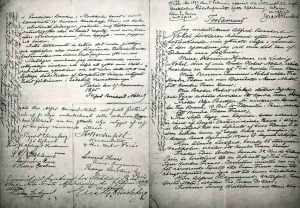
Sample Last Will and Testament

Abstracts of wills on file in the surrogate’s office city of New York 1660-1680. From May 1787 to the present, county surrogate’s courts have recorded probates. However, the court of probates and court of chancery handled estates of deceased persons who died in one county but who owned property in another. An 1823 law mandated that all probates come under the jurisdiction of the county surrogate’s courts. Each surrogate’s court has a comprehensive index to all probate records, including the unrecorded probate packets. Interestingly enough, there are wills existing and on record at the Surrogate’s Office in New York City for the time-span of 1660-1680. Genealogical extracts of these wills have been provided below.

Slave Narrative of John Eubanks

John Eubanks, born June 6, 1839, in Kentucky, reflects on his life as a slave on the Everett plantation, recalling harsh conditions and limited clothing. Despite the brutality, he experienced relatively lenient treatment from his owner’s daughter, Becky. Eubanks describes his enlistment in the Union Army and participation in significant battles during the Civil War. After the war, he married and worked various jobs, eventually settling in Gary, Indiana, where he lives with his daughter at the age of 98, sharing vivid memories of his past.

Will of Richard Everett – 1668

Richard Everett of Jamaica passed away without a will, prompting the appointment of Abraham Smith as administrator of his estate on September 4, 1668. While his children are noted in the records, their names are not specified, leaving an incomplete picture of his familial legacy.

Biography of Hon. Charles H. Everett

Charles H. Everett, born on March 22, 1855, in Rock County, Wisconsin, became a significant figure in the state’s agricultural development. Initially a farmer, he later lectured on agricultural practices and served as editor of The Wisconsin Agriculturist. His political career included roles in the state assembly and senate, where he championed beneficial legislation. Known for his dedication to agriculture and education, Everett’s influence remains prominent in Wisconsin’s farming community, earning him respect as a leader and friend to many.

Biographical Sketch of Franklin Everett

Franklin Everett, originally from Somerset County, Maine, moved to Dodge County, Wisconsin, in 1852 before relocating to Allamakee County, Iowa, in 1854. In 1868, he settled in Nebraska’s Everett Precinct, becoming one of its early residents. He owns approximately 1,500 acres, primarily focused on livestock, managing 150 cattle and 30 horses. Everett opened a general store in November 1874, served as Postmaster, closed the store in 1880, and started a banking business in 1881 under F. Everett & Son, also serving as County Commissioner for two years.

Biographical Sketch of Fremont Everett

Fremont Everett, an attorney and co-founder of Everett Shumway lumber, was born in Allmakee County, Iowa, in 1868. His family relocated to Everett Precinct in 1871. He began studying law in 1877 and was admitted to the bar in Onawa in 1879. Since then, he has practiced law while also establishing a lumber business with his partner in 1880.

Biographical Sketch of Sylvester T. Everett

Sylvester T. Everett, a financier born in Liberty, Ohio, on November 27, 1838, began his career as a messenger boy and later became a bank executive. He held significant positions including vice president and general manager of the Second National Bank, and he founded the National Bank of Commerce. Additionally, he was involved in various companies, promoted street railroads, and held mining interests in multiple states. A prominent Republican, he served as city treasurer for fourteen years and enjoyed traveling and outdoor activities.

Biographical Sketch of Henry A. Everett

Henry A. Everett, born in Cleveland on October 16, 1866, received his education in public and private schools in the same city. He served as president of the Toledo Railways and Light Company and the Northern Ohio Traction and Light Company, and chaired the board of the Detroit United Railway. His involvement extended to multiple corporations, particularly in the telephone and traction sectors. Everett was also a member of several prominent clubs, including the Union, Euclid, Century, Colonial, and Electric Clubs.

Cecil L. Everett

Private Cecil L. Everett served in the 79th Company, 2nd Division, 6th Regiment of the Marines. A resident of Martin County and son of A. S. and Mrs. Hattie Ross Everett, he entered military service on February 13, 1918. After training at various locations, he deployed to France in April 1918. Everett participated in pivotal battles, including Belleau Woods, where he sustained shrapnel wounds. He was treated at Field Hospital No. 23 and was mustered out on December 12, 1919, in Norfolk, Virginia.

Harry L. Everett

Harry L. Everett served as a Private in the Medical Corps at Base Hospital No. 6, Unit O. Born in Scotland County to Mr. and Mrs. L. T. Everett, he enlisted at Laurinburg, N.C., in November 1917. After training at Ft. McPherson and Camp Merritt, he sailed for France on February 12, 1918. Everett returned to the United States on March 12, 1919, and was mustered out at Camp Lee, Virginia, later that month.

Carlisle Indian Industrial School Graduates 1889 – 1895

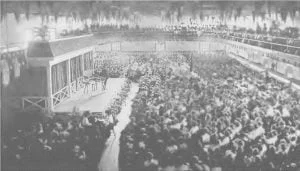
Carlisle School Gymnasium During Graduation Exercises

The Carlisle Indian School, located in Carlisle, Pennsylvania, served as an educational institution for Native American students from 1889 to 1895. Graduates from various tribes pursued diverse occupations, reflecting their adaptation to American society. Positions ranged from farmers and housewives to public service roles. Notable alumni include physicians, lawyers, and teachers, indicating a significant shift toward professional education. The school’s rich history is intertwined with its former military site, where Benjamin Franklin forged peace treaties with Native tribes in the 18th century.