History of Rindge New Hampshire

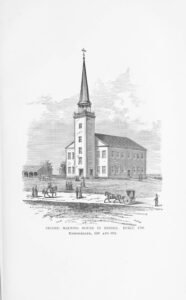
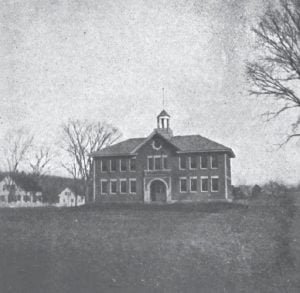
Second Meeting House in Rindge New Hampshire

The History of the Town of Rindge, New Hampshire by Ezra S. Stearns, was published in 1875, and covers the period from the original Rowley Canada grant or Massachusetts charter through the year 1874. Stearns traces the legal, territorial, and institutional development of Rindge, beginning with colonial land grants and boundary disputes and proceeding through settlement, incorporation into a town and development into a small manufacturing hub. More than half the volume is devoted to genealogical material. The genealogical register of Rindge families includes thousands of names compiled from a wide range of sources and assisted by contributions from residents and researchers beyond the town.
History of Newport New Hampshire

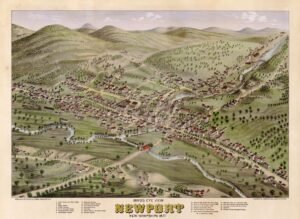
Bird's Eye View of Newport New Hampshire 1877

The History of Newport, New Hampshire, from 1766 to 1878 is a record of Newport’s growth from its early settlement through the close of the nineteenth century. It opens with the original charter and proprietary arrangements and follows the development of Newport’s physical setting, transportation routes, and economy. Particular attention is given to mills, banks, hotels, manufacturing, and the coming of the railroad, all of which shaped the town’s commercial life. The concluding genealogical section identifies families connected with Newport and other chapters provide biographical details that might otherwise be lost.

History and Genealogy of Hartford Vermont

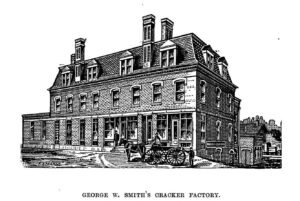
George W Smith's Cracker Factory, White River Junction, Vermont

History of Hartford, Vermont, July 4, 1761–April 4, 1889, published in 1889, is a comprehensive town history compiled by William Howard Tucker and issued by The Free Press Association of Burlington. The work covers the period from the chartering of Hartford in 1761, shortly after the close of the French and Indian War, through the late nineteenth century. It was undertaken to preserve, in permanent form, the documentary and narrative record of the town’s origin, settlement, organization, and development. It also includes biographical sketches and extended genealogies of prominent Hartford families, along with an 1889 business directory and detailed indexes.

History of Francestown New Hampshire

Map of Francestown New Hampshire

History of Francestown, New Hampshire is a historic and genealogical record of the town from its first settlement in 1758 through the beginning of 1891. It records Francestown’s settlement, civic growth, religious and educational institutions, military participation, industries, and social customs, followed by an extensive genealogical register of families associated with the town.

History of Amherst New Hampshire

Residence of Isaac Brooks in Amherst New Hampshire

The history of Amherst, New Hampshire, unfolds from its 1675 land grant to veterans of the Narraganset War, marking the impetus for settlement along the Souhegan River. From its early governance and incorporation in 1760 to territorial adjustments that birthed Mont Vernon and Milford, this narrative encompasses local geography, economy, and Indigenous presence. Key military engagements, civic institutions, and genealogical records are explored up to 1882, offering a comprehensive view of the town’s evolution and its prominent figures.

Pioneers of Chambers County Texas

Texas coastal pioneers of Chambers County

“Texas Coastal Pioneers of Chambers County” by Varuna Hartmann Lawrence, published in 1952 by Royal Publishing Co., offers a genealogical history of the early settlers of Chambers County, Texas. This book details the cultural and spiritual development of the Gulf Coast region and includes sketches of many early families. Lawrence, a native of Chambers County, draws on her personal experiences and extensive knowledge of farm and ranch life to provide a rich historical narrative. Her work captures the transformation of the region, influenced by both agricultural practices and oil development. Through her writings, Lawrence preserves the legacy of the pioneering families of Chambers County, making a significant contribution to Texas history.

Southborough Massachusetts vital records

Vital records of Southborough, Massachusetts, to the end of the year 1849 title page

The list of vital records of Southborough, Massachusetts, comprised in this volume includes all which were entered in the Town Books during the period from the earliest date there found to the end of the year 1849. Some additions and corrections of names and dates have been made from the records of the First Church, these being indicated in each instance by proper reference. There are a total of 6,267 births, marriages, and deaths recorded. This book is free to read or download.

Families of Ancient New Haven

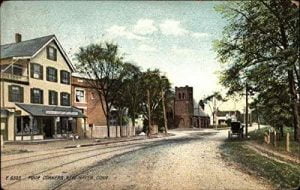
Four Corners New Haven Connecticut

The Families of Ancient New Haven compilation includes the families of the ancient town of New Haven, covering the present towns of New Haven, East Haven, North Haven, Hamden, Bethany, Woodbridge and West Haven. These families are brought down to the heads of families in the First Census (1790), and include the generation born about 1790 to 1800. Descendants in the male line who removed from this region are also given, if obtainable, to about 1800, unless they have been adequately set forth in published genealogies.

Genealogical Record of Thomas Wait and his descendants

Genealogical record of Thomas Wait and his descendants

Genealogical Record of Thomas Wait and his descendants looks at the genealogy of Thomas Wait (1601-1677) who was from Wethersfield Parish, Essex, England. On his arrival in America, landing in Rhode Island, he applied for a lot on which to build,and was granted it on 7/1/1639. On 3/l6/l641 he became a Freeman in Newport R. I. He died in Portsmouth R. I., before April 1677 intestate. This Thomas Wait was a cousin to the Richard Waite of Watertown Mass., who was a large land owner. This unpublished manuscript provides the descendants of this family.

Biographical and Portrait Cyclopedia of Chester County, PA

Title Page for Biographical and Portrait Cyclopedia of Chester County Pennsylvania

An introductory page for the Biographical and Portrait Cyclopedia of Chester County, Pennsylvania, this volume includes a historical sketch of the county by Samuel T. Wiley and more than 500 biographical sketches of prominent local men and leading citizens. It also outlines Chester County’s colonial origins, early boundaries, and its role in the formation of neighboring counties.

Partridge Family of Norwich Vermont

Samuel Partridge, Sr., born in 1721 in Preston, Connecticut, settled in Norwich, Vermont, around 1765 with his wife, Ruth Woodward, and their children. They established a hill farm that remained in the family’s possession for three generations until sold in the early 20th century. Samuel served as a lieutenant in the local militia during the Revolutionary War, and he passed away in 1826. His descendants included several who also fought in the war, ensuring the family’s legacy in Norwich.

Lord Family of Norwich Vermont

Jonathan Lord, Jr. and David Lord were early settlers in Norwich, Vermont, arriving from Colchester, Connecticut, around 1773. Jonathan, born in 1752, married Mary Smith and had several children, while David, born in 1756, married Hannah Hanks and fathered eight. Notable descendants include John Lord, who lived from 1782 to 1882, and Asa Lord, who moved to Illinois after graduating from Dartmouth. The Lord family has made significant contributions to the community, with multiple generations rooted in Norwich.

Dutton Family of Norwich Vermont

The Dutton family in Norwich traces its roots to Samuel Dutton, born in 1707, who migrated from Connecticut and settled on Dutton Hill. He married Abigail Merriam in 1729 and had multiple wives, fathering eight children. His lineage includes Daniel Benedict Dutton, who returned to Norwich after time in Stowe, and Deacon John Dutton, a lifelong farmer and community leader active in the Legislature. The family’s legacy continues through his wife, Harriet Anna Lord, and their surviving children, Charles and Hattie.

History of Norwich Vermont Education

High School Building, Norwich Village, Erected in 1898

The history of education in Norwich, Vermont, traces back to efforts in 1782 to establish school districts. The first successful division occurred in 1785, creating the First School District. Over the years, multiple districts were formed, with the establishment of a committee for school supervision in 1824. Notable developments included the construction of a brick schoolhouse in 1845 and the incorporation of the Norwich Classical and English Boarding School in 1867, although it ultimately closed in 1877. The town’s education framework evolved significantly, culminating in a unified system in 1892.

Norwich Vermont in the Civil War

During the Civil War, Norwich, Vermont, contributed 185 soldiers to the Union Army, representing over ten percent of its population of 1,759. Of these, 27 men died in service. The town provided substantial bounties totaling around $32,000 to support its troops. Although the community largely supported the war effort, some residents expressed disloyalty, yet over time, many reconciled their past by honoring the fallen soldiers on Memorial Days. Overall, Norwich’s commitment to the Union cause reflected a broader dedication seen throughout Vermont.

First Settlements in Norwich Vermont

The early settlement of Norwich, Vermont, began in 1762 when Samuel Slafter’s son, John, explored the area, reporting its fertile land and water sources. In 1763, after receiving his father’s rights, he commenced clearing lots but faced challenges, as his initial choice proved unsuitable. By 1765-66, a few families settled permanently, including the Hutchinsons and Manns, establishing homes and farms. Pioneers endured various hardships, yet they built foundations for a thriving community, characterized by a homogeneous population primarily from Connecticut.

Norwich Vermont an Independent Township

The political organization of America began with the Township, particularly in New England, where towns emerged as independent entities with self-governing rights in the mid-17th century. Town meetings served as foundational democratic institutions, allowing citizens to elect officials and manage local affairs. Norwich, Vermont, exemplified this tradition, organizing its town government in 1761 before any settlers arrived. Its early record-keeping and governance practices reflect a commitment to law, order, and community engagement, which have shaped its ongoing civic structure.

Biography of Natley Dutton

Natley Dutton, an early settler from England, established his family in Maryland following Lord Baltimore’s colonization efforts. His son, John H. Dutton, born in 1790, faced hardship after his father’s death, leading to his apprenticeship as a ship carpenter. In 1818, John and his half-brother Thomas T. Elton journeyed to Missouri, where they first rented land before settling in Montgomery County. John H. Dutton became a respected community leader, serving as a deacon and county judge until his death in 1853, leaving behind a legacy of service and family.