History of Windham New Hampshire

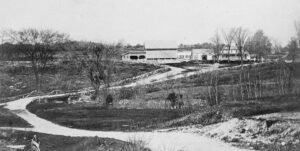
Residence of William H Anderson of Windham, New Hampshire

Leonard A. Morrison’s *The History of Windham, New Hampshire*, published in 1883, chronicles the town’s evolution from early settlements in the 18th century to the late 19th century. It highlights Windham’s roots in the Scotch-Irish Londonderry community and examines various aspects of local life, including land grants, education, and political developments. The work also documents significant historical events and includes extensive genealogies of the area’s early settlers and their descendants, drawing from comprehensive local records and archives.
Genealogies of the Town of Goffstown New Hampshire

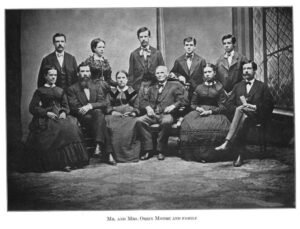
Orrin Moore and family of Goffstown, New Hampshire

The genealogical record of Goffstown, New Hampshire, was a substantial undertaking, hampered by the extinction of early families and the widespread scattering of descendants. Efforts to gather vital statistics necessitated considerable travel and correspondence, often revealing discrepancies in recorded dates across various sources. Despite challenges, contributions from former works and assistance from individuals proved invaluable in compiling this record. The comprehensive index reflects the depth of research involved in documenting the town’s heritage.

History of Amherst New Hampshire

Residence of Isaac Brooks in Amherst New Hampshire

The history of Amherst, New Hampshire, unfolds from its 1675 land grant to veterans of the Narraganset War, marking the impetus for settlement along the Souhegan River. From its early governance and incorporation in 1760 to territorial adjustments that birthed Mont Vernon and Milford, this narrative encompasses local geography, economy, and Indigenous presence. Key military engagements, civic institutions, and genealogical records are explored up to 1882, offering a comprehensive view of the town’s evolution and its prominent figures.

Brown Genealogy

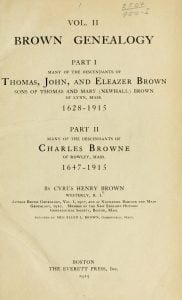
Brown Genealogy

In 1895, Cyrus Henry Brown began collecting family records of the Brown family, initially with the intention of only going back to his great-grandfathers. As others became interested in the project, they decided to trace the family lineage back to Thomas Brown and his wife Mary Newhall, both born in the early 1600s in Lynn, Massachusetts. Thomas, John, and Eleazer, three of their sons, later moved to Stonington, Connecticut around 1688. When North Stonington was established in 1807, the three brothers were living in the southern part of the town. Wheeler’s “History of Stonington” contains 400 records of early descendants of the Brown family, taken from the town records of Stonington. However, many others remain unidentified, as they are not recorded in the Stonington town records. For around a century, the descendants of the three brothers lived in Stonington before eventually migrating to other towns in Connecticut and New York State, which was then mostly undeveloped. He would eventually write this second volume of his Brown Genealogy adding to and correcting the previous edition. This book is free to search, read, and/or download.

Descendants of Philip Taber of New Bedford, MA

Philip Taber, born in 1605 and passed in 1672, was an early settler of New Bedford, MA, with a distinguished public service record, including roles as a deputy and representative. He had two wives, Lydia Masters and Jane, and fathered several children, including Thomas Taber, who continued the family legacy through civic duties in Dartmouth. The Taber lineage expanded with Joseph and Benjamin Taber, leading to notable descendants like Edward Smith Taber, who achieved success in various industries, including the Morse Twist Drill Company.

Richard Dexter Genealogy, 1642-1904

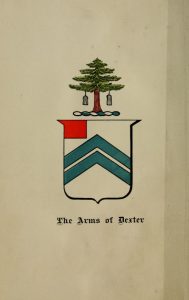
Arms of Dexter

Being a history of the descendants of Richard Dexter of Malden, Massachusetts, from the notes of John Haven Dexter and original researches. Richard Dexter, who was admitted an inhabitant of Boston (New England), Feb. 28, 1642, came from within ten miles of the town of Slane, Co. Meath, Ireland, and belonged to a branch of that family of Dexter who were descendants of Richard de Excester, the Lord Justice of Ireland. He, with his wife Bridget, and three or more children, fled to England from the great Irish Massacre of the Protestants which commenced Oct. 27, 1641. When Richard Dexter and family left England and by what vessel, we are unable to state, but he could not have remained there long, as we know he was living at Boston prior to Feb. 28, 1642.

The Settlers of Narraguagus Valley Maine

Narraguagus Valley Some Account of its Early Settlement and Settlers

The early settlement of the Narraguagus River in Washington County, Maine, involved significant developments in nearby towns such as Steuben, Milbridge, Harrington, and Cherryfield. Established between 1791 and 1816, these towns evolved from former townships. Key early settlers included Jabez Dorman, John Densmore, Ichabod Willey, and Samuel Colson, who arrived around 1757. Their families contributed to the growth of the region, establishing roots and communal records that reflect the intertwined histories of these communities. Notably, many surnames from the early settlers persist in the area today.

Muster Roll of Captain James Clark’s Company

Title page to the Aroostook War

Muster Roll of Captain James Clark’s Company of Light Infantry in the Detachment of drafted Militia of Maine, called into actual service “by the State, for the protection of its Northeastern Frontier, from the twentieth day of February, 1839, the time of its rendezvous at Bangor, Maine, to the eleventh day of May, 1839, when discharged or mustered.