History of Hampton New Hampshire vol 2

1892 Map of Hampton NH

The original version of this monumental work was published in 2 volumes. Volume 1 contains the history of the town of Hampton, New Hampshire from its settlement in 1638 to the autumn of 1892 and can be found here. Volume 2 featured the genealogical and biographical details of the early families of Hampton, NH up to the autumn of 1892 and this is the volume shown below. This manuscript was meticulously researched by Joseph Dow up until his death in 1889. Unfortunately his death preceded the final compilation of the genealogies and his daughter, Lucy Ellen Dow, took on the task after his decease. For genealogists this is an important fact. Lucy admits in her preface that she had difficulty bringing the genealogies down to date (1892) for lack of full understanding of Josiah Page’s notes and for the lack of accurate town records. As she laments about the town records “but whole decades are passed over with scarcely an entry of birth or marriage.” Indeed they are.
Brown Genealogy

Brown Genealogy

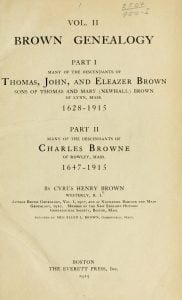
In 1895, Cyrus Henry Brown began collecting family records of the Brown family, initially with the intention of only going back to his great-grandfathers. As others became interested in the project, they decided to trace the family lineage back to Thomas Brown and his wife Mary Newhall, both born in the early 1600s in Lynn, Massachusetts. Thomas, John, and Eleazer, three of their sons, later moved to Stonington, Connecticut around 1688. When North Stonington was established in 1807, the three brothers were living in the southern part of the town. Wheeler’s “History of Stonington” contains 400 records of early descendants of the Brown family, taken from the town records of Stonington. However, many others remain unidentified, as they are not recorded in the Stonington town records. For around a century, the descendants of the three brothers lived in Stonington before eventually migrating to other towns in Connecticut and New York State, which was then mostly undeveloped. He would eventually write this second volume of his Brown Genealogy adding to and correcting the previous edition. This book is free to search, read, and/or download.

Seneca County New York Genealogy

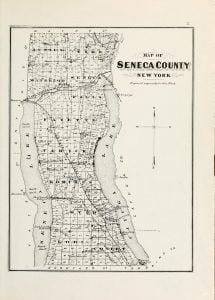
1876 Map of Seneca County NY

A guide and directory to Seneca County New York genealogy, containing both online and offline resources for genealogy and historical research. This article contains sources of genealogical data about Seneca County such as biographies, cemetery records, census records, church records, court records, family records, land records, military records, naturalization records, and vital records.

Seneca County New York Newspapers

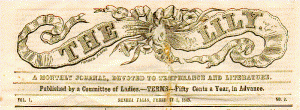
Masthead of the Lily in Seneca Falls

Seneca County’s newspaper history began with early settlers who had limited access to publications. The Ontario Gazette and Genesee Advertiser, the Impartial American, and The Expositor were among the first papers, starting between 1797 and 1806. George Lewis launched the Seneca Patriot in 1815, marking the area’s journalism struggle. Despite the lack of digitized historical papers, microfilm exists, potentially accessible through local societies. Newspaper archives are essential for genealogical research, providing unique insights into ancestors’ lives across various towns.

History of the Seneca County New York Press

Masthead of the Lily in Seneca Falls

The history of the press in Seneca County reflects the broader narrative of American journalism’s evolution, characterized by local newspapers that documented societal changes and opinions. The first publication, the Seneca Patriot, emerged in 1815, followed by various newspapers that reflected political trends from Federalism to Democratic ideals. Notable figures, such as Amelia Bloomer, contributed to the media landscape with publications advocating reform. Though many papers faced struggles with sustainability, they played pivotal roles in shaping public discourse and preserving local history, ultimately illustrating the press’s enduring influence in the county.

A History of Ovid New York Newspapers

Ovid Bee Newspaper

The history of newspapers in Ovid, New York, dates back to 1815 with George Lewis’s Seneca Patriot, later renamed The Ovid Gazette. Over the years, various publications emerged, including The Ovid Bee and The Ovid Independent. These newspapers served as crucial resources for genealogists, housing valuable records on local marriages and deaths. Numerous repositories, such as the Edith B. Ford Memorial Library and Cornell University, house microfilm and original issues, allowing researchers to access this rich historical material.

Biography of Dr. S. C. Bogart

Dr. S. C. Bogart, born in Pennsylvania in 1852 to Pennsylvania German parents, became a prominent dentist in San Bernardino County. After briefly studying dentistry in Illinois and practicing in Minnesota, he settled in California in 1881. His dental practice thrived, extending across the county. Besides dentistry, Dr. Bogart engaged in real estate and constructed a notable brick block in 1888. A Republican in politics, he is esteemed as an enterprising and public-spirited member of the San Bernardino community.

Biography of John Bogart

John Bogart, born in Albany on February 8, 1836, is a prominent civil engineer and state surveyor with Dutch ancestry tracing back to 1640. He excelled academically, earning both the Van Rensselaer and Caldwell medals. After graduating from Rutgers College in 1853, he worked on the New York Central Railroad, later contributing to significant urban park projects, including Central Park and Prospect Park. Bogart served as state engineer and surveyor, participating in various major engineering initiatives and was a respected member of professional organizations. He and his wife, Emma, are well-regarded in their community.