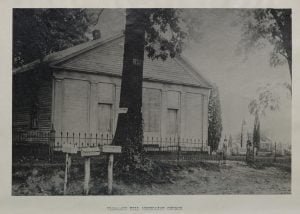
Vital records of Stratham, New Hampshire, 1700-1867

Plan of the Town of Stratham

In 1934, Priscilla Hammond compiled vital records from Stratham, New Hampshire, covering the years 1700 to 1867, based on original town records. This compilation, transcribed with imperfect typing, was privately published and distributed to libraries and societies. The records are presented largely as found, with family members often grouped together. An index is included to assist in locating individual records. Users should be cautious with dates, especially those before 1752, as it is unclear if old dates were converted.

New Hampshire Men

1892 Map of New Hampshire

New Hampshire Men presents 407 biographical sketches, with portraits, of men who were active in commercial, professional, and political life in New Hampshire in 1893.

Abington Massachusetts Marriage and Death Records

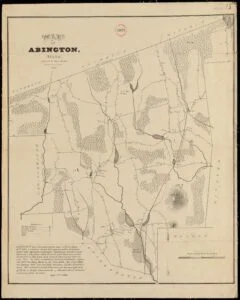
1830 Map of Abington, Massachusetts

Volume 2 of the Abington, Massachusetts vital records compiles marriage and death records up to 1850, complementing Volume 1, which contains birth records. Established in 1712, Abington’s boundaries have shifted, affecting historical jurisdiction. Extensive research from town records, cemeteries, and family Bibles ensured comprehensive documentation, including the identification of Black families recorded by given names. The volume is organized alphabetically by marriages and deaths.

Vital Records of Sheffield Massachusetts, 1733-1792

Map of Sheffield, Harstville, Southfield and New Marlborough Massachusetts

The vital records of Sheffield, Massachusetts from 1733 to 1792 detail the town’s historical births, marriages, and deaths. While names and dates are transcribed accurately, some wording has been abbreviated for clarity. Marriage records often specify the union of couples, while birth records typically include parental names. Notably, some families lack marriage entries, starting instead with a child’s birth. The records also document a few out-of-wedlock births, emphasizing lineage through parental names, even in adult death records.

1932 New Hampshire Notables

1892 Map of New Hampshire

New Hampshire Notables,” published by the Concord Press in 1932, is a biographical compilation that follows a previous work by Henry H. Metcalf. It contains 474 brief sketches of notable individuals, both natives and residents of New Hampshire, recognized for their contributions across various fields such as public life, business, and education. This edition focuses on living subjects as of 1932, with an alphabetical index for easy reference. While not exhaustive, it serves as a valuable resource for researchers and libraries, preserving important biographical data.

Supplement to The history of Windham in New Hampshire

Presbyterian Church of Windham New Hampshire

The 1892 supplement to “The History of Windham in New Hampshire,” compiled by Leonard Allison Morrison, expands on the local history initially published in 1883. It documents the Presbyterian society’s organization from 1827 to 1892, detailing church records, civic matters, and the development of Canobie Lake. The volume includes genealogical data from Ireland, accounts of early settlers, and significant events like the fiftieth anniversary of the church dedication. Additionally, it provides vital records and concludes with obituaries and Columbus Day celebration proceedings.

History of Windham New Hampshire

Residence of William H Anderson of Windham, New Hampshire

Leonard A. Morrison’s *The History of Windham, New Hampshire*, published in 1883, chronicles the town’s evolution from early settlements in the 18th century to the late 19th century. It highlights Windham’s roots in the Scotch-Irish Londonderry community and examines various aspects of local life, including land grants, education, and political developments. The work also documents significant historical events and includes extensive genealogies of the area’s early settlers and their descendants, drawing from comprehensive local records and archives.

History of Bedford, New Hampshire

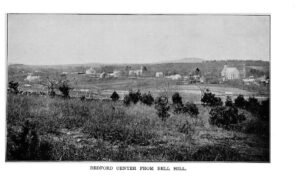
Bedford Center from Bell Hill

This volume, titled History of Bedford, New Hampshire, from 1737, was compiled by Peter P. Woodbury, Thomas Savage, and William Patten. It was published in Concord, N.H., by The Rumford Printing Co. in 1903. The primary objective of this edition was to incorporate all facts from the predecessor’s work, along with additional details and events that occurred since its publication, documenting the town’s history up to the occasion of the one hundred and fiftieth anniversary of its incorporation on May 15, 1900. A significant portion of the work is dedicated to Genealogies of 157 families, furnished largely by family representatives and compiled by Miss Mary E. Manning. The book also includes Biographies of notable figures associated with Bedford and a chapter on Vital Statistics (births, deaths, and marriages) compiled from town records, with recognized limitations due to the incompleteness of earlier record-keeping.

History of Francestown New Hampshire

Map of Francestown New Hampshire

History of Francestown, New Hampshire is a historic and genealogical record of the town from its first settlement in 1758 through the beginning of 1891. It records Francestown’s settlement, civic growth, religious and educational institutions, military participation, industries, and social customs, followed by an extensive genealogical register of families associated with the town.

Medway Massachusetts vital records

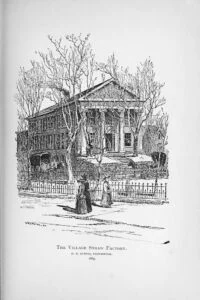
Medway Village Straw Factory

Alphabetical indexes to the vital records of Medway, Massachusetts, up to the year 1850, supplemented by information from church registers, cemetery inscriptions and other private sources to include Rev. Dr. Jacob Ide’s account of Marriages and Deaths, 1814-1849.

The history of Medway Massachusetts

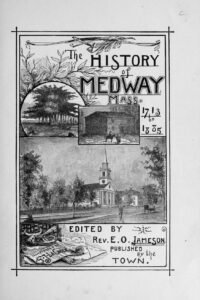
History of Medway title page

The History of Medway, Massachusetts, 1713–1885, covers the entire period of local history, embracing two hundred and twenty-five years, from 1660 to 1885; or, from the first appearance of a white settler within the territory, to the recent date of the incorporation of the town of Millis. The book is divided into ten sections, and gives, in consecutive order, an account of the first settlement, the municipal doings, the churches, the schools and other institutions, the industries, the military service, the miscellaneous matters, the cemeteries, the biographies of many persons, and the genealogies of numerous families.

History of Amherst New Hampshire

Residence of Isaac Brooks in Amherst New Hampshire

The history of Amherst, New Hampshire, unfolds from its 1675 land grant to veterans of the Narraganset War, marking the impetus for settlement along the Souhegan River. From its early governance and incorporation in 1760 to territorial adjustments that birthed Mont Vernon and Milford, this narrative encompasses local geography, economy, and Indigenous presence. Key military engagements, civic institutions, and genealogical records are explored up to 1882, offering a comprehensive view of the town’s evolution and its prominent figures.

Randolph County NC Tales

Early depiction of the Asheboro Train Depot

The stories in this book are some of the stories that were told a long time ago. Some are about people who have acted bravely in the face of danger and have become heroes. Some are about places in the county that are like no other places in the state. Some are stories that have been invented just for fun. All of the stories have one thing in common — they are unique to Randolph County.

The San Antonio Story

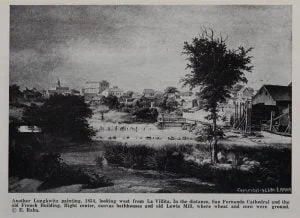
San Antonio Texas in 1854 looking west from La Villita

“The San Antonio Story” by Sam Woolford, with contributions from his wife Bess Carroll Woolford, is a history of San Antonio, Texas. Published in 1950 by Joske’s of Texas, the book was conceived as a remedy for the lack of historical knowledge among San Antonio’s school children, a concern identified by Herbert U. Rhodius, chairman of the Municipal Advertising Commission of San Antonio in 1948-49. Rhodius and his colleagues believed that a readable and authentic history could address this educational gap, making it suitable supplementary reading for public junior high schools.

Over the Misty Blue Hills: The Story of Cocke County, Tennessee

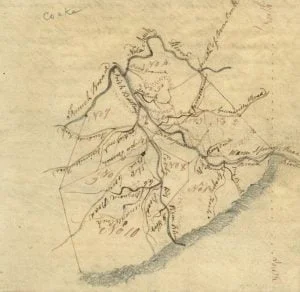
1836 Map of Cocke County, Tennessee

“Over the Misty Blue Hills: The Story of Cocke County, Tennessee,” written by Ruth Webb O’Dell and published in 1951, provides a historical account of Cocke County. The book covers various aspects of Cocke County’s history, including its political, social, religious, and industrial developments. The contents are divided into several detailed sections: the political history of Cocke County, the significance of local names, the natural resources and setting, early settlers, religious history, industrial development, and notable figures from the county. Additionally, it delves into specific family histories, offering insights into the lives of many influential families such as the Allens, Burnetts, Huff, McMahan, and many others.

Early Settlers of Ralls County, Missouri

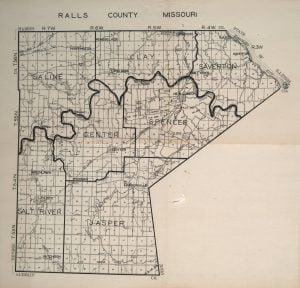
1930 Map of Ralls County, Missouri

The manuscript “Early Settlers of Ralls County, Missouri” compiled by Eunice Moore Anderson in 1951 serves as a valuable resource for those tracing their family genealogy in Ralls County. Divided into three parts, the compilation focuses on documenting early settlers prior to 1878, drawing from sources such as county atlases and historical records spanning Marion, Ralls, Pike Counties, and beyond. While not aiming to provide a comprehensive history, Anderson’s work catalogues pioneer families, offering insights into their origins, migration dates to Ralls County, and family connections. This structured approach, supplemented by an alphabetical index, aids researchers in navigating through ancestral records and locating further detailed information within related historical volumes.

Records of Pleasant Hill Methodist Church, 1829-1894

Pleasant Hill Methodist Church, 1953

This is a copy of a record book of the Pleasant Hill Methodist Church in Washington Township, Guernsey County, Ohio. The front portion of this manuscript contains the history of Pleasant Hill Methodist Church, which we provide here, and biographies of their pastors up to 1953. Starting on page 18 you will find the Membership Record for the church beginning in 1829 and through January of 1894.

A History of Newburgh Lodge No. 174, F. & A.M.

Old Masonic Lodge, Newburgh

A History of Newburgh Lodge No. 174, F. & A.M. provides a historical account of the lodge, detailing its founding in Newburgh, Indiana, in 1854. It traces the origins to an inaugural meeting under a dispensation with key figures like Draper Chipman and Azel Freeman leading the lodge. The narrative connects local events such as the burial of Mason John W. Palmer in 1851, hinting at an earlier Masonic presence in Newburgh. The chapter also paints a vivid picture of Newburgh in the 1850s as a bustling river port with significant economic activity and cultural vibrancy, suggesting these factors contributed to the establishment of the Masonic lodge. I have provided you an index to the genealogical information found in the section on “Our First One Hundred Years” 1855-1955.

Marriage records of Liberty County Georgia, 1785-1895

Marriage records of Liberty County, Georgia, 1785-1895

These marriage records were abstracted from unbound marriage bonds and licenses in the Liberty County Courthouse, Hinesville, Georgia. The names were copied as they were spelled on the bonds, often barely legible and often spelled differently on the same bond. Sometimes the marriages were performed before the licenses were issued. The first date given in the abstracts is the date of the license or bond; the second is the date of marriage. The following abbreviations are used in these abstracts with the meaning indicated:

Wintergreen Cemetery, Port Gibson, Mississippi

Wintergreen Cemetery, Port Gibson, Mississippi

This survey of Wintergreen Cemetery, Port Gibson, Mississippi, was completed in 1956 by Mr. Gordon M. Wells and published by Joyce Bridges the same year. It contains the cemetery readings Mr. Wells was able to obtain at that date. It is highly likely that not all of the gravestones had survived up to that point, and it is even more likely that a large portion of interred individuals never had a gravestone.