Roots in Birmingham

Roots in Birmingham

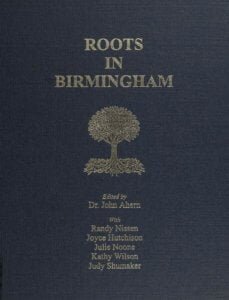
Roots in Birmingham is a compilation of interviews with Birmingham residents, evoking the neighborhood’s history and culture. A “Birmingham Cultural Center Book” Stories collected from Judy (Farkas) Balogh, Elizabeth “Kardy”(Kordas) Boray, Anna (Potoczki) Fabos, John Gocsik, Father Martin Hernady, Margaret “Peg”(v) Horvath, Nancy (Packo) Horvath, Lillian (Kertz) Keil, William Kertesz, Mary (Christian) King, Mariska Kinsey-LaCava, Eleanor (Weizer) Mesteller, Don and Barb Nyitray, John Oravec, Paul John Slovak, William Szabo, Steven Tarczali, Barbara (Priscsak) Torok, Alberta (Taylor) Traylor, Magdalene Ujvagi, Peter Ujvagi, Pete Vas, Jr. and Martha (Boden) Young.
Birmingham: reflections on community

Birmingham - reflections on community

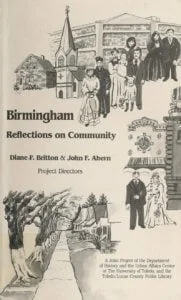
This book is the second volume of a collaborative project called “Birmingham Remembers” Residents of the Birmingham neighborhood had been interviewed in the 1980s. With this project the participants comments are organized by topic. Topics include heritage, education, religion, work, recreation, neighborhood, rituals, holidays, the Great Depression, military service, the Hungarian Revolution, activism and reminiscences.”

Ancestors of George Mitchell Hooper of Bridgewater, MA

George Mitchell Hooper

The Hooper family, established in New England by William Hooper in 1635, has deep roots in Bridgewater, MA. His son, John Hooper, settled in Bridgewater and had several descendants involved in various local endeavors. George Mitchell Hooper, born in 1838, engaged in the brick manufacturing business and served in local government, reflecting the family’s long-standing commitment to community service. His marriage to Jane Hayward further connected the Hoopers to influential local families, including the Mitchells, whose ancestry traces back to early colonial times.

Early Exploration and Native Americans

Ferdinand de Soto’s interactions with Native American tribes, specifically the Choctaws and Chickasaws, exemplify early European attempts to impose their ideologies of civilization and Christianity upon Indigenous populations. This approach set a precedent for further exploitation and oppression of Native Americans, as European settlers sought to acquire land and resources. Throughout history, tribes like the Chickasaws, known for their valor, remained steadfast allies rather than adversaries. This enduring alliance contrasts sharply with the overarching narrative of dispossession and extermination faced by Indigenous nations in North America.

Slave Narrative of Julia King

Julia King, born into slavery in Louisville, Kentucky, recounts her early life and family history during a 1937 interview. She describes her parents’ escape via the Underground Railroad, her experiences growing up on a plantation, and the struggles of enslaved people. After emancipation, she became the first colored juvenile officer in Toledo, Ohio. King highlights the importance of education and community among Black people and reflects on prominent figures like Abraham Lincoln and Booker T. Washington, advocating for self-improvement and unity.

Slave Narrative of Mrs. Hannah Davidson

Mrs. Hannah Davidson, born in 1852 in Ballard County, Kentucky, recounts her life as a slave and the hardships she endured. Raised by Isaac and Nancy Meriwether, she worked from a young age without compensation, often subjected to grueling labor and strict control over her freedom. Despite these challenges, she sought education and learned to read later in life. After emancipation, she continued to struggle, living on a meager pension. Hannah emphasizes forgiveness over remembering past traumas, advocating for kindness and religious values.

Biography of William Harry Little, M. D.

Dr. William Harry Little, born on November 5, 1868, in Ohio, has served the Alta Vista community as a physician for over fifteen years while also running the town’s prominent drug store. After receiving his M.D. from Kansas City Medical College in 1900, he practiced in Reno County before settling in Alta Vista in 1903. A member of various professional and social organizations, he has been married twice and has two children. His roots trace back to early American settlers who migrated from Scotland to Ohio and later to Kansas.

Biography of Herschel C. Porterfield

Herschel C. Porterfield, born August 10, 1856, in Butler County, Pennsylvania, has dedicated over thirty-five years to the oil industry, establishing a notable career as a contractor and producer. He moved to Kansas in 1903, settling in Independence, where he co-founded the Amherst Oil Company, managing numerous producing wells. A man of strong family ties and diverse interests, Porterfield’s heritage includes Irish and Scottish descent. He married Lydia A. Ogden in 1880, raising five children, many of whom followed in his footsteps in the oil business.

Biography of Martin B. Daly

Martin B. Daly, born on May 11, 1860, in Mayville, New York, began his career in the oil industry at the Bradford oil fields. He advanced from roles in drilling to assistant superintendent of the Warren County Gas Fuel and Heating Company. Daly played a crucial role in pioneering long-distance natural gas transportation, serving as general superintendent of the Buffalo Natural Gas Fuel Company. His leadership extended to several gas companies, including the East Ohio Gas Company, and he held various civic and business positions throughout his life. Daly was married to Kathleen McMahon and had five children.

Biographical Sketch of Louis Englander

Louis Englander, born in Toledo, Ohio, on January 26, 1883, was an accomplished attorney and prominent businessman. He graduated from Adelbert College and Western Reserve Law School with A.B. and LL.B. degrees. Married in 1912, he initially worked with Henderson, Quail & Siddall before founding Englander & Bowden. He held leadership roles in various companies, including president of The Cuyahoga Fire-Proofing Co. and secretary of several others. Englander was active in professional associations and fraternal organizations in Cleveland.

Biographical Sketch of C. Brenton Cook

C. Brenton Cook, born on November 30, 1882, in Frankfort, Indiana, was educated at public schools and Rose Polytechnic Institute. He married Francis Florence Smith in 1910 and had one daughter. Cook’s career included roles as a sales engineer at Bullock Electric Manufacturing Company and manager at Allis-Chalmers Company, followed by a position as branch manager for Stevens-Duryea Company. He was an active member of the American Institute of Electrical Engineers and held a Bachelor of Science degree.

Biographical Sketch of William Gordon

William Gordon, born December 15, 1862, in Oak Harbor, Ohio, was an attorney and public figure. He graduated from the University of Michigan with an LL.B. and held various positions in Ottawa County, including deputy county treasurer and prosecuting attorney. Elected to the 63rd Congress from Ohio’s 20th district in 1912, he was also involved in the Democratic Party and local businesses. Gordon married Elizabeth N. Garnhard in 1893 and had two children. He was an avid duck hunter.

Biographical Sketch of Thomas William Hill

Thomas William Hill, born on May 30, 1847, in England, immigrated to the United States with his parents in 1850, settling in Flint, Michigan. He served in the Michigan Cavalry during the Civil War and later worked for the W. U. Telephone Company. Hill held numerous banking positions, notably as cashier of the Cleveland National Bank from 1892 and president of the New City Hall Commission from 1898 until its dissolution in 1912. He was also involved in various corporate and Masonic organizations. He married Harriette C. De La. Hooke in 1870 and had one son, Harold H.

Biography of James C. Holland

James C. Holland, born April 2, 1853, in Ohio, became a pivotal figure in Kansas architecture, particularly in Topeka. With over thirty years of experience, he served as state architect and contributed significantly to public buildings, including the Shawnee County Courthouse and Topeka’s city hall. His expertise earned him membership in the prestigious New York Society of Architects. Holland’s lineage includes notable ancestors, and his family life has been supported by his wife, Lizzie, and children, who also joined him in the architectural field.

Biographical Sketch of Frank Z. Jones

Frank Z. Jones, a plaster contractor born in Delaware, Ohio, on September 21, 1879, was the son of Albert and Margaret Common Jones. He was educated in local public schools and married Lillie L. Baker in Windsor, Canada, in 1903, with whom he had three sons. After learning the plastering trade from his father, he moved to Dayton in 1901 and later worked in Toledo before settling in Cleveland in 1904. He established a contract business in Lakewood after building his home there in 1912.

Biographical Sketch of John S. McCarrens

John S. McCarrens, born on July 27, 1869, in Pennsylvania, was the son of D. A. and Anna McGinley McCarrens. He attended public schools and Niagara University before marrying Mary Sweeney in Toledo, Ohio, on June 24, 1896. McCarrens worked as an advertising manager and business collector, and he was an active member of the Cleveland Advertising Club. He was also known for his interest in horseback riding. He and Mary had two daughters and two sons.

Biographical Sketch of Fred A. Whitmore

Fred A. Whitmore was born on November 30, 1882, in Toledo, Ohio, to Charles A. and Harriet D. Moon Whitmore. He received a public school education and married Lucy J. Weil in Toledo on July 28, 1902. Whitmore has worked in real estate and loans and has been a representative of the Michigan Mutual Life Insurance Company since 1909, after spending nine years with the company prior to that.