An address delivered at Acton MA 1835

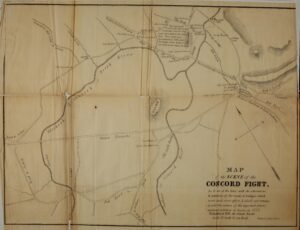
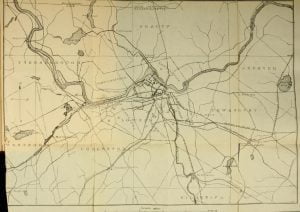
Map of the Scene of the Concord Fight

In this historical address, Josiah Adams commemorates the centennial anniversary of Acton Massachusetts incorporation, transitioning from a municipal chronicle to a fervent defense of the town’s Revolutionary legacy. The first half of the text details the founding of Acton in 1735, tracing the establishment of its church, the evolution of its local school system, and the leadership of early town officials. However, the narrative shifts its focus toward a spirited dispute regarding the Concord Fight of 1775, specifically aiming to correct historical accounts that Adams believes overlook the heroism of Acton’s minute-men. He places Captain Isaac Davis at the heart of the conflict, asserting that Davis and his company intentionally took the lead position in the march to the North Bridge, where the Captain ultimately became one of the first to fall. Through detailed survivor depositions and local records, Adams seeks to reclaim Acton’s rightful place in the national memory, emphasizing that the resistance to British authority was defined by the bravery and ultimate sacrifice of his townsmen.
History of the town of Acton Massachusetts

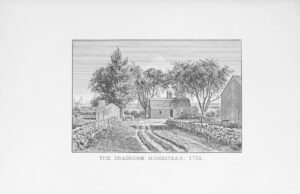
1751 The Brabrook Homestead in Acton Massachusetts

Acton’s story is laid out here as a careful account of how the town grew from a 17th century land grant tied to Concord into an independent community by 1735. Rather than listing events and dates, the author looks closely at the lives of leading families and early freemen, showing how daily concerns shaped the town’s course. The narrative gives special attention to the role of the church, disputes over land and authority during the time of royal governors such as Sir Edmund Andros, and the practical work of putting up meetinghouses and schools in a frontier setting. Drawing on deeds, ministerial agreements, and other early records, and mixing in bits of local tradition such as the tale of the “Count of the Rocky Guzzle,” the book captures something of the character and customs of the period.

Acton Massachusetts Genealogy

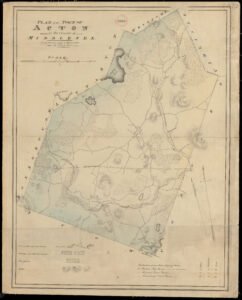
1831 Plan of Acton Massachusetts

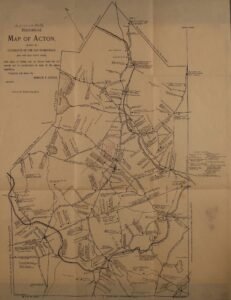
Acton, Massachusetts, was settled in 1639 and incorporated in 1735, previously part of Concord. Originally inhabited by the Nipmuc people, Acton played a vital role in the Revolutionary War, particularly with Captain Isaac Davis and the Acton Minutemen at the Battle of Concord. The Assabet River facilitated early mills, shaping settlement patterns. Genealogical materials, including cemetery, census, church, land, maps, military, newspaper, town, and vital records, as well as multiple history books are available here for free.

Acton Massachusetts Vital Records

1890 Tuttle's Historical Map of Acton Massachusetts

Alphabetical indexes to the vital records of Acton, Massachusetts, up to the year 1850. The Town of Acton, Middlesex County, wasestablished July 3, 1735, from a part of Concord called The Village or New Grant, together with Willard’s Farms. These vital records start about that time and run up to the year 1850. They include transcriptions taken in the early 1900s of the Woodlawn and North Acton cemeteries in Acton and the Mount Hope Cemetery in West Acton. Baptisms, marriages, and burials were also extracted from the First Congregational and the Evangelical Congregational churches in Acton as well as twelve Bibles held in private hands at the time. Free PDF to read or download.

Acton Massachusetts History

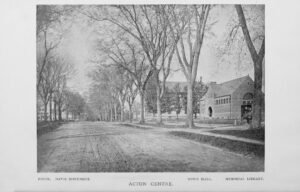
Acton Center,Acton Massachusetts

Acton in History traces the town’s development from its beginnings as Concord Village in the seventeenth century through its emergence as a modest industrial community. It gives particular attention to the religious life of the town, including the building of early meetinghouses and the long ministries of figures such as the Rev. John Swift and the Rev. James T. Woodbury. The work devotes substantial space to Acton’s role in the Revolution, especially the events at the North Bridge in 1775 and the loss of Captain Isaac Davis and his company of minute-men. It also follows the growth of local industries, from blacksmithing and cooperage to the far-reaching effects of the Fitchburg Railroad after its arrival in 1844. Later chapters include brief sketches of notable residents in the 1880s. Throughout, the narrative weaves in discussions of Acton’s everyday life, civic engagement, and social values.

Michael Bacon of Dedham Massachusetts and his descendants

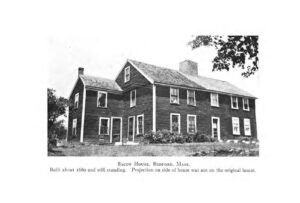
Bacon House in Bedford Massachusetts

This is a genealogy of Michael Bacon of Dedham and his descendants. Michael arrived in Dedham, Massachusetts in 1640 after sailing aboard an unnamed ship, likely from County of Suffolk, England, but possibly from Ireland. Baldwin treats the descendants of each of the three sons of Michael—Michael Jr., Daniel, and John—in a separate chapter, the first chapter being devoted to Michael Sr. and his English roots. The early descendants settled in Bedford, Billerica, Bridgewater, Cambridge, Dedham, Newton, Salem, Watertown, and Woburn Massachusetts.

History of the town of Medford, Massachusetts

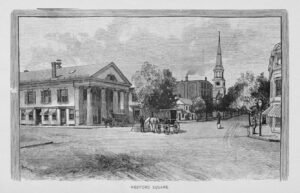
Medford Square about 1850

The History of the Town of Medford, Middlesex County, Massachusetts, from Its First Settlement in 1630 to 1885 (Boston, 1886) represents both a continuation and revision of Charles Brooks’s original 1855 history. Edited and supplemented by James M. Usher, with a genealogical register compiled by William H. Whitmore, this expanded edition incorporates Brooks’s extensive antiquarian research while extending the narrative to cover the developments of the following three decades. Drawing on scattered records, local traditions, and municipal documentation, the work preserves the character of Brooks’s text while providing a fuller account of Medford’s growth and a register of its early families.

Genealogy of John Howe of Sudbury and Marlborough, Massachusetts

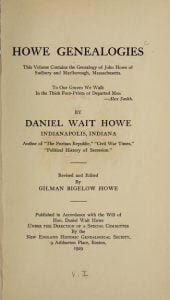
Howe Genealogies volume 1

Howe Genealogies, Volume 1 presents a detailed genealogy of John Howe of Sudbury and Marlborough, Massachusetts. This volume is part of a comprehensive three-volume set compiled by Judge Daniel Wait Howe and published by the New England Historic Genealogical Society in 1929. Volume 1 specifically covers the genealogy of John Howe of Sudbury and Marlborough, Massachusetts. The compilation is notable for its thoroughness and dedication to preserving the history of the Howe family, reflecting Judge Howe’s commitment to documenting his ancestry and contributing to the broader understanding of the Howe family’s heritage.

1919-2015 Malden High School Yearbooks

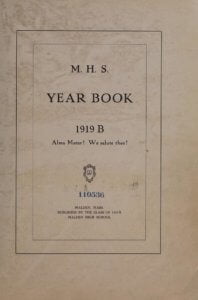
Malden High School 1919 B Yearbook

The Boston Public Library has digitized numerous yearbooks for the high school in Malden, Massachusetts. These yearbook images they have placed online for everyone at Internet Archive. To facilitate your access we have provided links to the individual yearbooks, by year published, oldest to newest. All 105 of these yearbooks, can be read, and/or downloaded for free!

Richardson Genealogy of Attleboro Massachusetts

Old Families of Southeastern Massachusetts

The Richardson family boasts a lineage in Bristol County, Massachusetts, tracing back to Samuel Richardson, who arrived from England in 1636. Samuel played a pivotal role in the early establishment of Woburn, serving as selectman and surveyor. His descendants, including Stephen and William Richardson, eventually settled in Attleboro in the early 18th century. Notably, Henry A. Richardson, a descendant, became a prominent figure in North Attleboro’s jewelry business, with his daughter Linda achieving academic distinction at Brown University and a career in education.

Middlesex County Massachusetts Cemeteries

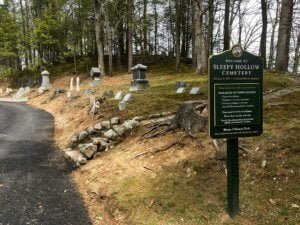
Sleepy Hollow Cemetery, Concord, Massachusetts

A complete listing of all available online Middlesex County Massachusetts cemeteries, with links to multiple cemetery transcriptions, gravestone photos, tombstone photos, official records, etc.

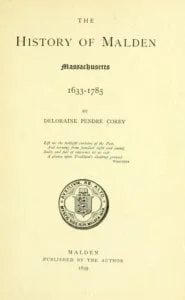
The History of Malden, Massachusetts, 1633-1785

The History of Malden, Massachusetts, 1633-1785

This volume is the result of a careful collection and verification of facts and traditions extending over a period of more than forty-five years. It embraces the history of a New England town to the close of the Revolution — to a time when old customs and systems were disappearing and new forces in political, ecclesiastical, educational, and social affairs were springing into life. It is the story of an elder day and of a life in which much appears that is strange to a later age. If we read it aright we shall better understand our indebtedness to those generations whose labors and trials made possible the freedom and prosperity of the present; and we shall avoid that effusive worship of the fathers which is a fashion rather than the result of a knowledge of the true character of the past in its weaknesses and strength.

Cambridge Massachusetts Directories 1848-1972

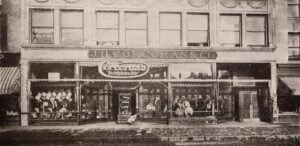
J. H. Corcoran & Co. at 587 Mass Ave., abt 1910

This collection includes 65 directories from Cambridge, Massachusetts, ranging from 1848 to 1972, though it is incomplete. Sourced from the Cambridge Room at the Cambridge Public Library, the directories are accessible online through archive.org for browsing or download at no cost. Each directory typically features lists of city and county officials, schools, churches, hotels, and advertisements, alongside an alphabetical listing of residents and businesses, detailing occupations and addresses.

Ancestors of Samuel Pearly Gates of Bridgewater Massachusetts

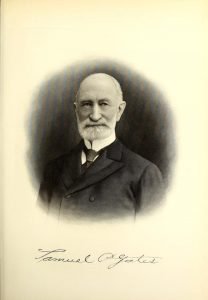
Samuel Pearl Gates

Samuel Pearly Gates, born on June 8, 1837, in Ashby, Massachusetts, has played a pivotal role in Bridgewater’s business and civic development, notably as treasurer and controlling interest of the Eagle Cotton Gin Company. A descendant of Stephen Gates, who arrived in New England in 1638, Samuel’s family has deep roots in the area. He served in the Civil War before establishing a successful career in business and banking. A respected community member, he is connected to various local institutions and remains active in his church and civic duties.

Descendants of Davis Snow Packard of Bridgewater, Massachusetts

Davis Snow Packard, born June 24, 1826, in North Bridgewater, Massachusetts, became a notable manufacturer and public figure in Brockton. He co-founded a successful boot and shoe counter company, which he later expanded. Packard played a significant role in local banking and civic organizations, serving as president of the Brockton National Bank and participating actively in the Brockton Agricultural Society. His public service included roles as selectman and state representative. He passed away on July 31, 1900, leaving a legacy of enterprise and community service.

Lowell Massachusetts Genealogy

1894 Map of Lowell

Tracing ancestors in Lowell, Massachusetts online and for free has been greatly enhanced by the University of Massachusetts in Lowell which provided digitized version of a large quantity of the Lowell public records. Combined with the cemetery and census records available freely online, you should be able to easily trace your ancestors from the founding of Lowell in 1826 through 1940, the last year of available census records. To add color to the otherwise basic facts of your ancestors existence we provide free access to a wide range of manuscripts on the history of Lowell, it’s manufactures and residents.

Lowell Massachusetts Newspaper Archives 1837-1893

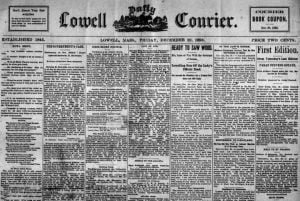
Lowell Daily Courier

The University of Massachusetts at Lowell offers digitized archives of newspapers from Lowell, Massachusetts, spanning 1837 to 1893, including The Lowell Courier and the Lowell Daily Journal and Courier. While these records provide a rich historical resource, some issues are incomplete or damaged. The archives detail numerous editions throughout the years, capturing significant local events and community narratives, though future updates may supplement the existing material.

Lowell Massachusetts Suburban Directories 1896-1926

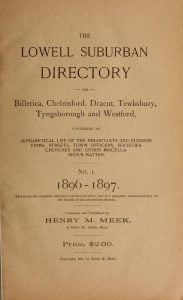
Lowell Suburban Directory for 1896-1897

This post provides information about eight free digitized directories for the Massachusetts towns of Billerica, Chelmsford, Dracut, Tewksbury, Tyngsboro, and Westford, covering the years 1896 to 1926. These directories include alphabetical listings of residents and businesses, as well as details on streets, town offices, and local societies and churches. They serve as valuable resources for understanding individual employment, addresses, and housing situations during those years. The post also mentions various Lowell suburban directory editions from 1896 to 1933.

Lowell Massachusetts City Directories 1832-1985

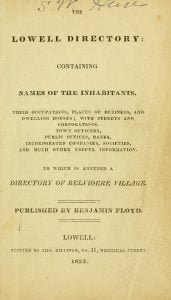
Title page to the 1832 Lowell Massachusetts City Directory

A collection of 50 digitized city directories from Lowell, Massachusetts, spanning 1832 to 1985, is available free of charge. These directories provide insights into residents’ employment, addresses, and living arrangements during the year of publication. Included are specialized editions, such as supplementary directories highlighting female employment in 1836, as well as suburban directories listing inhabitants and businesses from surrounding towns. This resource serves as a valuable tool for understanding the community’s demographic and economic history throughout the years.