
Indian Villages and Towns of Canada

This resource offers an alphabetical compilation of villages, towns, and settlements from Canada, as recorded in the Handbook of American Indians of North America (1908). The listing is ongoing, with the intention to expand it over time. Each letter corresponds to a section dedicated to Canadian Indian villages, towns, and settlements, reflecting the historical presence and significance of these communities.
Indian Tribes of Canada

This post provides an overview of Canadian First Nations, responding to inquiries from readers about the various tribes in Canada. It offers a comprehensive list of Indigenous tribes categorized by province, including Alberta, British Columbia, and more. Many tribes are organized under Tribal Councils, and the use of browser search features is encouraged for finding specific tribes. A selection of notable First Nations is also included, showcasing the diversity and cultural richness of Indigenous peoples in Canada.

Handbook of American Indians North of Mexico

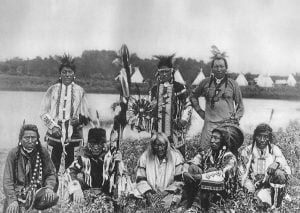
Cree Indians (Saskatchewan)

The Handbook of American Indians North of Mexico offers a detailed examination of tribes from the United States and associated regions. It includes descriptions of linguistic stocks, tribal divisions, and associated histories, designed to aid scholars and the public in identifying tribal names and their origins. Compiled through extensive research by contributors, it addresses the complexities of names assigned by early explorers, while aiming to provide a comprehensive overview of contemporary knowledge of these native groups and their cultures.

Biography of Edward C. Peck

Edward C. Peck, born in Canada in 1834, emigrated to the U.S. and journeyed to California in 1858 via the Santa Fe Trail. His party faced challenges, particularly from Apaches, before retreating safely to the Zuni villages. In 1863, Peck returned to Arizona, securing a hay contract at Fort Whipple and later commanding a squad against Apache forces. As a skilled guide, he contributed significantly to military efforts. He discovered the Peck mine, which initially prospered but ended in litigation, leaving him impoverished at his death in Nogales in 1910.

Biographical Sketch of Banker,Louis

Louis Banker arrived in Russell in 1876, managing a general store owned by G. A. Hart for five years. He later became a partner in Giddings, Banker & Co., which commenced operations on September 14, 1881, with a merchandise stock valued at about $8,000. The partnership included Banker, R. S. Giddings, and M. A. Blaine. Born in 1858 in Belleville, Canada West, Banker moved with his family to Wisconsin in 1864 and later to Cass County, Iowa, before settling in Kansas.

Biographical Sketch of Hart, Q. A.

Q. A. Hart, born April 2, 1825, in Upper Canada, established a general merchandise store in Russell on October 2, 1872, making it the oldest in the area. He constructed the first store building in 1874 and has expanded it over the years. Hart, a veteran of the Civil War, served in the Wisconsin Volunteer Infantry and has held various local government positions. He is also a farmer, landowner, and community leader, actively participating in church and veteran organizations.

Biographical Sketch of Lars C. Henrichsen

Lars C. Henrichsen, born in Denmark in 1839, emigrated to America in 1860 and settled in Portland, Oregon. He began his career as a watchmaker and later became a prominent wholesale and retail jeweler. Henrichsen co-founded L. C. Henrichsen & Co. on Front Street, later moving to First Street, where he built a successful jewelry business recognized for its integrity and quality. Married in 1867, he has three children and is active in the Episcopal Church and Masonic order. He remains the oldest jeweler in Portland.

Biography of Dr. Kenneth A. J. Mackenzie

Dr. Kenneth A. J. Mackenzie, born on January 13, 1859, in Cumberland House, Manitoba, emerged from a notable Scottish lineage. After pursuing his early education in Scotland, he studied medicine at McGill University, later enhancing his skills across Europe. He settled in Portland, Oregon, in 1882, quickly attaining a distinguished reputation in surgery and medicine. Active in professional organizations, he served as president of the Oregon State Medical Association and contributed to medical literature. Married in 1885, he balanced a thriving practice with a commitment to community health and charitable initiatives.

Biography of Donald MacLeay

Donald MacLeay, born in August 1834 in Scotland, immigrated to Canada at sixteen and began his business career at twenty in partnership with George K. Foster. He later co-founded the successful firm Corbitt Macleay in Portland, becoming a prominent merchant and a key player in the region’s economy. He was instrumental in various industries, including salmon canning and real estate, enhancing Portland’s commercial growth. Active in community affairs, he held numerous directorships and was president of the Board of Trade, reflecting his significant influence and commitment to public service.

Original Patentees, not on original farm, Ops, Ontario, Canada

The list details 89 patentee families who are recorded but do not occupy the original farms in Ops, Ontario, Canada. Notable names include Thomas Bell, Philip Bennett, and James Blackwell, among others. The families span various surnames and reflect a diverse group of early settlers, highlighting their contributions to the region’s settlement history while indicating a disconnect from their ancestral land.

Original Patentees, not on original farm Digby Township, Ontario, Canada

In Digby Township, Ontario, Canada, nine original patentees are noted for their continued representation, although not on their original farms. The list includes John Bailey, Alex. McDonald, Andrew McDonald, Daniel McDonald, John McDonald, Neil McDonald, Edward McFadyen, Richard Peel, and Robert Tufts.

Patentee Survivors in Mariposa, Ontario, Canada

The descendants of 22 pioneers from Mariposa, Ontario, continue to hold the original farms established by their ancestors. Each farm is designated by its concession in Roman numerals and lot number in Arabic numerals. Notable names among these patentee survivors include Hugh Cameron, John Campbell, Kenneth Campbell, and William Wright, among others, reflecting a legacy of agricultural heritage that persists in the community today.

Patentee Survivals in Dalton Township, Ontario, Canada

In Dalton Township, Ontario, 24 farms remain in the hands of the original patentee families. The list includes notable names such as Christopher Adams, Thomas Brooks, and John Campbell, along with their respective lots identified by Roman and Arabic numerals. This enduring legacy reflects a deep connection to the land among these families, highlighting the historical significance of agricultural settlement in the region.

Original Patentees, not on original farm, Mariposa, Ontario, Canada

The descendants of 97 patentees originally granted land in Mariposa, Ontario, are now located on different farms. This list includes notable names such as Henry Armitage, Jesse Armitage, and John Black, among others, representing a diverse group of families who have since spread beyond their ancestral lands. The historical significance of these patentees is evident in the continuation of their family lines, although they no longer reside on the original properties awarded by the Crown.

Original Patentees, not on original farm Dalton Township, Ontario, Canada

The list includes 20 patentees who have established farms outside their original holdings in Dalton Township, Ontario, Canada. These individuals are Wm. Adams, Thomas Braden, Samuel Camick, Alexander and James Cathcart, Thomas Cooper, John Dewell, Robert Fleming, Edward Gardiner, James Johnson, Alex. Montgomery, George McLeish, John Oxby, Henry Powell, John Reid, George Sandford, Isaac Snider, and brothers Robert and William Young, along with Angus Snider.

Patentee Survivors in Verulam, Ontario, Canada

The list details 25 patentees in Verulam, Ontario, who remain on their original farms. Each farm is designated by Roman numerals for concessions and Arabic numerals for lots, providing a structured overview of property ownership. Notable individuals include Wm. Brandon, John Davidson, and Thomas Steele, among others, indicating a continuity of landholding and settlement patterns in the area. This record contributes to the understanding of land distribution and historical land use in early Verulam.

4th Regiment of Durham Militia

The 4th Regiment of Durham Militia’s personnel included Lieut. Colonel John Logie as Officer Commanding and Charles Ruttan as second-in-command. The regimental staff comprised several captains, including Edward Davidson and Francis Henderson, alongside a team of lieutenants and ensigns, such as Samuel Cottingham and Charles Hamilton, respectively. This diverse assembly of officers reflects the structured leadership within the regiment during its operational period.

Original Patentees, not on original farm, Verulam, Ontario Canada

The descendants of 40 original patentees, including notable figures such as David Ball and Thomas Beatty, continue to reside in Verulam, Ontario, although they are no longer on the farms originally assigned to their ancestors. This heritage is reflected in the ongoing presence of families like the Junkins, Longs, and Thompsons in the township.