The Eastern Cherokee Domain and the Guion-Miller Applications
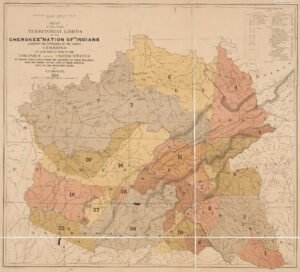
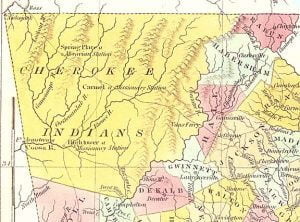
Map of Cherokee Land Cessions

The Guion-Miller Commission did not decide Cherokee eligibility based on ancestry alone, but on descent from the treaty-era Cherokee tribal body tied to the Eastern Cherokee Domain. Applicants had to prove residence, enrollment, or continued association with recognized Cherokee communities through rolls, testimony, and affidavits. Many claims failed because family tradition was not enough.
Guion-Miller Cherokee Enrollment and Burned County Record Losses

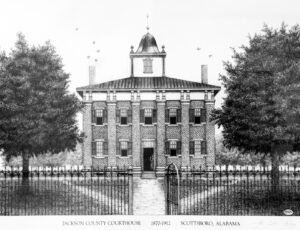
1870-1912 Jackson County, Alabama Courthouse

A guide to the record losses that complicate Guion Miller applications for Eastern Cherokee enrollment, this article explains how applicants had to prove descent from the 1835 Henderson Roll or residence in the Cherokee domain. It highlights burned counties across Alabama, Georgia, North Carolina, and Tennessee where courthouse fires and Civil War destruction erased vital marriage, deed, probate, and tax records.

1819 Cherokee Reservation List

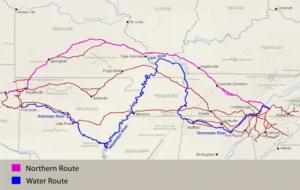
Map of the principal routes taken by Cherokee removal parties in the late 1830s.

This specific roll is of a list of 146 heads of families entitled to reservations under the Treaty with the Cherokee of the 27th February, 1819.

Cherokee Muster Rolls, 1835 – 1838

1830 Map of Cherokee Territory in Georgia

The Cherokee Muster Rolls of 1835-1838 document the forced relocation of the Cherokee people during the Trail of Tears. These rolls list families who were moved west, including those who left voluntarily, were rounded up by military forces, or migrated under Cherokee leadership. They offer crucial genealogical information for descendants of Cherokee individuals from the southeastern U.S., particularly those connected to the Cherokee Nation and the Eastern Band. These records, like the 1835 Henderson Roll and various muster rolls, are important for researchers tracking Cherokee ancestry during this difficult chapter in American history.

1838 Cherokee Muster Roll 1

The muster roll details the arrival of Lt. Deas and a large group of Cherokees to the West on May 1, 1838. While most were in the Northern Georgia area, some like William Davis and Robert Brown were from Alabama, and others like the Timberlake’s were from Tennessee.

Slave Narrative of Walter Calloway

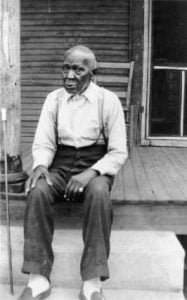
Walter Calloway

Walter Calloway, an 89-year-old former slave, reflects on his life during an interview in Birmingham, Alabama, in 1937. Born in Richmond, Virginia, in 1848, he recounts being sold to a plantation owner in Montgomery, where he faced hard work but relatively fair treatment. He describes witnessing the Civil War’s impact and the destruction caused by Union raiders. Although emancipation brought freedom, he notes that many former slaves, including himself, continued to work just as hard under difficult circumstances. Calloway’s narrative captures the resilience and hardships of ex-slaves.

Slave Narrative of Charity Anderson

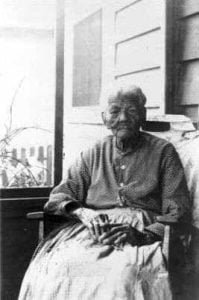
Charity Anderson, age 101

Charity Anderson, a 101-year-old former slave, recounts her life in Monroe County, Alabama, during the antebellum period. Born at Belles Landing, she describes her experiences under the care of Mr. Leslie Johnson, her white owner, whom she remembers as kind. Despite her frail health, Aunt Charity shares fond memories of her youth and duties in the Johnson household. She contrasts her past with the present, lamenting the loss of respect and manners in today’s society while expressing gratitude for her well-being and community support.

The Occupation Of Alabama And Mississippi By The English

History of Alabama and incidentally of Georgia and Mississippi, from the earliest period

Following France’s cession of its North American territories, it secretly transferred west Mississippi lands to Spain before yielding its eastern Louisiana possessions, including Mobile, to England. The British established West Florida, encompassing large parts of present-day Alabama and Mississippi, governed primarily through military rule. Under governors like Captain George Johnstone and later Peter Chester, the region saw tensions with local populations, including French settlers and Native Americans, as well as significant economic activities despite health issues and environmental challenges.

Bossu’s Visit To The French Forts Upon The Alabama And Tombigby Rivers

History of Alabama and incidentally of Georgia and Mississippi, from the earliest period

Captain Bossu, dispatched by Governor Kerlerec from New Orleans, reached Fort Toulouse after a lengthy journey up the Alabama River. He encountered Creek and Alabama tribes, noting their prosperity and peaceful relations. The fort’s command saw tensions with Jesuit missionaries, highlighted by a scandal involving a complaint against the fort’s commander, Montberaut. Bossu’s detailed account also described interactions with local leaders, the hospitality of the tribes, and the changing landscape due to colonial expansion, foreshadowing the eventual transfer of Louisiana to British control.

Alabama Funeral Home Records

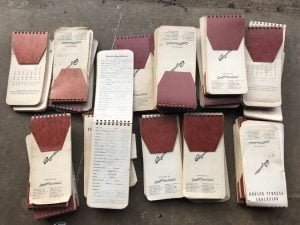
Funeral Log Books

This page links to known Alabama Funeral Records whether they be available online or offline. Funeral records are an invaluable source of genealogical information that can provide insight into the lives and deaths of our ancestors. They offer a wealth of details on the deceased and their family, including their names, ages, dates of death, causes of death, and other key information. While funeral records can be found in a variety of places, genealogists must be careful when interpreting the information they contain, paying close attention to accuracy and cultural context. By using funeral records in their research, genealogists can gain a deeper understanding of their ancestors and build a more complete picture of their family history.

Revolutionary War Pension and Bounty Land Warrants

Civil War Cannon

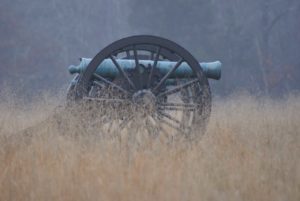
This article helps you access the Revolutionary War Pension and Bounty Land Warrants for free. Following two simple steps, one to search, and the other to browse the actual microfilms, you can quickly find your ancestors Revolutionary War pension record, or Bounty-Land record and download the images. During 1800-1900 the United States issued more than 80,000 pensions and bounty-land-warrants to soldiers of the Revolutionary War, their spouse, or their children. Was your ancestor one of them?

Marriage Records of Shelby County, Alabama – 1885-1905

This is a series of record extracts which Don Thompson published by the Shelby County Historical Society in Columbiana, Alabama. While the series covers the years of 1824-1905, only the years of 1885-1905 are currently included online.

Baylor & Shortridge Receipt Book, 1822-1835

The Baylor & Shortridge Receipt Book documents court judgments from 1822 to 1835 in Tuscaloosa County, Alabama, reflecting the legal activities of attorneys Hiram Shortridge and Robert Emmett Bledsoe Baylor, who co-founded their firm in 1822. Both men originated from Kentucky, with Baylor later lending his name to Baylor University. The book is a photocopy of the original manuscript, lacking pagination and a table of contents, with some text lost due to binding damage.

Alabama Online Historical Newspapers

Winchester Star

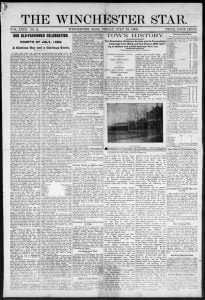
Alabama has a rich newspaper history, with over 2,300 titles published since the first newspaper, the Mobile Centinel, in 1811. Currently, the availability of online historical newspapers is limited, primarily due to insufficient digitization efforts. While Newspapers.com holds over 500 digital collections, many require paid subscriptions. Significant efforts by the Alabama Department of Archives and History have digitized Civil War-era papers, but accessibility and quality can vary. Researchers are encouraged to explore neighboring counties if their own lack online historical newspapers.

Bessemer High School Yearbooks

1925 The Kalista, Bessemer High School Yearbook, Bessemer, Alabama

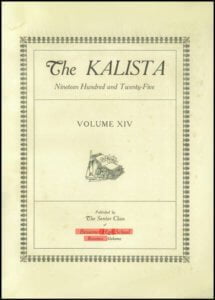
The Birmingham Public Library Digital Collection offers access to 12 volumes of Bessemer High School yearbooks, spanning from 1925 to 1963, albeit not exhaustively. These can be freely read and downloaded through links organized by year, with titles consistently named “The Kallista.” This collection provides a unique window into the history of Bessemer High School and its community during these decades.

Bessemer Academy Yearbooks, Bessemer, Alabama

1973 Reflections, Bessemer Academy, Bessemer, Alabama

The Birmingham Public Library Digital Collection offers access to 27 volumes of Bessemer Academy yearbooks, spanning from 1972 to 2006. While not comprehensive, these yearbooks are available for free reading and downloading. The collection is organized by publication year, allowing users to explore the unique reflections and memories captured within each issue.

Berry High School, Birmingham, Alabama Yearbooks

1966 Caravel, Berry High School Yearbook, Birmingham, Alabama

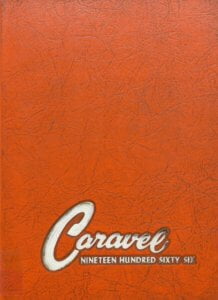
The Birmingham Public Library Digital Collection features ten volumes of Berry High School yearbooks, spanning from 1966 to 1986, although not every year is represented. Each yearbook, titled “Caravel,” is available for free online, allowing users to read and download individual pages. Access is organized chronologically, ensuring easy navigation through these historical records of Berry High School in Birmingham, Alabama.

Banks High School, Birmingham, Alabama Yearbooks

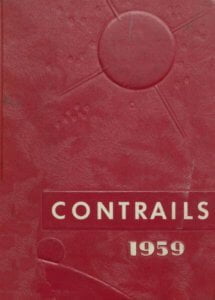
1959 Contrails, Banks High School Yearbook, Birmingham Alabama

The Birmingham Public Library Digital Collection includes 23 volumes of yearbooks from Banks High School in Birmingham Alabama. These yearbooks cover the years of 1959-1989, and are not all inclusive. To facilitate your access we have provided links to the individual yearbooks below, by year published, oldest to newest. All 29 of these yearbooks, can be read, and/or their individual pages downloaded.

Autauga County, Alabama Biographies

Biographical records for notable individuals from Autauga County, Alabama, can be accessed through Alabama Genealogy and USGenWeb Archives. Among those featured are Dr. John W. Davis, Col. Charles S. G. Doster, Hon. Daniel Pratt, and others, including judges, military officers, and local leaders. This compilation serves as a valuable resource for understanding the county’s historical figures and contributions.

United States Bureau of Land Management Tract Books, 1800-c. 1955

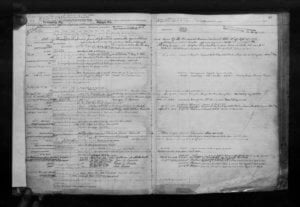
record-image_3QS7-89W3-39QL-W

3,907 land management tract books containing official records of the land status and transactions involving surveyed public lands arranged by state and then by township and range. These books indicate who obtained the land, and include a physical description of the tract and where the land is located. The type of transaction is also recorded such as cash entry, credit entry, homesteads, patents (deeds) granted by the Federal Government, and other conveyances of title such as Indian allotments, internal improvement grants (to states), military bounty land warrants, private land claims, railroad grants, school grants, and swamp grants. Additional items of information included in the tract books are as follows: number of acres, date of sale, purchase price, land office, entry number, final Certificate of Purchase number, and notes on relinquishments and conversions.