Medway Massachusetts vital records

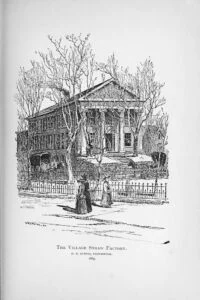
Medway Village Straw Factory

Alphabetical indexes to the vital records of Medway, Massachusetts, up to the year 1850, supplemented by information from church registers, cemetery inscriptions and other private sources to include Rev. Dr. Jacob Ide’s account of Marriages and Deaths, 1814-1849.

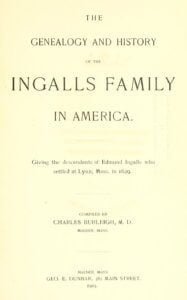
The genealogy and history of the Ingalls family in America

The genealogy and history of the Ingalls family in America

Edmund Ingalls, son of Robert, was born about 1598 in Skirbeck, Lincolnshire, England. He immigrated in 1628 to Salem, Massachusetts and with his brother, Francis, founded Lynn, Massachusetts in 1629. He married Ann, fathered nine children, and died in 1648.

Richard Dexter Genealogy, 1642-1904

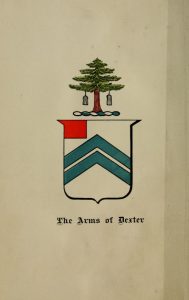
Arms of Dexter

Being a history of the descendants of Richard Dexter of Malden, Massachusetts, from the notes of John Haven Dexter and original researches. Richard Dexter, who was admitted an inhabitant of Boston (New England), Feb. 28, 1642, came from within ten miles of the town of Slane, Co. Meath, Ireland, and belonged to a branch of that family of Dexter who were descendants of Richard de Excester, the Lord Justice of Ireland. He, with his wife Bridget, and three or more children, fled to England from the great Irish Massacre of the Protestants which commenced Oct. 27, 1641. When Richard Dexter and family left England and by what vessel, we are unable to state, but he could not have remained there long, as we know he was living at Boston prior to Feb. 28, 1642.

Descendants of Alexander Bisset Munro of Bristol, Maine

Munro Family

Alexander Bisset Munro was born 25 Dec. 1793 at Inverness, Scotland to Donald and Janet (Bisset) Munro. Alexander left Scotland at the age of 14, and lived in Dimecrana in the West Indies for 18 years. He owned a plantation, raising cotton, coffee and other produce. He brought produce to Boston Massachusetts on the ship of Solomon Dockendorff. To be sure he got his money, Solomon asked his to come home with him, where he met Solomon’s sister, Jane Dockendorff. Alexander went back to the West Indies, sold out, and moved to Round Pond, Maine, and married Jane. They had 14 children: Janet, Alexander, Margaret, Nancy, Jane, Mary, Solomon, Donald, John, William, Bettie, Edmund, Joseph and Lydia.

Biography of Reverend Samuel Goddard

Samuel Goddard, born in Sutton, Massachusetts, on July 6, 1772, faced limited educational opportunities and initially worked in trade before pursuing a religious vocation. Studying under Doctor Seth Payson, he was ordained in 1809 as pastor of a small church in Concord, Vermont, where he expanded the congregation significantly and established missionary work. In 1822, he became pastor of the North Congregational Church in Norwich, Vermont, growing its membership and promoting community welfare. Goddard was known for his devotion, despite personal losses and health challenges, leaving a lasting impact on his community.

History of the Merchants of Norwich VT

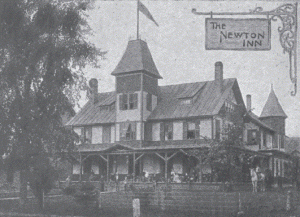
Newton Inn, Vermont

Peter Olcott operated a store in Norwich during the Revolutionary War, followed by Stephen Burton and Ichabod Marshall, early merchants who later moved west. The late 18th and early 19th century saw various merchants such as George Woodward, William Little, and Elias Lyman establishing businesses in the region. The mercantile landscape evolved with partnerships and new firms, including the Olds, Newton, and Lyman firms, adapting through various challenges, such as fires, until the late 19th century, reflecting Norwich’s commercial development.

Migration of Families out of Norwich VT

In the late 18th and early 19th centuries, Norwich, Vermont, experienced significant emigration, leading to a notable decline in its population. Initially home to 40 families in 1771, the town saw many residents relocate to newer settlements, such as Royalton and Randolph, during and after the Revolutionary War. Prominent families, including the Hibbards and Carpenters, contributed to the establishment of towns in northern Vermont and beyond. By the 1800s, the trend of outmigration intensified, marking a long-term shift in the region’s demographic landscape.

History of Norwich Vermont Education

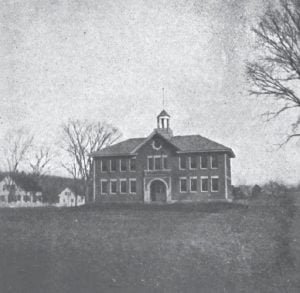
High School Building, Norwich Village, Erected in 1898

The history of education in Norwich, Vermont, traces back to efforts in 1782 to establish school districts. The first successful division occurred in 1785, creating the First School District. Over the years, multiple districts were formed, with the establishment of a committee for school supervision in 1824. Notable developments included the construction of a brick schoolhouse in 1845 and the incorporation of the Norwich Classical and English Boarding School in 1867, although it ultimately closed in 1877. The town’s education framework evolved significantly, culminating in a unified system in 1892.

Norwich Vermont in the Revolutionary War

Norwich, Vermont provided modest participation in the Revolutionary War, highlighted by its formation of a Committee of Safety in March 1777. Evidence suggests a militia was established as early as 1774. The town contributed to regiments under Colonels Warner and Bedell. Local militias organized for defense amid threats from British forces in 1776, further demonstrating Norwich’s involvement. Despite lacking comprehensive records, the enlistment of local soldiers was significant, along with efforts to protect the community from loyalist activities and contribute to the war effort.

Church History of Norwich Vermont

The first generation of Norwich settlers accomplished a significant community milestone by constructing a meeting house for public worship within a decade of settlement. This project involved the entire community, showcasing their determination despite limited resources. A committee ultimately selected the location after significant debate, with the cornerstone laid in 1778. Delays due to the Revolutionary War slowed progress, but by 1785, the building was completed and became a site for various civic activities, including sessions of the Vermont Legislature. The meeting house served the town until 1817 when a new structure was erected due to growing needs.

The Ministerial Act of Vermont

The Ministerial Act, enacted by Vermont’s legislature in October 1783, mandated local taxation for building meeting houses and supporting ministers. In 1785, Norwich decided to assume the cost of its meeting house via taxation, raising £694 from its citizens. This tax, payable in various forms, equalized expenses for all, regardless of prior contributions. The meeting house became a town property, leading to new seating arrangements based on age and contribution. The Act remained until 1801, fostering a unified religious practice among Norwich’s residents.

First Settlements in Norwich Vermont

The early settlement of Norwich, Vermont, began in 1762 when Samuel Slafter’s son, John, explored the area, reporting its fertile land and water sources. In 1763, after receiving his father’s rights, he commenced clearing lots but faced challenges, as his initial choice proved unsuitable. By 1765-66, a few families settled permanently, including the Hutchinsons and Manns, establishing homes and farms. Pioneers endured various hardships, yet they built foundations for a thriving community, characterized by a homogeneous population primarily from Connecticut.

Biography of Albert Henry Warren Stimson

Albert Henry Warren Stimson, born in Palmer, Massachusetts, in 1873, evolved from a successful contractor to a prosperous farmer in Northampton, where he has been active in community affairs since 1909. He descends from a distinguished New England family with roots tracing back to the Colonial era. Stimson’s career included notable construction projects and significant roles in local government, such as serving on the City Council. He married Sarah E. Kingsley in 1895 and has three children, continuing the family’s legacy in the region.

Biography of Ansel Clark Ernest Stimson

Ansel Clark Ernest Stimson, born in Northfield, Massachusetts, in 1858, was the son of Lucius Stimson and Lucia Ann Clark. After being educated in local schools, he engaged in farming, lumbering, and shoemaking before becoming a foreman in a shoe factory. In 1898, he established a successful insurance business in Greenfield, which was incorporated in 1924. Active in civic and political life, Stimson was involved in various community organizations. He married Julia Marie Chapin, and they had one son, Myron Chapin Stimson, who later joined him in business.