History of Carbondale, Illinois, 1852-1905
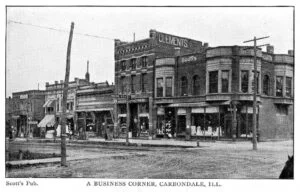
A Business Corner, Carbondale

Carbondale, Illinois, spans about 6,000 acres, primarily in the southwest quarter of Carbondale Township, established following congressional guidelines. Early settlers settled near Little Crab Orchard and Piles Fork creeks. The city’s growth is intertwined with the contributions of its founders, highlighted through 330 biographical sketches in the book, which offer details into their lives during challenging times. Carbondale’s history reflects the influence of individual leadership on municipal progress, celebrated here in the context of the nation’s bicentennial.

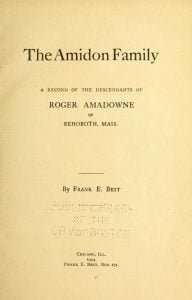
The Amidon Family of Rehoboth, MA

The Amidon Family

The Amidon Family genealogy book details the lineage of Roger Amadowne, a French Huguenot who fled to England and later to America after the revocation of the Edict of Nantes. Documented in Salem, Massachusetts in 1637, variations of his surname include Amadon, Amidown, and Ammidon. The work, organized with biographical sketches and two helpful indexes, presents the family’s history and is richly illustrated. Originally published in 1904, it serves as a valuable resource for descendants and historians alike.

A Genealogy of the Lake Family

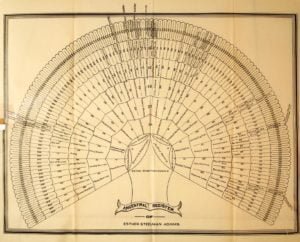
Ancestor Register of Esther Steelman Adams

A genealogy of the Lake family of Great Egg Harbour in Old Gloucester County in New Jersey : descended from John Lade of Gravesend, Long Island; with notes on the Gravesend and Staten Island branches of the family. This volume of nearly 400 pages includes a coat-of-arms in colors, two charts, and nearly fifty full page illustrations – portraits, old homes, samplers, etc. The coat-of-arms shown in the frontspiece is an unusually good example of the heraldic art!

Narrative of the Sufferings of Peter Williamson – Indian Captivities

Not for the faint of heart or stomach, this is a graphically descriptive recounting of the captivity of Peter Williamson, who was taken by the Delaware Indians, at his own house near the forks of the Delaware in Pennsylvania. Of all the sufferings reported by captives, this particular account appears to go above and beyond the usual descriptions, almost to the point of unbelievability – because in this case, he doesn’t simply report the acts of cruelty, but vividly describes them in the most horrid fashion, even to claim the Delaware committed cannibalism on one of their captives, and then explaining how they did it.

Ridgelawn Memorial Cemetery – Oxford Michigan

This cemetery record from Oxford, west of Burdick Street, lists hundreds of burials collected in September 2001 by Christopher Schnur. The transcription includes names, birth and death dates, military service, family relationships, and epitaphs, offering a detailed historical snapshot of local families, veterans, children, and spouses buried in the cemetery.

Biographical Sketch of H. F. Snider

H. F. Snider, born on July 18, 1843, in Warrick County, Indiana, moved to Tama County, Iowa, in 1862 after marrying Nancy Moses. Following her death, he wed Harriet E. Watts in 1866, who also passed away, leaving him with four children. Snider relocated to Nebraska in 1872 and married Mary E. Heacock in 1877. A prominent Republican and community leader, he served as Neoma’s Postmaster and Justice of the Peace. Snider operates a general merchandise business and manages a 160-acre farm.

Biography of Dr. James Snider

Dr. James Snider, born September 14, 1808, in Blount County, Tennessee, was a significant early settler of Carter County, Missouri. He came to the area in 1836, witnessing its development over decades. Initially a blacksmith and farmer, he became a self-taught physician, practicing medicine until his later years. Active in community affairs, he served as probate judge and helped establish a local Baptist church. A Democrat, he has been respected in his community and is the father of two, with many descendants.

Biographies of the Cherokee Indians

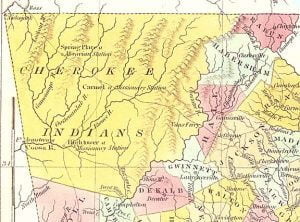
1830 Map of Cherokee Territory in Georgia

The Cherokee Indians, primarily from the Southeastern U.S., have a rich history marked by their early adoption of a written language and a government structure similar to that of the United States. Despite their forced relocation to Oklahoma in the 1830s, they maintained significant genealogical ties, often intermarrying with Whites. Emmet Starr’s “History of the Cherokee Indians and Their Legends and Folklore” emphasizes personal biographies and genealogies, providing insights into the lives and connections of many Cherokee families across generations, thereby enriching their cultural narrative.

Biography of Elbert Jacob Snider

Elbert Jacob Snider, born September 29, 1888, in Delaware District, was the son of Andrew Johnson and Cynthia Snider. He married Martha Elizabeth Daniels on September 26, 1912, and they had two children, Genevieve and Elbert Jacob. An educated man from Grove and Male Seminary, Snider was part of a notable lineage, being a great-great-grandson of Richard Fields, Chief of the Texas Cherokee. His family included several siblings and in-laws, reflecting a rich connection to the local community and its history.