Vital Records of Bellingham, Massachusetts

Vital Records of Bellingham Massachusetts to the year 1850

Alphabetical indexes to the vital records of Bellingham, Massachusetts, up to the year 1850, supplemented by information from bible records, church registers, cemetery inscriptions and other private sources to include the diary kept by Samuel Wight and his daughters.

History of Adair County Iowa and its People – vol 2

History of Adair County, Iowa, and its people vol 2 title page

Back in 1915, Lucian Moody Kilburn, was engaged to write a history of Adair County Iowa by the Pioneer Publishing Company of Chicago Illinois, he then being at that time a resident of the county for 50 years. The manuscript was divided into two volumes. This volume, numbered 2, provides biographical sketches of 348 leading men and women of the County of Adair including many of its founding families. You can read or download the free eBook from this website.

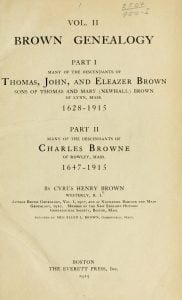
Brown Genealogy

Brown Genealogy

In 1895, Cyrus Henry Brown began collecting family records of the Brown family, initially with the intention of only going back to his great-grandfathers. As others became interested in the project, they decided to trace the family lineage back to Thomas Brown and his wife Mary Newhall, both born in the early 1600s in Lynn, Massachusetts. Thomas, John, and Eleazer, three of their sons, later moved to Stonington, Connecticut around 1688. When North Stonington was established in 1807, the three brothers were living in the southern part of the town. Wheeler’s “History of Stonington” contains 400 records of early descendants of the Brown family, taken from the town records of Stonington. However, many others remain unidentified, as they are not recorded in the Stonington town records. For around a century, the descendants of the three brothers lived in Stonington before eventually migrating to other towns in Connecticut and New York State, which was then mostly undeveloped. He would eventually write this second volume of his Brown Genealogy adding to and correcting the previous edition. This book is free to search, read, and/or download.

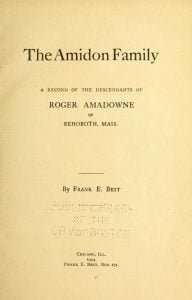
The Amidon Family of Rehoboth, MA

The Amidon Family

The Amidon Family genealogy book details the lineage of Roger Amadowne, a French Huguenot who fled to England and later to America after the revocation of the Edict of Nantes. Documented in Salem, Massachusetts in 1637, variations of his surname include Amadon, Amidown, and Ammidon. The work, organized with biographical sketches and two helpful indexes, presents the family’s history and is richly illustrated. Originally published in 1904, it serves as a valuable resource for descendants and historians alike.

1st Mississippi Light Artillery

The 1st Mississippi Light Artillery, also known as Withers’ Light Artillery, comprised several companies raised across Mississippi, participating in key battles during the Civil War. Initially assembled in May 1862, the regiment played a crucial role in the defense of Vicksburg against Union forces, with notable contributions at Chickasaw Bayou and the Vicksburg campaign. Throughout its service, the artillery faced significant casualties and challenges, ultimately surrendering at Vicksburg in July 1863. Afterward, surviving members regrouped as infantry before continuing their service in various capacities.

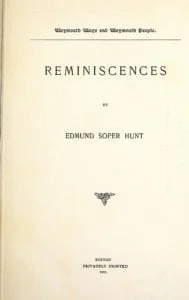
Weymouth ways and Weymouth people

Weymouth ways and Weymouth people

Edward Hunt’s “Weymouth ways and Weymouth people: Reminiscences” takes the reader back in Weymouth Massachusetts past to the 1830s through the 1880s as he provides glimpses into the people of the community. These reminiscences were mostly printed in the Weymouth Gazette and provide a fair example of early New England village life as it occurred in the mid 1800s. Of specific interest to the genealogist will be the Hunt material scattered throughout, but most specifically 286-295, and of course, those lucky enough to have had somebody “remembered” by Edward.

Allen Genealogy of New Bedford Massachusetts

In March 1635, George Allen and his family sailed from England to New England with Rev. Joseph Hull, settling initially in Weymouth before moving to Sandwich, Massachusetts. As a yeoman farmer, he became involved in local governance, serving as constable and deputy to the General Court. George’s descendants include prominent figures in Old Dartmouth, with familial branches spreading throughout Massachusetts and beyond. The Allen family navigated challenges of religious intolerance while establishing their legacy, and their story reflects the broader historical tapestry of early New England settlements.

Descendants of Philip Taber of New Bedford, MA

Philip Taber, born in 1605 and passed in 1672, was an early settler of New Bedford, MA, with a distinguished public service record, including roles as a deputy and representative. He had two wives, Lydia Masters and Jane, and fathered several children, including Thomas Taber, who continued the family legacy through civic duties in Dartmouth. The Taber lineage expanded with Joseph and Benjamin Taber, leading to notable descendants like Edward Smith Taber, who achieved success in various industries, including the Morse Twist Drill Company.

Barker Genealogy of Tiverton, RI

The Barker family of Tiverton, Rhode Island, traces its roots to Robert Barker, born in 1616, who settled in New England early on. He purchased land in 1641 and later became a surveyor in Duxbury. His descendants included Isaac Barker, a businessman and surveyor, and Prince Barker, known for his hospitality. The family flourished over generations, with members involved in various enterprises, including mills and banking. Notable descendants include Benjamin Barker and his son Abraham, who furthered the family legacy through successful careers and numerous offspring.

Descendants of Peter Crapo

William W. Crapo

The Crapo family has long been associated with exemplary citizenship, especially in New Bedford and Michigan. Peter Crapaud, a French shipwreck survivor from the 1680s, founded the lineage, which includes notable figures like Henry Howland Crapo, who rose from humble beginnings to become Governor of Michigan. His son, William Wallace Crapo, also made significant contributions as a lawyer, politician, and community leader. Their dedication to public service and agriculture has left a lasting legacy reflecting the family’s New England roots and commitment to civic duty.

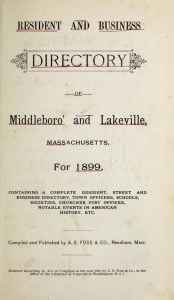
1899 Directory for Middleboro and Lakeville Massachusetts

1899 Middleboro and Lakeville Massachusetts Directory Cover

The 1899 Directory for Middleboro and Lakeville, Massachusetts, compiled by A. E. Foss & Co., provides a comprehensive list of residents and businesses, alongside town officers, schools, churches, and societies. It includes notable historical events and offers a detailed account of the local community, featuring numerous surnames from both towns. This directory serves as an essential resource for understanding the demographics and social structure of Middleboro and Lakeville during that period.

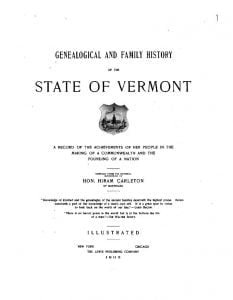
Genealogical and Family History of Vermont

Genealogical and Family History of the State of Vermont vol 1

Hiram Charlton took on the publication of the Genealogical and Family History of the State of Vermont for Lewis Publishing. In it, he enlisted the assistance of living residents of the state in providing biographical and genealogical details about their family, and then he published all 1104 family histories in two distinct volumes.

Biographical Sketch of Milton Russell Slocum

Milton Russell Slocum was born on August 4, 1859, in Lyendonville, New York, and moved to Ohio at age four. Educated in Osborn public schools, he began his career as a music salesman in Dayton at just 17. Slocum opened a successful music store in Cleveland in 1897. He married Minnie M. Walsh in 1889, with whom he had a daughter, Lucile. An active member of various organizations, he also had a deep understanding of piano manufacturing and embraced Christian Science.