Vital records of Stratham, New Hampshire, 1700-1867

Plan of the Town of Stratham

In 1934, Priscilla Hammond compiled vital records from Stratham, New Hampshire, covering the years 1700 to 1867, based on original town records. This compilation, transcribed with imperfect typing, was privately published and distributed to libraries and societies. The records are presented largely as found, with family members often grouped together. An index is included to assist in locating individual records. Users should be cautious with dates, especially those before 1752, as it is unclear if old dates were converted.

New Hampshire State Builders

Birthplace of George Franklyn Willey in the Summer

State Builders, published in 1903, serves as a historical and biographical account of New Hampshire at the turn of the twentieth century. Authored by local writers, it covers the state’s development across various sectors including politics, education, and industry, while documenting the lives of notable residents. The volume reflects both continuity and change in the state’s traditions, making it a valuable reference for understanding New Hampshire’s institutions and influential figures during this pivotal period.

History of Francestown New Hampshire

Map of Francestown New Hampshire

History of Francestown, New Hampshire is a historic and genealogical record of the town from its first settlement in 1758 through the beginning of 1891. It records Francestown’s settlement, civic growth, religious and educational institutions, military participation, industries, and social customs, followed by an extensive genealogical register of families associated with the town.

History of Hampton New Hampshire vol 2

1892 Map of Hampton NH

The original version of this monumental work was published in 2 volumes. Volume 1 contains the history of the town of Hampton, New Hampshire from its settlement in 1638 to the autumn of 1892 and can be found here. Volume 2 featured the genealogical and biographical details of the early families of Hampton, NH up to the autumn of 1892 and this is the volume shown below. This manuscript was meticulously researched by Joseph Dow up until his death in 1889. Unfortunately his death preceded the final compilation of the genealogies and his daughter, Lucy Ellen Dow, took on the task after his decease. For genealogists this is an important fact. Lucy admits in her preface that she had difficulty bringing the genealogies down to date (1892) for lack of full understanding of Josiah Page’s notes and for the lack of accurate town records. As she laments about the town records “but whole decades are passed over with scarcely an entry of birth or marriage.” Indeed they are.

History of Chester, New Hampshire, including Auburn

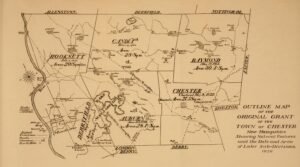
Outline map of the Original Grant of the town of Chester New Hampshire

The *History of Chester, New Hampshire, Including Auburn* by John Carroll Chase, published in 1926, serves as a supplement to the original 1869 *History of Old Chester*. This work was produced in response to a desire to document events that had occurred in the town since the previous publication, as well as to cover topics that were initially omitted. While Chester had seen a decline in population and industrial activity, the book highlights notable historical and social developments. It incorporates additions to military history, church records, and gravestone inscriptions, providing a comprehensive overview of Chester and Auburn’s past.

History of old Chester from 1719 to 1869

History of Old Chester title page

The *History of Old Chester from 1719 to 1869* by Benjamin Chase, published in 1869, offers a detailed account of the early settlement and development of Chester, New Hampshire. Compiled with the assistance of local historian Judge Samuel D. Bell, the book explores the town’s founding, genealogies, and significant events, using primary sources such as deeds, probate records, and personal diaries. Chase aimed to preserve the history and traditions of Chester’s early settlers while providing a comprehensive record for future generations. The work covers a broad range of topics, including religious, military, industrial, and genealogical history.

The genealogy and history of the Ingalls family in America

The genealogy and history of the Ingalls family in America

Edmund Ingalls, son of Robert, was born about 1598 in Skirbeck, Lincolnshire, England. He immigrated in 1628 to Salem, Massachusetts and with his brother, Francis, founded Lynn, Massachusetts in 1629. He married Ann, fathered nine children, and died in 1648.

Carter Genealogy of Blue Hill, Maine

Historical Sketches of Bluehill Maine

The post recounts the genealogy of the Carter family in Blue Hill, Maine, beginning with James Carter, Sr., who settled there around 1770. His children, notably James Jr. and David, contributed to the family’s growth, with James Jr. marrying twice and having numerous descendants. The narrative details various branches of the family, including the offspring of James, David, and other family members, highlighting their contributions to local agriculture and community life. The post ultimately emphasizes the industrious nature and historical significance of the Carter lineage.

Genealogical and Family History of Vermont

Genealogical and Family History of the State of Vermont vol 1

Hiram Charlton took on the publication of the Genealogical and Family History of the State of Vermont for Lewis Publishing. In it, he enlisted the assistance of living residents of the state in providing biographical and genealogical details about their family, and then he published all 1104 family histories in two distinct volumes.

Biographies of the Cherokee Indians

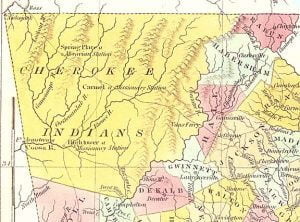
1830 Map of Cherokee Territory in Georgia

The Cherokee Indians, primarily from the Southeastern U.S., have a rich history marked by their early adoption of a written language and a government structure similar to that of the United States. Despite their forced relocation to Oklahoma in the 1830s, they maintained significant genealogical ties, often intermarrying with Whites. Emmet Starr’s “History of the Cherokee Indians and Their Legends and Folklore” emphasizes personal biographies and genealogies, providing insights into the lives and connections of many Cherokee families across generations, thereby enriching their cultural narrative.

Biography of William Q. Elliott

William Q Elliott

William Q. Elliott, born in February 1837 in Indiana, was a prominent pioneer in Rice County, Kansas, in the 1870s. As a successful farmer and businessman, he had a significant impact on his community, promoting religion and morality while raising a large family. Elliott contributed to agriculture and forestry in Kansas, developing extensive lands and orchards. He co-founded the Rice County Bank and remained active in community service, particularly with Friends University in Wichita. His legacy includes over 100 descendants and a dedication to public service.

Biographical Sketch of Mrs. Minnie Sleeper

Lucile Jackson, born on August 7, at Tanglewood, was educated locally and married Gideon Daniels Sleeper on June 27, 1894. They had five children: Julia, Gideon, Walter, Martha, and Minnie. Gideon Sleeper served as Commissioner in 1909 and was re-elected in 1910-12. Lucile descends from the Cordery family, which traces its lineage to Souchville-Cordery, who accompanied William the Conqueror to England. Her maternal lineage is connected to the Cherokee heritage of the Blind Savannah Clan.