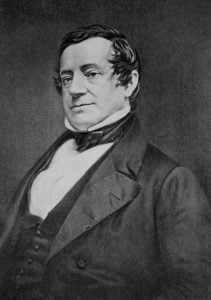
Governor Stokes’s Uncompleted Plans

In March 1836, Governor Stokes became the sub-agent for the Cherokee, Seneca, and Shawnee tribes at Fort Gibson, receiving a modest salary of $750 annually. He faced numerous challenges, including a cramped office space and subordination to a disbursing officer, complicating his relations with the tribes. Stokes advocated for the rights of the Half-Breed reserves of the Osage Nation but struggled to secure assistance for them. Despite his dedication, his term ended without reappointment, and he passed away in November 1842, leaving a significant legacy.
Brown Genealogy

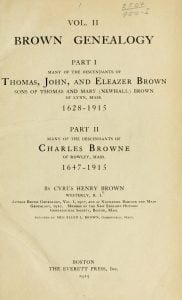
Brown Genealogy

In 1895, Cyrus Henry Brown began collecting family records of the Brown family, initially with the intention of only going back to his great-grandfathers. As others became interested in the project, they decided to trace the family lineage back to Thomas Brown and his wife Mary Newhall, both born in the early 1600s in Lynn, Massachusetts. Thomas, John, and Eleazer, three of their sons, later moved to Stonington, Connecticut around 1688. When North Stonington was established in 1807, the three brothers were living in the southern part of the town. Wheeler’s “History of Stonington” contains 400 records of early descendants of the Brown family, taken from the town records of Stonington. However, many others remain unidentified, as they are not recorded in the Stonington town records. For around a century, the descendants of the three brothers lived in Stonington before eventually migrating to other towns in Connecticut and New York State, which was then mostly undeveloped. He would eventually write this second volume of his Brown Genealogy adding to and correcting the previous edition. This book is free to search, read, and/or download.

The Amidon Family of Rehoboth, MA

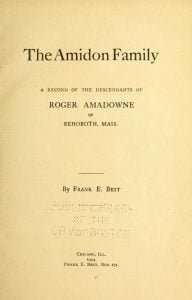
The Amidon Family

The Amidon Family genealogy book details the lineage of Roger Amadowne, a French Huguenot who fled to England and later to America after the revocation of the Edict of Nantes. Documented in Salem, Massachusetts in 1637, variations of his surname include Amadon, Amidown, and Ammidon. The work, organized with biographical sketches and two helpful indexes, presents the family’s history and is richly illustrated. Originally published in 1904, it serves as a valuable resource for descendants and historians alike.

Progressive Men of Western Colorado

Early Life in Colorado

This manuscript, in its essence, is a collection of 948 biographies of prominent men and women, all leading citizens of Western Colorado. In this context, Western Colorado encompasses the counties of Archuleta, Chaffee, Delta, Eagle, Garfield, Gunnison, Hinsdale, La Plata, Lake, Mesa, Mineral, Moffat, Montezuma, Montrose, Ouray, Pitkin, Rio Blanco, Routt, San Juan, and San Miguel.

Washington Irving at Fort Gibson, 1832

Irving Washington

The McIntosh Creeks established productive farms along the Arkansas River, but their land was mistakenly included in the 1828 treaty with the Cherokee, leading to tensions and grievances. The Creeks petitioned the government for aid against attacks from other Indian bands. In response, Congress set up a commission to address these issues, appointing three commissioners, including Montford Stokes. Eventually, Washington Irving joined the commission’s journey from St. Louis to Fort Gibson, experiencing the rich tapestry of frontier life and the challenges faced by the tribes.

Biography of William E. Schermerhorn

William E. Schermerhorn, born in 1882 in Wilson, Kansas, is a successful merchant managing a prominent department store established by his father, E. D. Schermerhorn. A graduate of Armour Institute of Technology, William shifted from pursuing a technical career to taking over the family business. He has also served on Wilson’s city council and expanded the business by opening a branch in Hays. Married to Abbie Fletcher, they have one daughter, Eloise. William’s strong connections to local history and community reflect his family legacy.