Genealogies of Pembroke New Hampshire

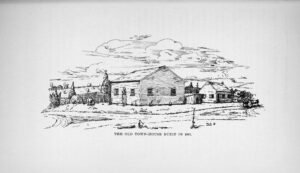
Old Pembroke NH Town House, built 1811

The “Genealogies of Pembroke, New Hampshire” is derived from the town’s second historical volume, and documents the connections of early settler families through the nineteenth century. It emphasizes families of the first settlers and families who resided in Pembroke over a long period of time. Organized alphabetically by surname, the genealogies use a consistent numbering system for easy reference. Carter draws from diverse sources, including town records and personal accounts of Pembroke’s citizens, while acknowledging possible inaccuracies in both their memory and the collection of information. However, by preserving these family lineages, Carter enhances the town’s historical narrative, complementing the first volume’s historical content. Supplementing this volume of genealogies is a compilation of marriage records which occurred in Pembroke, New Hampshire, from 1739 through 1895.
History of Rindge New Hampshire

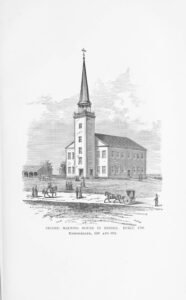
Second Meeting House in Rindge New Hampshire

The History of the Town of Rindge, New Hampshire by Ezra S. Stearns, was published in 1875, and covers the period from the original Rowley Canada grant or Massachusetts charter through the year 1874. Stearns traces the legal, territorial, and institutional development of Rindge, beginning with colonial land grants and boundary disputes and proceeding through settlement, incorporation into a town and development into a small manufacturing hub. More than half the volume is devoted to genealogical material. The genealogical register of Rindge families includes thousands of names compiled from a wide range of sources and assisted by contributions from residents and researchers beyond the town.

History of Amherst New Hampshire

Residence of Isaac Brooks in Amherst New Hampshire

The history of Amherst, New Hampshire, unfolds from its 1675 land grant to veterans of the Narraganset War, marking the impetus for settlement along the Souhegan River. From its early governance and incorporation in 1760 to territorial adjustments that birthed Mont Vernon and Milford, this narrative encompasses local geography, economy, and Indigenous presence. Key military engagements, civic institutions, and genealogical records are explored up to 1882, offering a comprehensive view of the town’s evolution and its prominent figures.

Essex County Massachusetts Probate Records 1675-1681

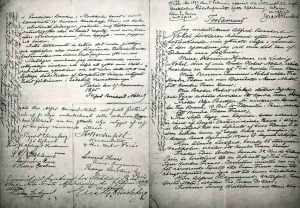
Sample Last Will and Testament

The “Governor and Company of Massachusetts Bay” established a judicial system in 1628, with a General Court in Boston and quarterly courts in major towns like Salem and Ipswich by 1635. These courts managed probate matters, and after Essex County’s formation in 1643, individual probate courts were later established in 1692. These are the probate records from 1675 to 1681, sourced from various original documents, including detailed wills and estate settlements.

Early Records and Notes of the Brown Family

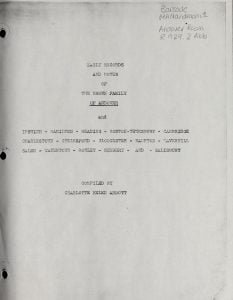
Early Records and Notes of the Brown Family

This is not a compiled genealogy, but rather, a compilation of notes, facts, and genealogies concerning the various early Brown families of the towns of Andover, Ipswich, Hamilton, Reading, Boston-Tewksbury, Cambridge, Charlestown, Chelmsford, Gloucester, Hampton NH, Haverhill, Salem, Watertown, Rowley, Sudbury, and Salisbury. Charlotte Helen Abbott compiled a series of volumes on early families of New England called the “Abbott Genealogies.” This is volume 7 of the series.

History of Littleton New Hampshire

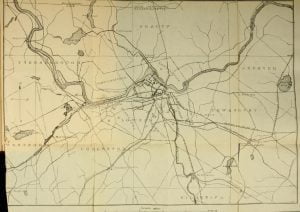
1895 Map of Littleton New Hampshire

The History of Littleton New Hampshire is comprised of three volumes, two volumes of history, and a final volume of genealogies. Considered one of the best examples of local history written in the early 20th century, is your ancestors resided in Littleton then you need these books. Read and download for free!

Abbe-Abbey Genealogy

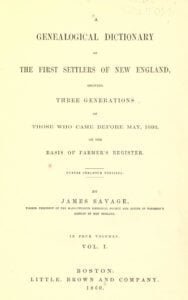
A genealogical dictionary of the first settlers of New England vol 1

The “Abbe-Abbey Genealogy” serves as a comprehensive and meticulously compiled homage to the heritage of the Abbe and Abbey families, tracing its roots back to John Abbe and his descendants. Initiated by the life-long passion of Professor Cleveland Abbe, this genealogical exploration began in his youth and expanded throughout his illustrious career, despite numerous challenges. It encapsulates the collaborative efforts of numerous family members and researchers, including significant contributions from individuals such as Charles E. Abbe, Norah D. Abbe, and many others, each bringing invaluable insights and data to enrich the family’s narrative.

Abbot Family of New England

A genealogical dictionary of the first settlers of New England vol 1

The Abbot family of New England, traced in James Savage’s genealogical work, includes notable figures such as Arthur Abbot, who settled in Marblehead around 1634 and had a son, Philip. Several generations followed, with families established in towns such as Ipswich, Andover, and Cambridge. Many Abbots contributed to early colonial life, engaging in various trades and civic duties. The family’s legacy persists, with descendants continuing to thrive across New England into the 19th century.

Abbott Genealogical Register

Abbott Genealogical Register

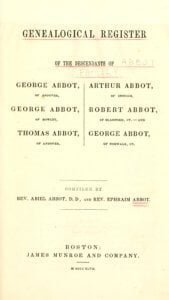
In 1847, Abiel Abbot and Ephraim Abbot compiled a comprehensive genealogical record titled “Abbott Genealogical Register,” detailing the lineage of several Abbott families originating from early New England settlers. Initially aimed to document the descendants of George Abbot, Sr. of Andover, the scope expanded to include numerous branches such as George Abbot, Jr., Thomas Abbot of Andover, Arthur Abbot of Ipswich, Robert Abbot of Branford, Ct., and George Abbot of Norwalk, Ct., among others. This volume, published by J. Munroe and Company in Boston, Massachusetts, integrates meticulously gathered data, revealing the expansive and intertwined genealogies of the Abbott families. The authors’ painstaking research and dedication to accuracy, despite challenges in data completeness, provide a valuable resource for anyone tracing the Abbott lineage or studying early American familial structures.

The genealogy and history of the Ingalls family in America

The genealogy and history of the Ingalls family in America

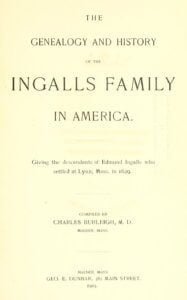
Edmund Ingalls, son of Robert, was born about 1598 in Skirbeck, Lincolnshire, England. He immigrated in 1628 to Salem, Massachusetts and with his brother, Francis, founded Lynn, Massachusetts in 1629. He married Ann, fathered nine children, and died in 1648.

Ivers Family of Dedham, MA

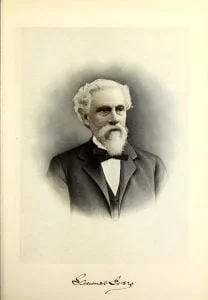
Samuel Ivers

The Ivers family, though not numerous in New England, has roots tracing back to the early 18th century when brothers William and Gregory Ivers settled in Boston around 1720. William married Jane Barber in 1724. Their descendants include Samuel Ivers, a prominent businessman in New Bedford, who contributed to various enterprises, including the Southern Massachusetts Telephone Company. Samuel was active in local politics and church, demonstrating a commitment to community. He had two marriages and two daughters, living a life marked by both personal and civic dedication until his death in 1905.

Jackson Family of Fall River, MA

The Jackson family, while not among Fall River’s oldest, boasts a significant legacy within Massachusetts. Notable members include Rev. John Jackson, whose sons, John Henry and Col. Amos Messer Jackson, served as esteemed physicians and community leaders. Their lineage traces back to John Jackson, an early settler from England, with strong ties to the American Revolution. This family contributed extensively to medicine and civic life in Fall River, emphasizing the Jacksons’ lasting impact on the region’s history and development.

Lowell Massachusetts Genealogy

1894 Map of Lowell

Tracing ancestors in Lowell, Massachusetts online and for free has been greatly enhanced by the University of Massachusetts in Lowell which provided digitized version of a large quantity of the Lowell public records. Combined with the cemetery and census records available freely online, you should be able to easily trace your ancestors from the founding of Lowell in 1826 through 1940, the last year of available census records. To add color to the otherwise basic facts of your ancestors existence we provide free access to a wide range of manuscripts on the history of Lowell, it’s manufactures and residents.

Colburn Genealogy of Blue Hill, Maine

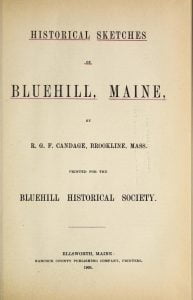
Historical Sketches of Bluehill Maine

Charles Colburn, originally from Billerica, Massachusetts, settled in Blue Hill before 1829. He married Serena Parker on October 15, 1829, and likely built their home shortly after. They had four children: Hannah Jane, Eliza Ann, and twins Charles Henry and Mary Frances. The family relocated to East Boston in the 1840s, where Charles worked as a teamster. All family members have since passed away, with only Hannah Jane and Charles Henry having married, though neither had descendants.

Parker Genealogy of Bluehill, Maine

Historical Sketches of Bluehill Maine

Peter Parker, Sr. emigrated from Andover, Massachusetts, to Blue Hill, Maine, in 1765. Born on January 8, 1741, he married Phebe Marble in 1766. They had several children, including Marble Parker, who later established his own family. Isaac Parker, another son, was noted for his industrious farming and was affectionately known as “Lord Isaac.” The Parker lineage in Blue Hill includes various descendants who contributed to the community, with many properties transformed into summer cottages in contemporary times.

History of the Merchants of Norwich VT

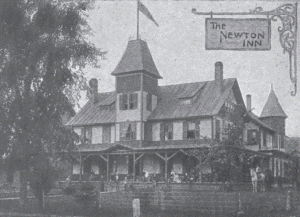
Newton Inn, Vermont

Peter Olcott operated a store in Norwich during the Revolutionary War, followed by Stephen Burton and Ichabod Marshall, early merchants who later moved west. The late 18th and early 19th century saw various merchants such as George Woodward, William Little, and Elias Lyman establishing businesses in the region. The mercantile landscape evolved with partnerships and new firms, including the Olds, Newton, and Lyman firms, adapting through various challenges, such as fires, until the late 19th century, reflecting Norwich’s commercial development.

Biography of Pleasant H. Lovejoy

Pleasant H. Lovejoy, a dedicated civic leader from Jasper County, Georgia, was a man of remarkable spirit and integrity. He enlisted in the Confederate Army at 16 and faced the challenges of Reconstruction with resilience. After establishing a successful business in Hawkinsville and serving as its mayor for 14 years, Lovejoy was instrumental in constructing essential public services and institutions. His commitment to family, community, and faith was evident throughout his life, marked by deep love for his wives, children, and the church. He passed away in 1917, leaving a lasting legacy.

Biography of Thomas E. Lovejoy

Thomas E. Lovejoy, born in Macon County, Georgia, emerged from humble beginnings to become a prominent businessman. After graduating from local schools and pursuing a business course in New York, he established a grocery business, later transitioning into banking and insurance. Lovejoy served as president of the Manhattan Life Insurance Company and maintained ties with several financial institutions. A devoted father after the untimely death of his wife, he exemplified Christian values and strong family bonds, earning respect and admiration in Hawkinsville and beyond.