History of Newport New Hampshire

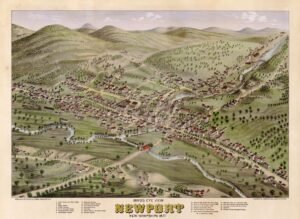
Bird's Eye View of Newport New Hampshire 1877

The History of Newport, New Hampshire, from 1766 to 1878 is a record of Newport’s growth from its early settlement through the close of the nineteenth century. It opens with the original charter and proprietary arrangements and follows the development of Newport’s physical setting, transportation routes, and economy. Particular attention is given to mills, banks, hotels, manufacturing, and the coming of the railroad, all of which shaped the town’s commercial life. The concluding genealogical section identifies families connected with Newport and other chapters provide biographical details that might otherwise be lost.

Collections of the New Hampshire Historical Society

1892 Map of New Hampshire

The Collections of the New Hampshire Historical Society is a 15 publication series documenting the state’s history through various primary sources, including manuscripts, letters, and public records. It collates valuable narratives that were previously difficult to access, providing insight into events, individuals, and communities in New Hampshire. Each volume offers focused topics and historical analyses, and most volumes contain individual indexes.

Families of Ancient New Haven

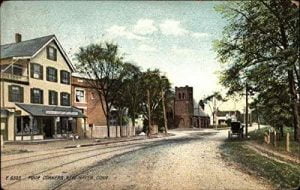
Four Corners New Haven Connecticut

The Families of Ancient New Haven compilation includes the families of the ancient town of New Haven, covering the present towns of New Haven, East Haven, North Haven, Hamden, Bethany, Woodbridge and West Haven. These families are brought down to the heads of families in the First Census (1790), and include the generation born about 1790 to 1800. Descendants in the male line who removed from this region are also given, if obtainable, to about 1800, unless they have been adequately set forth in published genealogies.

Abbe-Abbey Genealogy

A genealogical dictionary of the first settlers of New England vol 1

The “Abbe-Abbey Genealogy” serves as a comprehensive and meticulously compiled homage to the heritage of the Abbe and Abbey families, tracing its roots back to John Abbe and his descendants. Initiated by the life-long passion of Professor Cleveland Abbe, this genealogical exploration began in his youth and expanded throughout his illustrious career, despite numerous challenges. It encapsulates the collaborative efforts of numerous family members and researchers, including significant contributions from individuals such as Charles E. Abbe, Norah D. Abbe, and many others, each bringing invaluable insights and data to enrich the family’s narrative.

The genealogy and history of the Ingalls family in America

The genealogy and history of the Ingalls family in America

Edmund Ingalls, son of Robert, was born about 1598 in Skirbeck, Lincolnshire, England. He immigrated in 1628 to Salem, Massachusetts and with his brother, Francis, founded Lynn, Massachusetts in 1629. He married Ann, fathered nine children, and died in 1648.

Descendants of Matthew Watson of Leicester, Massachusetts

Watson Coat of arms

Matthew Watson (d. 1720), of English lineage, married Mary Orr in 1695, and in 1718 the family immigrated from Ireland to Boston, Massachusetts and settled in Leicester, Massachusetts. Descendants and relatives lived in New England, New York, New Jersey, Pennsylvania, Ohio, Nebraska, Rhode Island, California, Nevada, Michigan and elsewhere. Includes Watson, Armington, Bemis, Denny, Draper, Kent, Washburn, Bailey, Barnard, Belcher, Bent, Biscoe, Bolles, Breckenridge, Bright, Browning, Bryant, Bullock, Burrage, Dennis, Fisher, Foster, Green, Hayward, Hobbs, Hodgkins, Holman, Howard, Jenks, Jones, Kellogg, Kitchell, Knight, Lazelle, Livermore, Loring, Mason, Maynard, Munger, Patrick, Prouty, Remington, Reed, Rice, Richardson, Rogers, Sadler, Sibley, Snow, Sprague, Stone, Studley, Symonds, Taitt, Thomas, Thompson, Trask, Tucker, Waite, Webster, Westcott, Wheeler, Whittermore, Wilson, Woods and related families.

Weymouth ways and Weymouth people

Weymouth ways and Weymouth people

Edward Hunt’s “Weymouth ways and Weymouth people: Reminiscences” takes the reader back in Weymouth Massachusetts past to the 1830s through the 1880s as he provides glimpses into the people of the community. These reminiscences were mostly printed in the Weymouth Gazette and provide a fair example of early New England village life as it occurred in the mid 1800s. Of specific interest to the genealogist will be the Hunt material scattered throughout, but most specifically 286-295, and of course, those lucky enough to have had somebody “remembered” by Edward.

Descendants of Isaac Benjamin of New Bedford, MA

The Benjamin family of New Bedford traces its lineage back to John Benjamin, who arrived in Massachusetts in 1632. His descendant, Isaac W. Benjamin, became a significant figure in New Bedford, serving for over three decades at the New Bedford Cordage Company and holding various public offices, including a long tenure on the school committee. His dedication to education led to a school being named in his honor. Isaac W. married Olive Lane Moulton and had one child, Lucy E., ensuring the family’s legacy continued.

Lowell Massachusetts Genealogy

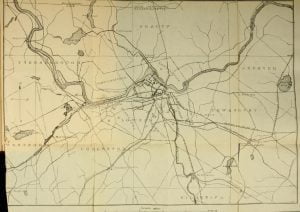
1894 Map of Lowell

Tracing ancestors in Lowell, Massachusetts online and for free has been greatly enhanced by the University of Massachusetts in Lowell which provided digitized version of a large quantity of the Lowell public records. Combined with the cemetery and census records available freely online, you should be able to easily trace your ancestors from the founding of Lowell in 1826 through 1940, the last year of available census records. To add color to the otherwise basic facts of your ancestors existence we provide free access to a wide range of manuscripts on the history of Lowell, it’s manufactures and residents.

Richard Dexter Genealogy, 1642-1904

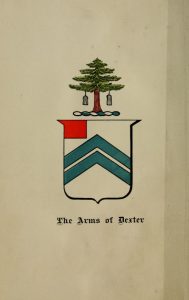
Arms of Dexter

Being a history of the descendants of Richard Dexter of Malden, Massachusetts, from the notes of John Haven Dexter and original researches. Richard Dexter, who was admitted an inhabitant of Boston (New England), Feb. 28, 1642, came from within ten miles of the town of Slane, Co. Meath, Ireland, and belonged to a branch of that family of Dexter who were descendants of Richard de Excester, the Lord Justice of Ireland. He, with his wife Bridget, and three or more children, fled to England from the great Irish Massacre of the Protestants which commenced Oct. 27, 1641. When Richard Dexter and family left England and by what vessel, we are unable to state, but he could not have remained there long, as we know he was living at Boston prior to Feb. 28, 1642.

Contributions of the Old Residents’ Historical Association, Lowell MA

Historical Association of Lowell Mass

The Lowell Historical Society published six volumes documenting the history of Lowell, Massachusetts, primarily during the late 19th and early 20th centuries. Contributions include memoirs, biographies, and accounts from notable residents and events, highlighting the city’s development, industries, and community life. Key topics cover early manufacturing, educational institutions, local governance, and personal recollections from various citizens. These volumes serve as a vital resource for understanding Lowell’s historical landscape and the contributions of its residents.

Handbook of Historical Data Concerning Leicester, Massachusetts

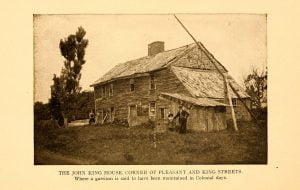
The John King House

This post contains a brief outline of the history of the town of Leicester, Massachusetts. However, at the bottom of the page, it provides extensive additional free material on historical and genealogical research within Leicester Massachusetts. If you have ancestors in Leicester, do not miss this!

Biography of Lot Livermore

Lot Livermore, a prominent figure in Eastern Oregon’s development, was born in Ohio in 1835 and migrated to Illinois as a child. He traveled to Oregon in 1851, facing challenges like conflicts with Native Americans. By 1866, he was engaged in merchandise operations in Umatilla, later serving as Pendleton’s first mayor and county treasurer despite political opposition. Married twice, he has three children. Livermore remains deeply invested in the future of the Inland Empire, reflecting his lifelong contributions to the region’s progress.