History of Rindge New Hampshire

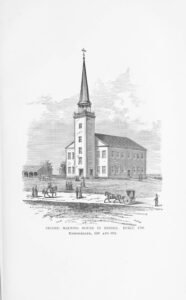
Second Meeting House in Rindge New Hampshire

The History of the Town of Rindge, New Hampshire by Ezra S. Stearns, was published in 1875, and covers the period from the original Rowley Canada grant or Massachusetts charter through the year 1874. Stearns traces the legal, territorial, and institutional development of Rindge, beginning with colonial land grants and boundary disputes and proceeding through settlement, incorporation into a town and development into a small manufacturing hub. More than half the volume is devoted to genealogical material. The genealogical register of Rindge families includes thousands of names compiled from a wide range of sources and assisted by contributions from residents and researchers beyond the town.
Abington Massachusetts Birth Records

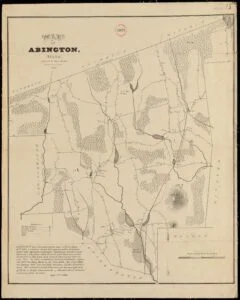
1830 Map of Abington, Massachusetts

Volume 1 of the Abington, Massachusetts vital records details births recorded in the town up to 1850, featuring comprehensive research from town records, cemeteries, and church documents. Established in 1712, Abington’s jurisdictional changes may affect genealogical searches. The records also include separate listings for Black families, primarily by given names. Additionally, various surnames are cataloged, emphasizing the need to consider alternate spellings. For marriages and deaths, researchers should consult Volume 2.

History of Ontario County, New York, part 2

History of Ontario County, New York

The History of Ontario County, New York genealogical section provides an extensive array of surnames, indicating the comprehensive nature of the section in Part 2. These genealogies not only serves as a reference for individuals researching family histories but also reflects the diverse settler and immigrant populations that have contributed to the fabric of Ontario County. Each surname represents a family’s journey, struggles, and contributions to the county’s development over centuries.

Washburn Genealogy of Bridgewater Massachusetts

Old Families of Southeastern Massachusetts

The Washburn family, among the earliest settlers of Bridgewater, Massachusetts, traces its roots to John Washburn, who arrived in New England by 1632. His lineage includes notable descendants such as Capt. Abraham Washburne, a Revolutionary War soldier, and his son Seth, who became a successful entrepreneur in cotton gins. The family continued to thrive, with later generations like George and Lucy Eaton, who contributed to the community’s legacy. The Washburns remain a significant part of Bridgewater’s history, exemplifying the town’s early growth and development.

Descendants of Philip Trafford from Dartmouth and Fall River, MA

The Trafford family, originating from Lancashire, England, has maintained an unbroken lineage dating back to Randolphus de Trafford, who flourished around 1030. Thomas Trafford, a descendant who fled England during the Catholic persecution, settled in Dartmouth, MA, around 1690. His line produced notable figures in the industrial sector, particularly in cotton manufacturing in Dartmouth and Fall River. Successive generations, including prominent names like William Bradford Trafford and his sons, played significant roles in local business and civic life, establishing a lasting legacy in the community.

Descendants of John Washburn of Duxbury, MA

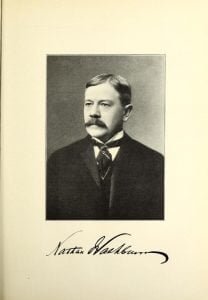
nathan washburn

The Washburn family of Middleboro, Massachusetts, traces its lineage to John Washburn, who emigrated from Evesham, England, in 1632. His descendants played significant roles in early American history, including Capt. Amos Washburn, a Revolutionary War officer, and his son Gen. Abiel Washburn, a prominent leader in Middleboro. The lineage continued through notable figures, including Judge Nathan Washburn, who practiced law and served as a special justice in the Plymouth district. This family has left a lasting impact on the Old Colony and its governance.

Hussey and Morgan Families of New Bedford MA

The Hussey and Morgan families have a significant history in New Bedford, dating back nearly a century. Key figures include George Hussey and Charles Wain Morgan, both influential in the whaling and shipping industries during the early nineteenth century. Christopher Hussey, their ancestor, was among the early settlers in New England, while George Hussey and his son were prominent ship merchants. Charles Morgan, who also established a successful shipping business, contributed to community institutions and left an enduring legacy in New Bedford’s wealthy society.

Will of Nancy Austin

In her last will, Nancy Austin bequeaths her enslaved individuals to her grandchildren, children, and specifies their divisions among them. She instructs for the sale of her house and remaining personal property, with debts to be settled first. Proceeds are to be divided among her children and grandsons. Additionally, she grants freedom to her servant Amanda upon her death, ensuring her support if needed. Executors named include Samuel Casey, Gibson B. Taylor, and William Grundy. The will is dated May 26, 1837.

Biography of Amos S. Lapham

Amos S. Lapham, a distinguished attorney in Chanute, Kansas, has had a remarkable legal career, marked by dedication to ethical practice and significant cases. Born on April 6, 1845, in Ohio, he hailed from a prominent family with roots tracing back to 17th-century England. Lapham graduated from the University of Michigan and was admitted to practice law in 1869. He held various civic roles, including treasurer of Neosho County and judge of the District Court. Married in 1875, he fathered seven children, while also engaging in business and community endeavors.

Biographical Sketch of Nathan D. Lapham

Nathan D. Lapham is a respected attorney in Geneva, New York, recognized for his contributions to civil and criminal law. He has also been an influential figure in local public affairs, advocating for improvements that benefit the community. Nathan D. Lapham is named after his grandfather, who descended from a family associated with the Society of Friends in Massachusetts. His grandfather was a traditional farmer in Wayne County, known for integrating modern practices into his farming methods while maintaining the family homestead for many years.

Biographical Sketch of De Witt C. Lapham

De Witt C. Lapham, born in 1846 in Macedon, New York, was the son of Nathan Lapham and engaged in agriculture throughout his life. He held various local offices and was an active member of the Republican party, with ties to the Methodist church. He married Amelia J. Finley, born in 1847, whose family also resided in Macedon. Lapham passed away in 1909 on the family homestead.

Biography of Nathan D. Lapham

Nathan D. Lapham, born on November 14, 1871, in Macedon, New York, graduated from Macedon Academy and later from Cornell Law School in 1895. He began practicing law in 1896 in Lyons, New York, and later moved to Geneva, gaining recognition for his work, especially in criminal cases. A Republican, he was involved in political campaigns and served various community organizations. Lapham married Rose E. Case in 1903, and both are active members of the North Presbyterian Church.