List of Marriages at St. Catherine Jamaica Previous to 1680
A historical record of marriages solemnized and confirmed at St. Catherine, Jamaica, before 1680, presented from a British Museum manuscript source.

A historical record of marriages solemnized and confirmed at St. Catherine, Jamaica, before 1680, presented from a British Museum manuscript source.
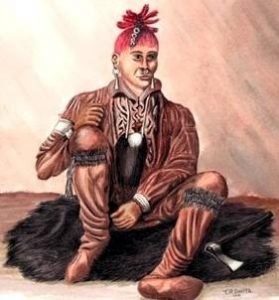
James Smith, pioneer, was born in Franklin county, Pennsylvania, in 1737. When he was eighteen years of age he was captured by the Indians, was adopted into one of their tribes, and lived with them as one of themselves until his escape in 1759. He became a lieutenant under General Bouquet during the expedition against the Ohio Indians in 1764, and was captain of a company of rangers in Lord Dunmore’s War. In 1775 he was promoted to major of militia. He served in the Pennsylvania convention in 1776, and in the assembly in 1776-77. In the latter year he was commissioned colonel in command on the frontiers, and performed distinguished services. Smith moved to Kentucky in 1788. He was a member of the Danville convention, and represented Bourbon county for many years in the legislature. He died in Washington county, Kentucky, in 1812. The following narrative of his experience as member of an Indian tribe is from his own book entitled “Remarkable Adventures in the Life and Travels of Colonel James Smith,” printed at Lexington, Kentucky, in 1799. It affords a striking contrast to the terrible experiences of the other captives whose stories are republished in this book; for he was well treated, and stayed so long with his red captors that he acquired expert knowledge of their arts and customs, and deep insight into their character.
Samuel T. Howell, born on February 22, 1843, in Gentry County, Missouri, was raised on a farm and received his education at local schools and Camden Point College. He began studying medicine at 24 with Dr. G. W. Stapleton, later graduating from Jefferson College in 1871, excelling in surgery. Practicing near his birthplace, he moved to a new county in 1874, focusing on surgical care. Howell married Julia A. Evans in 1869, and they had four children together.
This index compiles 1,352 Baldwin County, Georgia marriage records from court documents covering 1806 to 1850. It lists groom, bride, and marriage date entries in chronological order, offering a valuable genealogical resource for tracing family history, local relationships, and early county residents across more than four decades.
A September 7, 1831 true copy of Choctaw claims in Mingo Mushulatubbe’s District lists names, acreage, and outcomes such as relinquished, sold, kept, or provided for in treaty. Compiled by Special Agent F. W. Armstrong, the record documents land claims, captains’ allowances, cultivation rights, and transfers to individuals including Grant and Clement.
Sena B. Davis, born on September 20, 1887, in Delaware District, was educated in the Cherokee National Schools. She married C. W. Howell on February 11, 1906. Together, they had three children: Nora May (born May 31, 1913), Woodrow Wilson (born November 5, 1916), and Louis C. Howell (born September 8, 1919). The family resides near Ketchum, where Mr. Howell works as a farmer.
Lou Gott Harris, born on July 31, 1886, in Fort Gibson, was educated in Nowata and Oswego, Kansas. She married Dr. Dumont D. Howell on January 7, 1905. Dr. Howell, a graduate of Nashville Medical College, passed away on December 6, 1919. Together they had four children: Sue, Alfred, Lucile, and Margaret. Lou’s lineage includes her father, Charles Joseph Harris, who married Emma J. Walker.
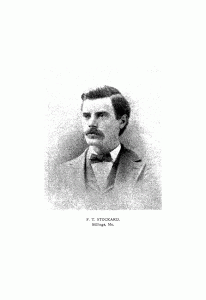
Fenton T. Stockard, born December 16, 1867, in Gibson County, Tennessee, is a prominent attorney in Billings, where he has practiced law since 1891. He began his legal career after studying under Hon. H. E. Howell and has gained recognition for his skills. The son of C. H. and Patience E. Stockard, he grew up in a family of six children and has roots in both Irish and French heritage. Mr. Stockard married Mignonette Gregory in 1893 and is known for his Republican advocacy and public spirit.
Henry Maxwell, born in 1859 in Lownes County, Georgia, shares his experiences as a former enslaved individual. His family was fragmented after the Civil War, with several members sold to different owners. Maxwell vividly recalls the violence against enslaved people, including gruesome punishments and the horrors of hunting escaped slaves. After the war, he moved with his family to Titusville, Florida, where he eventually became a successful orange grove owner, amassing significant wealth and respect in his community.
Andrew J. Howell, a prominent figure in Greenwood County, Kansas, was born on October 7, 1863, in Indiana. A dedicated educator for twenty-eight years, he garnered deep respect from former students. Howell served as postmaster during Cleveland’s and Wilson’s presidencies and ran a successful general merchandise store in Virgil. Active in local politics, he was a Democrat and held various community roles. He married Sarah Driver in 1896, and they had one daughter, Ruie A., furthering the Howell legacy in the region.
Thomas George Howell, born April 30, 1861, in Quebec, Canada, represents the agricultural backbone of Silver Lake Township, Shawnee County. His 235-acre farm reflects years of dedication and hard work, having expanded from an initial 80 acres purchased in 1887. Active in community affairs, Howell served on the township and school boards and contributed to local churches. He married Amanda Dietrich in 1887, and they raised five children, emphasizing education and community involvement. Howell’s legacy is one of stewardship and civic responsibility in his township.
Dr. Dumont D. Howell was a prominent physician in Nowata for sixteen years before his passing on December 6, 1919. Born in Murphy, North Carolina, in 1874, he received his M.D. from the University of Nashville in 1903 and furthered his education at the Chicago Postgraduate Medical School. He built a substantial medical practice and served on the city’s board of health, while also contributing to local oil development. He married Lucile G. Harris and had five children, leaving a lasting legacy in his community.
Major James H. Howell, born in Haywood County and the son of E. H. Howell, served in the 30th Division, 118th Regiment. He enlisted in Waynesville, N.C., and was deployed to France in May 1918. He fought in significant battles such as the Somme and Ypres, sustaining a shell wound on October 5, 1918. After recovering in hospitals in France and Biltmore, N.C., he was mustered out on April 9, 1919. He also served on the Mexican border in 1907.
Sergt. Lonnie H. Howell served in Company E of the 119th Regiment, 30th Division during World War I. From Nash County, North Carolina, he enlisted on May 5, 1917, and underwent training at Camp Sevier before moving to Camp Merritt. Howell sailed to France a year later, participating in all engagements with his regiment. He returned to the United States on April 2, 1919, and was mustered out of service at Camp Jackson on April 7, 1919.
George Rogers Howell, born on June 15, 1833, in Southampton, Long Island, emerged as a prominent American scholar after studying at Yale and Princeton Theological Seminary. Initially pursuing teaching and ministerial work, he pivoted to literary research, notably authoring “The Early History of Southampton.” In 1872, he was appointed assistant librarian at the state library, eventually becoming its acting librarian, where he excelled in book classification and administration. Howell has also contributed to the Albany Institute, showcasing his wide-ranging scholarship and commitment to the literary field.
This document contains genealogical statements regarding various individuals and families of Creek, Choctaw, Chickasaw, and Mississippi Choctaw descent who sought recognition and enrollment in tribal rolls. The records, primarily from 1909 reports, detail claimants’ ancestry, enrollment issues, and tribal affiliations. Many individuals were denied enrollment due to factional disputes, legal technicalities, or failure to apply within deadlines. The document includes references to official reports and affidavits, offering insights into the complexities of Native American citizenship and land rights during the early 20th century.
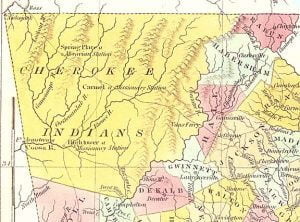
The Cherokee Indians, primarily from the Southeastern U.S., have a rich history marked by their early adoption of a written language and a government structure similar to that of the United States. Despite their forced relocation to Oklahoma in the 1830s, they maintained significant genealogical ties, often intermarrying with Whites. Emmet Starr’s “History of the Cherokee Indians and Their Legends and Folklore” emphasizes personal biographies and genealogies, providing insights into the lives and connections of many Cherokee families across generations, thereby enriching their cultural narrative.
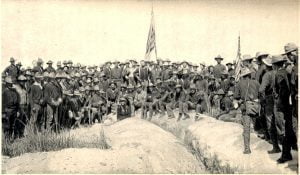
The compiled military service records of 1,235 Rough Riders, including Theodore Roosevelt, have been digitized. Each record features individual jackets detailing the soldier’s name, organization, rank, and medical records. The records also contain personal information and documentation descriptions. Discharges occurred for various reasons, such as age, ability, discipline issues, or hardship. This initiative provides significant insights into the personnel of the 1st U.S. Volunteer Cavalry during the Spanish-American War.