Acton Massachusetts History

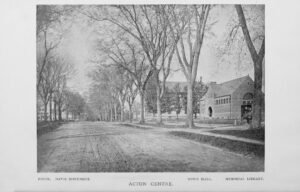
Acton Center,Acton Massachusetts

Acton in History traces the town’s development from its beginnings as Concord Village in the seventeenth century through its emergence as a modest industrial community. It gives particular attention to the religious life of the town, including the building of early meetinghouses and the long ministries of figures such as the Rev. John Swift and the Rev. James T. Woodbury. The work devotes substantial space to Acton’s role in the Revolution, especially the events at the North Bridge in 1775 and the loss of Captain Isaac Davis and his company of minute-men. It also follows the growth of local industries, from blacksmithing and cooperage to the far-reaching effects of the Fitchburg Railroad after its arrival in 1844. Later chapters include brief sketches of notable residents in the 1880s. Throughout, the narrative weaves in discussions of Acton’s everyday life, civic engagement, and social values.
Medway Massachusetts vital records

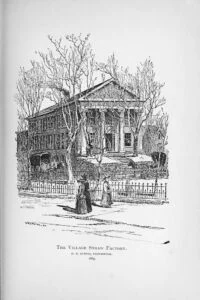
Medway Village Straw Factory

Alphabetical indexes to the vital records of Medway, Massachusetts, up to the year 1850, supplemented by information from church registers, cemetery inscriptions and other private sources to include Rev. Dr. Jacob Ide’s account of Marriages and Deaths, 1814-1849.

The history of Medway Massachusetts

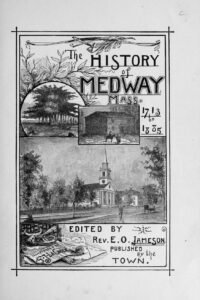
History of Medway title page

The History of Medway, Massachusetts, 1713–1885, covers the entire period of local history, embracing two hundred and twenty-five years, from 1660 to 1885; or, from the first appearance of a white settler within the territory, to the recent date of the incorporation of the town of Millis. The book is divided into ten sections, and gives, in consecutive order, an account of the first settlement, the municipal doings, the churches, the schools and other institutions, the industries, the military service, the miscellaneous matters, the cemeteries, the biographies of many persons, and the genealogies of numerous families.

Ashfield Massachusetts Vital Records

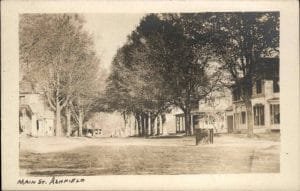
Main Street, Ashfield, Massachusetts

Alphabetical indexes to the vital records of Ashfield, Massachusetts, up to the year 1850, supplemented by information from bible records, church registers, cemetery inscriptions and other sources. PDF file is free to read and download.

History of Sierra Madre California

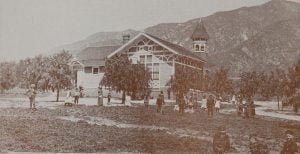
Central School between 1887 and 1906

The *Annals of Early Sierra Madre* by Edith Blumer Bowen, published in 1950 by the Sierra Madre Historical Society, offers a vivid account of the early history of Sierra Madre, California. This volume serves as a vital record of the community’s development, drawn from the personal experiences and narratives of those who lived through the events described. This historical compilation focuses on various aspects of Sierra Madre’s past, including its founding, significant local figures, and the establishment of institutions such as churches and schools. The work also delves into the biographies of prominent families and individuals, detailing their contributions to the growth and character of the town.

History of Littleton New Hampshire

1895 Map of Littleton New Hampshire

The History of Littleton New Hampshire is comprised of three volumes, two volumes of history, and a final volume of genealogies. Considered one of the best examples of local history written in the early 20th century, is your ancestors resided in Littleton then you need these books. Read and download for free!

Families of Ancient New Haven

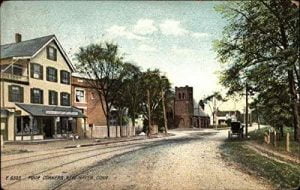
Four Corners New Haven Connecticut

The Families of Ancient New Haven compilation includes the families of the ancient town of New Haven, covering the present towns of New Haven, East Haven, North Haven, Hamden, Bethany, Woodbridge and West Haven. These families are brought down to the heads of families in the First Census (1790), and include the generation born about 1790 to 1800. Descendants in the male line who removed from this region are also given, if obtainable, to about 1800, unless they have been adequately set forth in published genealogies.

Abbe-Abbey Genealogy

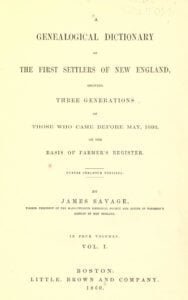
A genealogical dictionary of the first settlers of New England vol 1

The “Abbe-Abbey Genealogy” serves as a comprehensive and meticulously compiled homage to the heritage of the Abbe and Abbey families, tracing its roots back to John Abbe and his descendants. Initiated by the life-long passion of Professor Cleveland Abbe, this genealogical exploration began in his youth and expanded throughout his illustrious career, despite numerous challenges. It encapsulates the collaborative efforts of numerous family members and researchers, including significant contributions from individuals such as Charles E. Abbe, Norah D. Abbe, and many others, each bringing invaluable insights and data to enrich the family’s narrative.

Ridgelawn Memorial Cemetery – Oxford Michigan

This cemetery record from Oxford, west of Burdick Street, lists hundreds of burials collected in September 2001 by Christopher Schnur. The transcription includes names, birth and death dates, military service, family relationships, and epitaphs, offering a detailed historical snapshot of local families, veterans, children, and spouses buried in the cemetery.

Treaty of October 19, 1865 – Two Kettle Sioux

On October 19, 1865, a treaty was established at Fort Sully between U.S. commissioners and the Two Kettle Sioux chiefs. The treaty acknowledged the band’s allegiance to the U.S. and aimed to cease hostilities among tribes. Key provisions included a commitment to peace, an annual payment of six thousand dollars, and support for agricultural development. In compensation for the death of a Sioux chief by U.S. soldiers, the treaty specified payments to his family and the tribe. The treaty underlines efforts to maintain peace and stability in the region.

Personal characteristics

Red Jacket exhibited a strong self-esteem and unwavering confidence in his abilities, which allowed him to engage equally with prominent figures without feeling intimidated. He maintained his dignity in all interactions, even humorously challenging those who approached him with disregard. Known for his keen memory and adaptability, he often defended the interests of his people while displaying a disdain for superficiality. Red Jacket cherished nature’s grandeur, especially Niagara Falls, and he navigated social interactions with an innate refinement, embodying the qualities of a true gentleman.