Abington Massachusetts Birth Records

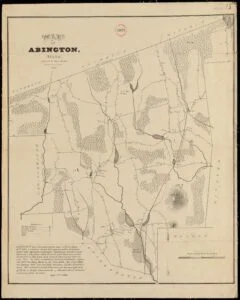
1830 Map of Abington, Massachusetts

Volume 1 of the Abington, Massachusetts vital records details births recorded in the town up to 1850, featuring comprehensive research from town records, cemeteries, and church documents. Established in 1712, Abington’s jurisdictional changes may affect genealogical searches. The records also include separate listings for Black families, primarily by given names. Additionally, various surnames are cataloged, emphasizing the need to consider alternate spellings. For marriages and deaths, researchers should consult Volume 2.
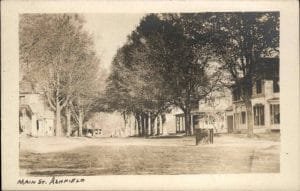
Ashfield Massachusetts Vital Records

Main Street, Ashfield, Massachusetts

Alphabetical indexes to the vital records of Ashfield, Massachusetts, up to the year 1850, supplemented by information from bible records, church registers, cemetery inscriptions and other sources. PDF file is free to read and download.

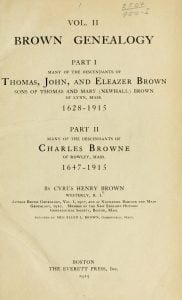
Brown Genealogy

Brown Genealogy

In 1895, Cyrus Henry Brown began collecting family records of the Brown family, initially with the intention of only going back to his great-grandfathers. As others became interested in the project, they decided to trace the family lineage back to Thomas Brown and his wife Mary Newhall, both born in the early 1600s in Lynn, Massachusetts. Thomas, John, and Eleazer, three of their sons, later moved to Stonington, Connecticut around 1688. When North Stonington was established in 1807, the three brothers were living in the southern part of the town. Wheeler’s “History of Stonington” contains 400 records of early descendants of the Brown family, taken from the town records of Stonington. However, many others remain unidentified, as they are not recorded in the Stonington town records. For around a century, the descendants of the three brothers lived in Stonington before eventually migrating to other towns in Connecticut and New York State, which was then mostly undeveloped. He would eventually write this second volume of his Brown Genealogy adding to and correcting the previous edition. This book is free to search, read, and/or download.

History of Littleton New Hampshire

1895 Map of Littleton New Hampshire

The History of Littleton New Hampshire is comprised of three volumes, two volumes of history, and a final volume of genealogies. Considered one of the best examples of local history written in the early 20th century, is your ancestors resided in Littleton then you need these books. Read and download for free!

Abbe-Abbey Genealogy

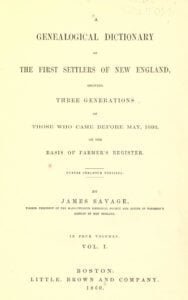
A genealogical dictionary of the first settlers of New England vol 1

The “Abbe-Abbey Genealogy” serves as a comprehensive and meticulously compiled homage to the heritage of the Abbe and Abbey families, tracing its roots back to John Abbe and his descendants. Initiated by the life-long passion of Professor Cleveland Abbe, this genealogical exploration began in his youth and expanded throughout his illustrious career, despite numerous challenges. It encapsulates the collaborative efforts of numerous family members and researchers, including significant contributions from individuals such as Charles E. Abbe, Norah D. Abbe, and many others, each bringing invaluable insights and data to enrich the family’s narrative.

The genealogy and history of the Ingalls family in America

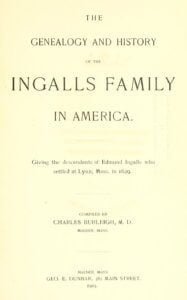
The genealogy and history of the Ingalls family in America

Edmund Ingalls, son of Robert, was born about 1598 in Skirbeck, Lincolnshire, England. He immigrated in 1628 to Salem, Massachusetts and with his brother, Francis, founded Lynn, Massachusetts in 1629. He married Ann, fathered nine children, and died in 1648.

Biography of Reverend Samuel Goddard

Samuel Goddard, born in Sutton, Massachusetts, on July 6, 1772, faced limited educational opportunities and initially worked in trade before pursuing a religious vocation. Studying under Doctor Seth Payson, he was ordained in 1809 as pastor of a small church in Concord, Vermont, where he expanded the congregation significantly and established missionary work. In 1822, he became pastor of the North Congregational Church in Norwich, Vermont, growing its membership and promoting community welfare. Goddard was known for his devotion, despite personal losses and health challenges, leaving a lasting impact on his community.

The Bush Family of Norwich Vermont

Captain Timothy Bush, an early settler of Norwich, Vermont, arrived in the town during its formative years, marrying Deborah House and fathering ten children. He played a significant role in local governance, serving as a selectman and landowner in the Pompanoosuc section. Active in military service during the Revolutionary War, he commanded a company in Colonel Marsh’s regiment. Although he reportedly moved to New York around 1809, there is speculation about his final resting place in Norwich. His legacy includes contributions to both town affairs and military endeavors.

Migration of Families out of Norwich VT

In the late 18th and early 19th centuries, Norwich, Vermont, experienced significant emigration, leading to a notable decline in its population. Initially home to 40 families in 1771, the town saw many residents relocate to newer settlements, such as Royalton and Randolph, during and after the Revolutionary War. Prominent families, including the Hibbards and Carpenters, contributed to the establishment of towns in northern Vermont and beyond. By the 1800s, the trend of outmigration intensified, marking a long-term shift in the region’s demographic landscape.

History of Norwich Vermont Education

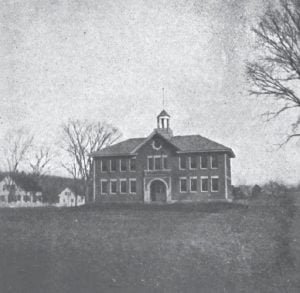
High School Building, Norwich Village, Erected in 1898

The history of education in Norwich, Vermont, traces back to efforts in 1782 to establish school districts. The first successful division occurred in 1785, creating the First School District. Over the years, multiple districts were formed, with the establishment of a committee for school supervision in 1824. Notable developments included the construction of a brick schoolhouse in 1845 and the incorporation of the Norwich Classical and English Boarding School in 1867, although it ultimately closed in 1877. The town’s education framework evolved significantly, culminating in a unified system in 1892.

First Settlements in Norwich Vermont

The early settlement of Norwich, Vermont, began in 1762 when Samuel Slafter’s son, John, explored the area, reporting its fertile land and water sources. In 1763, after receiving his father’s rights, he commenced clearing lots but faced challenges, as his initial choice proved unsuitable. By 1765-66, a few families settled permanently, including the Hutchinsons and Manns, establishing homes and farms. Pioneers endured various hardships, yet they built foundations for a thriving community, characterized by a homogeneous population primarily from Connecticut.

Hibbard, C. R. Mrs. – Obituary

Mrs. C. R. Hibbard passed away late yesterday after a period of illness. Born on January 30, 1876, in Summerville, she married C. R. Hibbard in 1901 and is survived by her two sons, Reid and Dick, along with two sisters and a brother. Funeral services will be held tomorrow at the Snodgrass and Zimmerman chapel, with burial in Summerville cemetery. A former public school teacher and Willamette University attendee, Mrs. Hibbard was deeply respected and cherished by her community.

Albert Lyon Hibbard

Albert Lyon Hibbard, a sergeant in Company K of the 30th Division, 119th Regiment, hailing from Craven County, began his military service on June 27, 1916. He progressed through various training camps before deploying to France, where he was promoted to corporal in July 1917 and sergeant by September 1918. Hibbard fought in significant battles, including the Bellicourt Sector, where he was wounded on September 29, 1918. After treatment, he returned to the U.S. and was mustered out on April 7, 1919.

Mrs. Muriel Estella Dotson Merritt – Obituary

Muriel Estella Merritt, 89, of New Meadows, Idaho, passed away on February 13, 2002, at St. Elizabeth Health Care Center. Born on December 29, 1912, she grew up in Idaho and married Lawrence J. Merritt in 1932, with whom she had three children. A devoted homemaker, she enjoyed writing, gardening, and storytelling, leaving a cherished legacy among her family. Her funeral will be held at the New Meadows United Methodist Church, with interment at Meadow Valley Cemetery. Mrs. Merritt is survived by her children, grandchildren, and many relatives.

Biographical Sketch of Hibbard, H. C.

H. C. Hibbard, born in Fulton County, Illinois, moved to Russell County, Kansas, in 1871, after serving in the Civil War with the Eighth Illinois Cavalry. He transitioned from farming to law in Russell village by 1874 and was admitted to the bar in 1876. Hibbard was the first superintendent of schools in Russell County and held positions such as Deputy Register of Deeds, Police Judge, and Deputy County Attorney. He married Sonora White in 1878, and they had one son, Duane, in 1879.