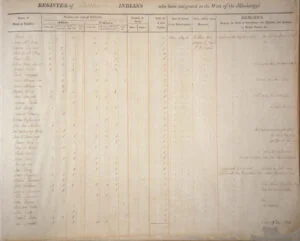
1832 Cherokee Muster Roll

1834 Cherokee Muster Roll - page 1

This Muster Roll details Cherokee Indians who migrated west of the Mississippi River under B. F. Curry’s supervision. It includes payments made by Capt. Vashon, outlining the number of individuals and slaves receiving subsistence. Each Indian received $32.50, with payments occurring in April or May 1832. The document lists heads of families and their respective counts of males, females, and slaves, totaling 231 men, 193 women, and 157 slaves, with a cumulative total of 561 individuals.

1838 Cherokee Muster Roll 2

The 1838 muster roll documents the journey of 1,072 Georgia Cherokees from Rosses Landing to Indian Territory, culminating with 635 survivors arriving on September 7, 1838. The official count recorded on July 23 noted 763 individuals, accounting for 144 deaths, 289 desertions, and 2 births along the Trail of Tears. The detailed enumeration lists 91 family groups, suggesting many of the missing were likely enslaved individuals whose descendants later became Cherokee freedmen.

Marriage records of Liberty County Georgia, 1785-1895

Marriage records of Liberty County, Georgia, 1785-1895

These marriage records were abstracted from unbound marriage bonds and licenses in the Liberty County Courthouse, Hinesville, Georgia. The names were copied as they were spelled on the bonds, often barely legible and often spelled differently on the same bond. Sometimes the marriages were performed before the licenses were issued. The first date given in the abstracts is the date of the license or bond; the second is the date of marriage. The following abbreviations are used in these abstracts with the meaning indicated:

Biographical Sketch of William Custis Harnage

William Curtis Harnage, born on April 15, 1884, was educated at the Male Seminary and Henry Kendall College in Muskogee. He married Rose B. Nye in 1905, and they had three children: William Halleck, Griffith Scott, and Lawrence Nye. Active in his community, Harnage was involved in the Presbyterian Church and the Knights of Pythias. His lineage traces back to William Thomas Harnage, who was born in 1847 and served as a Senator for the Tahlequah District starting in 1899.

Biographical Sketch of C. L. Harnage

Custis Lee Harnage, born on June 30, 1867, in Texas, was the son of John Griffith and Emily Walker Mayfield Harnage. He married Frances Catherine Hunt on January 29, 1899, in Vinita, where she was also educated. They had five children, including Emma Ruth and James Hall. A farmer and stockraiser based in Talala, Harnage was actively involved in several fraternal organizations, including the Masonic Lodge, I. O. O. F., and the Knights of Pythias.

Genealogy of the Cherokee Adair Family

The genealogy of the Cherokee Adair family outlines numerous descendants and marriages within the family lineage, detailing the connections between Scotch and Cherokee ancestry. Key individuals include John Adair, who married a full-blood Cherokee woman, and their children, alongside subsequent generations marked by marriages to both Indigenous and non-Indigenous partners. The document presents a rich tapestry of family ties, encapsulating over a century of history and illustrating the integration of Cherokee heritage within a broader familial context.

Slave Narrative of Phyllis Petite

Phyllis Petite, born on a Texas plantation in the 1830s, recounts her early life in slavery under Master John Harnage. Her family, originally belonging to a Cherokee master, was sold multiple times. Petite describes life on the plantation, detailing daily chores, meals, and brief experiences of freedom. After the Civil War, she moved to the Cherokee Nation and later settled in Fort Gibson, Oklahoma. Petite reflects on her family, her marriage, and her connection to her Cherokee heritage, emphasizing her fondness for church and community.

Biographical Sketch of C. D. Harnage

William Wilson, the son of George and Nannie (Mayfield) Harnage, wed Jennie, the daughter of John Shepherd and Elizabeth P. (Fields) Vann. Together, they had two sons, Richard Vann and Charles Dana Harnage, linking the Harnage family to the Vann lineage and highlighting their continued legacy through these descendants.

Biography of W. W. Harnage

W. W. Harnage, born on January 8, 1852, in Rusk County, Texas, was a prominent farmer and stock raiser. He moved to Oklahoma in 1883, becoming well-known in the Muskogee area. Harnage married Jennie Vann, a Cherokee Nation member, and they had two children. Following her death in 1899, he continued to thrive in agriculture until retiring in 1919. Now living with his son, he remains involved in local affairs and has witnessed the region’s significant development over the years.

Biographies of the Cherokee Indians

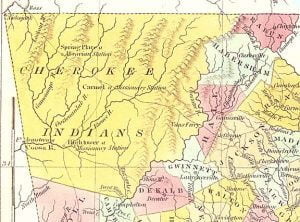
1830 Map of Cherokee Territory in Georgia

The Cherokee Indians, primarily from the Southeastern U.S., have a rich history marked by their early adoption of a written language and a government structure similar to that of the United States. Despite their forced relocation to Oklahoma in the 1830s, they maintained significant genealogical ties, often intermarrying with Whites. Emmet Starr’s “History of the Cherokee Indians and Their Legends and Folklore” emphasizes personal biographies and genealogies, providing insights into the lives and connections of many Cherokee families across generations, thereby enriching their cultural narrative.