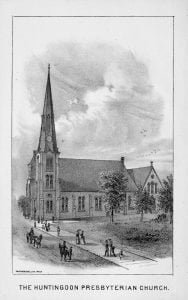
The Huntingdon Presbyterian Congregation, an historical sketch, 1789-1939
An historical sketch of the Huntingdon Presbyterian Congregation : in connection with the celebration of the sesqui-centennial of its founding, 1789 – November – 1939
The “Abbe-Abbey Genealogy” serves as a comprehensive and meticulously compiled homage to the heritage of the Abbe and Abbey families, tracing its roots back to John Abbe and his descendants. Initiated by the life-long passion of Professor Cleveland Abbe, this genealogical exploration began in his youth and expanded throughout his illustrious career, despite numerous challenges. It encapsulates the collaborative efforts of numerous family members and researchers, including significant contributions from individuals such as Charles E. Abbe, Norah D. Abbe, and many others, each bringing invaluable insights and data to enrich the family’s narrative.
Two volumes of Cox family genealogy combined as one. The first volume contains information about the various early Cox families across America. The second volume deals specifically with the descendants of James and Sarah Cock of Killingworth upon Matinecock, in the township of Oysterbay, Long Island, New York.
The aim of this history was to present in a permanent form the key incidents in the history of Minneapolis, from its earliest settlement to its publication in 1895. The primary facts and events recounted were mostly obtained from living witnesses and participants. It was rare for a city with more than two hundred thousand inhabitants to have so many of its first settlers still alive. The city’s growth had been so extraordinary and unprecedented that many of its earliest settlers remained. Some information was also gleaned from the notes left by now-deceased writers who witnessed the events described. Great care was taken to verify the accuracy of all facts and incidents mentioned. While it might have been too much to hope that the work was entirely free from errors, it was confidently believed that any such errors were few and insignificant.
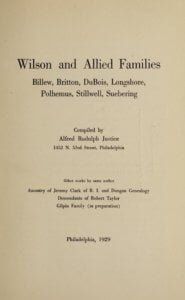
William Wilson, the pioneer ancestor of this family, emigrated from Stewardstown, County of Tyrone, Ireland, in 1732, when 19 years of age. The Town of Stewardstown is in the parish of Donagheny in the province of Ulster and eighty-two miles northwest of Dublin, long noted for its very superior linen cloth.
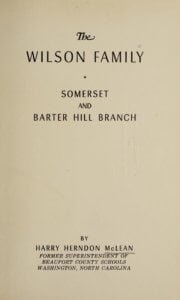
In the preparation of “The Wilson family, Somerset and Barter Hill branch” I have discovered two lists of the names of the sons and daughters of Col. Ben and Ann Seay Wilson of “Somerset” in Cumberland County, Virginia, in addition to the list found in my father’s notes. None of these was arranged in the same chronological order. It was my good fortune in 1915 to find the Bible, claimed to be the Bible of Col. Ben and Ann Seay Wilson of “Somerset” in Cumberland County, Virginia. At that time this was in the hands of Miss Clementine Reid Wilson, Col. Ben’s great-granddaughter, and it was my privilege to copy, with the aid of a reading glass, for the ink was badly faded, the names of their children from that Bible in the same chronological order in which they were recorded. This chronological order, and military records found, support each other. I therefore believe that this sketch contains the most accurate chronological list of Col. Ben’s and Ann Seay Wilson’s children to be found outside of his Bible.
FREE – Readable and downloadable copy of the Portrait and biographical record of Genesee, Lapeer and Tuscola counties, Michigan published in 1892.
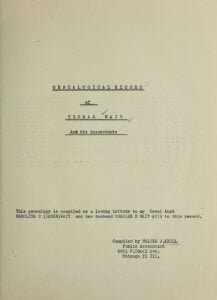
Genealogical Record of Thomas Wait and his descendants looks at the genealogy of Thomas Wait (1601-1677) who was from Wethersfield Parish, Essex, England. On his arrival in America, landing in Rhode Island, he applied for a lot on which to build,and was granted it on 7/1/1639. On 3/l6/l641 he became a Freeman in Newport R. I. He died in Portsmouth R. I., before April 1677 intestate. This Thomas Wait was a cousin to the Richard Waite of Watertown Mass., who was a large land owner. This unpublished manuscript provides the descendants of this family.
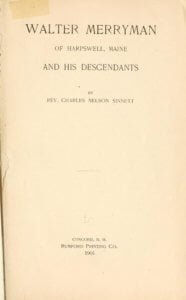
Walter Merryman was kidnapped in an Irish port in 1700 and brought to Boston, Massachusetts, where he was indentured to a shipbuilder in Portland, Maine. He married Elizabeth Potter and settled in Harpswell, Maine. Descendants and relatives lived in Maine, New Hampshire, Connecticut, New York, Pennsylvania, Idaho and elsewhere. Includes Alexander, Curtiss, Hamilton, McManus, Stover, Webber and related families.
Matthew Watson (d. 1720), of English lineage, married Mary Orr in 1695, and in 1718 the family immigrated from Ireland to Boston, Massachusetts and settled in Leicester, Massachusetts. Descendants and relatives lived in New England, New York, New Jersey, Pennsylvania, Ohio, Nebraska, Rhode Island, California, Nevada, Michigan and elsewhere. Includes Watson, Armington, Bemis, Denny, Draper, Kent, Washburn, Bailey, Barnard, Belcher, Bent, Biscoe, Bolles, Breckenridge, Bright, Browning, Bryant, Bullock, Burrage, Dennis, Fisher, Foster, Green, Hayward, Hobbs, Hodgkins, Holman, Howard, Jenks, Jones, Kellogg, Kitchell, Knight, Lazelle, Livermore, Loring, Mason, Maynard, Munger, Patrick, Prouty, Remington, Reed, Rice, Richardson, Rogers, Sadler, Sibley, Snow, Sprague, Stone, Studley, Symonds, Taitt, Thomas, Thompson, Trask, Tucker, Waite, Webster, Westcott, Wheeler, Whittermore, Wilson, Woods and related families.
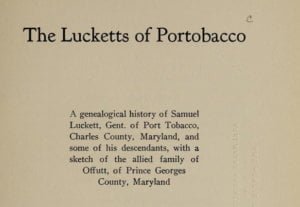
A genealogical history of Samuel Luckett, Gent, of Port Tobacco, Charles County, Maryland, and some of his descendants, with a sketch of the allied family of Ofifutt, of Prince Georges County, Maryland.
Adams, Adderton, Addison, Alexander, Applebaugh, Ashby, Atkisson, Baggett, Bainbridge, Baldwin, Barnes, Barney, Bartlett, Battle, Beale, Beall, Beatty, Beaven, Belt, Benson, Bethel, Blair, Borden, Bottrell, Bowie, Bradford, Brazier, Brengle, Briscoe, Brocke, Brogdon, Brown, Bryan, Burgess, Campbell, Cantwell, Carr, Carroll, Cave, Chiswell, Clapman, Clements, Clephane, Contee, Cooke, Cooper, Cope, Cox, Creek, Cumming, Dade, Davis, Delahay, Dent, Doling, Dorry, Dorsey, Douglas, Drone, Duval, Eagler, Earle, Edelen, Edmonston, Elms, Evans, Fendall, Ferguson, Field, Fink, Floyd, Fouch, Franklin, Galford, Gladden, Glahn, Glenn, Godfrey, Goodrick, Gracey, Graham, Gray, Green, Griffin, Gulick, Haddox, Hall, Hamill, Hamilton, Hanson, Harding, Harris, Harrison, Harrold, Hawkins, Haynie, Hobbs, Hobson, Holton, Hussey, Jamieson, Jenifer, Jenkins, Jett, Johnson, Jones, Jordan, Kalbfleisch, Keith, Kennedy, Kenner, Kerrick, Kybert, Langworth, Lawson, Lennarts, Lewis, Lilley, Lowe, Luckett, Lynn, Maddox, Magruder, Mantz, Manzy, Markham, Marlow, Martin, Marye, Mastin, Matthews, McCane, McCauley, Metcalf, Middleton, Miller, Minor, Mooney, Moore, Morehead, Morris, Mudd, Muir, Murray, Neale, Nelson, Nesbit, Nichnow, Nichollas, Odom, Offord, Offutt, Oldham, ORea, Orrell, Parker, Parnell, Patton, Payne, Perry, Peters, Peyton, Posey, Price, Ramsey, Rankin, Rasbury, Ratliff, Reed, Robey, Robinson, Roxborough, Sage, Sargeant, Sayles, Scott, Sewell, Seydel, Shaw, Shrive, Sidener, Skinner, Smith, Smoot, Sprigg, Spriplin, Steel, Stone, Sugar, Swansted, Swearingen, Taylor, Theobald, Thickpenny, Thompson, Tolson, Tongue, Trundle, Tyler, Venom, Wall, Wallace, Ware, Watkins, West, Westman, Wheadon, Wheeler, White, Whiting, Wickliff, Willcoxen, Williams, Withers, Witt, Wood, Woods, Woodward, Yates, Yost.

General Leavenworth’s expedition to the Wichita country faced significant challenges, suffering from sickness among his men and horses, leading to a drastic reduction in their numbers. Upon reaching the Washita River, Colonel Dodge took command of the reorganized force, now diminished to 250 men. Their journey included encounters with Comanche tribes, where they sought to establish peace and facilitate trade. As the expedition progressed, the troops faced further hardships, including loss of supplies and sickness, ultimately culminating in a crucial meeting with the Wichita tribe to discuss treaties and exchanges.
The Lincoln County New Mexico online archives contains pdf’s of all remaining copies of the El Farol Newspaper of Capitan NM, but doesn’t have an index to the newspaper. C. W. Barnum, an active member of AHGP, and state coordinator for the New Mexico AHGP recently invested his time and energy into providing an every person index to the various extant issues. He has shared this wonderful index with AccessGenealogy in hopes that it will reach a wider audience. Enjoy!
This manuscript, in its essence, is a collection of 948 biographies of prominent men and women, all leading citizens of Western Colorado. In this context, Western Colorado encompasses the counties of Archuleta, Chaffee, Delta, Eagle, Garfield, Gunnison, Hinsdale, La Plata, Lake, Mesa, Mineral, Moffat, Montezuma, Montrose, Ouray, Pitkin, Rio Blanco, Routt, San Juan, and San Miguel.
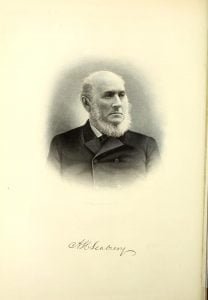
The Seabury family, with variations in spelling, traces its American roots to John Seabury of Boston, who died before 1662. His son, Samuel, a physician, fathered several children and settled in Duxbury before moving to Little Compton, Rhode Island. Notable descendants include Alexander Hamilton Seabury, a key businessman in New Bedford, who contributed to the city’s industrial growth and maritime trade. The family’s connections to early American history are emphasized through their ties to Mayflower descendants and various significant local enterprises.
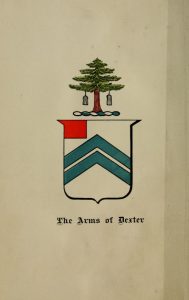
Being a history of the descendants of Richard Dexter of Malden, Massachusetts, from the notes of John Haven Dexter and original researches. Richard Dexter, who was admitted an inhabitant of Boston (New England), Feb. 28, 1642, came from within ten miles of the town of Slane, Co. Meath, Ireland, and belonged to a branch of that family of Dexter who were descendants of Richard de Excester, the Lord Justice of Ireland. He, with his wife Bridget, and three or more children, fled to England from the great Irish Massacre of the Protestants which commenced Oct. 27, 1641. When Richard Dexter and family left England and by what vessel, we are unable to state, but he could not have remained there long, as we know he was living at Boston prior to Feb. 28, 1642.
The 1860 census for the Creek Nation, located west of Arkansas, reveals a diverse array of free inhabitants, including Native Americans from Creek and Seminole tribes. This listing indicates that many individuals either renounced their tribal affiliations or were never granted citizenship. Several entries mark those who married Native individuals but were still denied citizenship, suggesting a complex social structure within the community. The presence of individuals identified by racial categories reflects the intricate interplay of identities during this period.
A historical overview of western Nebraska and its pioneer settlers, this volume highlights the men who helped build counties across the Nebraska Panhandle, including Cheyenne, Box Butte, Deuel, Garden, Sioux, Kimball, Morrill, Sheridan, Scotts Bluff, Banner, and Dawes. It also points readers to biographies, history volumes, and a gallery of 143 photographs.
Alexander Bisset Munro was born 25 Dec. 1793 at Inverness, Scotland to Donald and Janet (Bisset) Munro. Alexander left Scotland at the age of 14, and lived in Dimecrana in the West Indies for 18 years. He owned a plantation, raising cotton, coffee and other produce. He brought produce to Boston Massachusetts on the ship of Solomon Dockendorff. To be sure he got his money, Solomon asked his to come home with him, where he met Solomon’s sister, Jane Dockendorff. Alexander went back to the West Indies, sold out, and moved to Round Pond, Maine, and married Jane. They had 14 children: Janet, Alexander, Margaret, Nancy, Jane, Mary, Solomon, Donald, John, William, Bettie, Edmund, Joseph and Lydia.