History of Newport New Hampshire

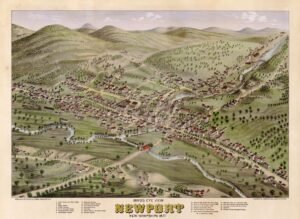
Bird's Eye View of Newport New Hampshire 1877

The History of Newport, New Hampshire, from 1766 to 1878 is a record of Newport’s growth from its early settlement through the close of the nineteenth century. It opens with the original charter and proprietary arrangements and follows the development of Newport’s physical setting, transportation routes, and economy. Particular attention is given to mills, banks, hotels, manufacturing, and the coming of the railroad, all of which shaped the town’s commercial life. The concluding genealogical section identifies families connected with Newport and other chapters provide biographical details that might otherwise be lost.
Ashfield Massachusetts Vital Records

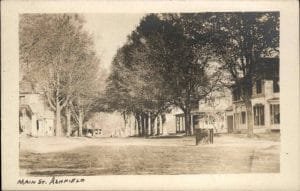
Main Street, Ashfield, Massachusetts

Alphabetical indexes to the vital records of Ashfield, Massachusetts, up to the year 1850, supplemented by information from bible records, church registers, cemetery inscriptions and other sources. PDF file is free to read and download.

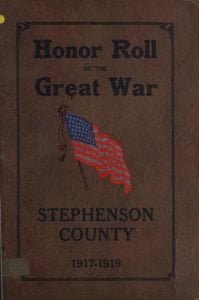
Stephenson County Illinois World War 1 Veterans

Honor roll of the Great War, Stephenson County, 1917-1919

This small booklet contains all the known men and women who participated in World War 1 and claimed their home of record as Stephenson County, Illinois. By participation, this record does not limit this to soldiers, but also contains the records of those men and women who served the Red Cross, Y.M.C.A., and other non-fighting positions. This book is free to read or download.

The Amidon Family of Rehoboth, MA

The Amidon Family

The Amidon Family genealogy book details the lineage of Roger Amadowne, a French Huguenot who fled to England and later to America after the revocation of the Edict of Nantes. Documented in Salem, Massachusetts in 1637, variations of his surname include Amadon, Amidown, and Ammidon. The work, organized with biographical sketches and two helpful indexes, presents the family’s history and is richly illustrated. Originally published in 1904, it serves as a valuable resource for descendants and historians alike.

Families of Ancient New Haven

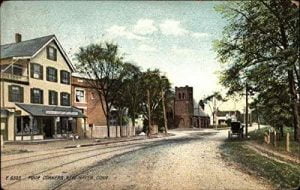
Four Corners New Haven Connecticut

The Families of Ancient New Haven compilation includes the families of the ancient town of New Haven, covering the present towns of New Haven, East Haven, North Haven, Hamden, Bethany, Woodbridge and West Haven. These families are brought down to the heads of families in the First Census (1790), and include the generation born about 1790 to 1800. Descendants in the male line who removed from this region are also given, if obtainable, to about 1800, unless they have been adequately set forth in published genealogies.

Abbe-Abbey Genealogy

A genealogical dictionary of the first settlers of New England vol 1

The “Abbe-Abbey Genealogy” serves as a comprehensive and meticulously compiled homage to the heritage of the Abbe and Abbey families, tracing its roots back to John Abbe and his descendants. Initiated by the life-long passion of Professor Cleveland Abbe, this genealogical exploration began in his youth and expanded throughout his illustrious career, despite numerous challenges. It encapsulates the collaborative efforts of numerous family members and researchers, including significant contributions from individuals such as Charles E. Abbe, Norah D. Abbe, and many others, each bringing invaluable insights and data to enrich the family’s narrative.

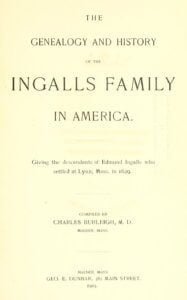
The genealogy and history of the Ingalls family in America

The genealogy and history of the Ingalls family in America

Edmund Ingalls, son of Robert, was born about 1598 in Skirbeck, Lincolnshire, England. He immigrated in 1628 to Salem, Massachusetts and with his brother, Francis, founded Lynn, Massachusetts in 1629. He married Ann, fathered nine children, and died in 1648.

Leach Genealogy of Bridgewater, Massachusetts

James Cushing Leach

The Leach family has been integral to Bridgewater, Massachusetts, since its early settlement, with roots tracing back to Lawrence Leach, an immigrant from England in 1629. His descendants, including Giles Leach, a town founder, and James Cushing Leach, a prominent businessman and politician, have significantly influenced the community. The Leach lineage is marked by contributions to public service, education, and local governance, fostering a rich heritage in the region. The genealogy reflects a lineage of resilience and commitment to civic duty, underscoring the family’s enduring legacy.

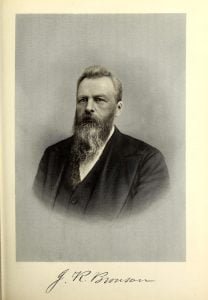
Ancestors of John Richardson Bronson of Attleboro, MA

J. R. Bronson

John Richardson Bronson, M.D., born June 5, 1829, in Middlebury, Connecticut, was a distinguished physician in southern Massachusetts and Rhode Island, residing in Attleboro for over fifty years. The Bronson lineage traces back to early New England settlers, including John Bronson, a soldier in the Pequot War. Dr. Bronson, who graduated from Berkshire Medical College in 1852, served as a field surgeon during the Civil War and remained engaged in community affairs until his death on May 9, 1900. He married Catherine Wheelock and had five children.

Migration of Families out of Norwich VT

In the late 18th and early 19th centuries, Norwich, Vermont, experienced significant emigration, leading to a notable decline in its population. Initially home to 40 families in 1771, the town saw many residents relocate to newer settlements, such as Royalton and Randolph, during and after the Revolutionary War. Prominent families, including the Hibbards and Carpenters, contributed to the establishment of towns in northern Vermont and beyond. By the 1800s, the trend of outmigration intensified, marking a long-term shift in the region’s demographic landscape.

The Meeting in 1811 of Tecumseh and Apushamatahah

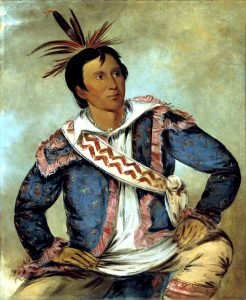
Peter Perkins Pitchlynn was the Choctaw Principal Chief from 1864-1866

In 1811, Tecumseh, the Shawnee leader, met with Apushamatahah, a prominent Choctaw chief, to rally southern tribes against American encroachment amidst looming war between the U.S. and England. Tecumseh passionately urged unity against their common foe, warning of the dire consequences of inaction. Apushamatahah countered with a call for prudence, advocating for peaceful measures. Ultimately, the council resulted in favoring American alliance, thwarting Tecumseh’s ambitions. This pivotal meeting highlighted the contrasting strategies of the two influential leaders, shaping tribal responses during a critical historical period.

Biographical Sketch of Benjamin Griswold

Benjamin Griswold settled in Bristol Flats in 1787, moving from New York with his family to a portion of the former Morgan estate. After a few years, he relocated to Cambridge, Vermont. His son Horace became notable as the second child born in the township.

Biographical Sketch of Lester Griswold

Lester Griswold, born on April 18, 1786, was the second son of a pioneer family in Orwell. He married Lucinda Parks, and they had six children, including Emmitt Darwin, a prominent figure in Orwell known for his high-quality farm and thoroughbred livestock. Emmitt married Martha Conkey, and they had two daughters, Gracie L. and Mary C. The Griswold family’s legacy highlights their contributions to the community and the success of their agricultural endeavors.

Biography of David F. Griswold

David F. Griswold, born on December 26, 1854, in Racine, is a prominent city editor of the Racine Journal, reflecting a long career in journalism. After starting his apprenticeship at the Racine Weekly Argus, he moved to the Daily Journal, where he has earned recognition for his effective reporting. A member of various fraternal organizations and the Racine Commercial Club, Griswold is committed to promoting community welfare and holds an independent political stance, with ties to St. Luke’s Episcopal Church.

Biographical Sketch of Frederick Griswold and Harvey Griswold

Harvey and Frederick Griswold, cousins from Connecticut, ventured to Warren County, Missouri, at an early age. Frederick opened the first store in Pinckney after marrying Rebecca Shobe, while Harvey, arriving as a teen, began as a clerk in Frederick’s store. Eventually, he established his own store in Marthasville, gaining significant wealth. Married to Mahala Shobe, they had sixteen children, though only six survived. Harvey notably owned the land of Daniel Boone’s graves, opposing their removal and planning to erect a monument there.