New Hampshire Men

New Hampshire Men presents 407 biographical sketches, with portraits, of men who were active in commercial, professional, and political life in New Hampshire in 1893.

New Hampshire Men presents 407 biographical sketches, with portraits, of men who were active in commercial, professional, and political life in New Hampshire in 1893.
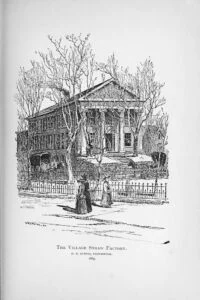
Alphabetical indexes to the vital records of Medway, Massachusetts, up to the year 1850, supplemented by information from church registers, cemetery inscriptions and other private sources to include Rev. Dr. Jacob Ide’s account of Marriages and Deaths, 1814-1849.
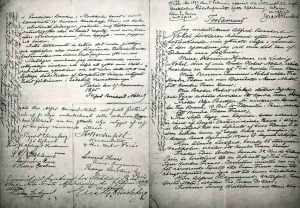
The “Governor and Company of Massachusetts Bay” established a judicial system in 1628, with a General Court in Boston and quarterly courts in major towns like Salem and Ipswich by 1635. These courts managed probate matters, and after Essex County’s formation in 1643, individual probate courts were later established in 1692. These are the probate records from 1665 to 1674, sourced from various original documents, including detailed wills and estate settlements.
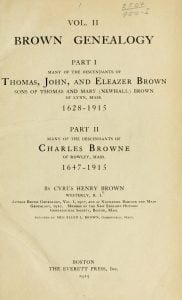
In 1895, Cyrus Henry Brown began collecting family records of the Brown family, initially with the intention of only going back to his great-grandfathers. As others became interested in the project, they decided to trace the family lineage back to Thomas Brown and his wife Mary Newhall, both born in the early 1600s in Lynn, Massachusetts. Thomas, John, and Eleazer, three of their sons, later moved to Stonington, Connecticut around 1688. When North Stonington was established in 1807, the three brothers were living in the southern part of the town. Wheeler’s “History of Stonington” contains 400 records of early descendants of the Brown family, taken from the town records of Stonington. However, many others remain unidentified, as they are not recorded in the Stonington town records. For around a century, the descendants of the three brothers lived in Stonington before eventually migrating to other towns in Connecticut and New York State, which was then mostly undeveloped. He would eventually write this second volume of his Brown Genealogy adding to and correcting the previous edition. This book is free to search, read, and/or download.

The History of Littleton New Hampshire is comprised of three volumes, two volumes of history, and a final volume of genealogies. Considered one of the best examples of local history written in the early 20th century, is your ancestors resided in Littleton then you need these books. Read and download for free!
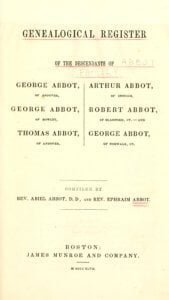
In 1847, Abiel Abbot and Ephraim Abbot compiled a comprehensive genealogical record titled “Abbott Genealogical Register,” detailing the lineage of several Abbott families originating from early New England settlers. Initially aimed to document the descendants of George Abbot, Sr. of Andover, the scope expanded to include numerous branches such as George Abbot, Jr., Thomas Abbot of Andover, Arthur Abbot of Ipswich, Robert Abbot of Branford, Ct., and George Abbot of Norwalk, Ct., among others. This volume, published by J. Munroe and Company in Boston, Massachusetts, integrates meticulously gathered data, revealing the expansive and intertwined genealogies of the Abbott families. The authors’ painstaking research and dedication to accuracy, despite challenges in data completeness, provide a valuable resource for anyone tracing the Abbott lineage or studying early American familial structures.
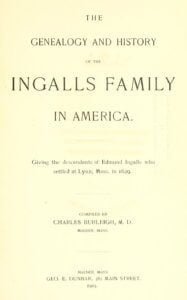
Edmund Ingalls, son of Robert, was born about 1598 in Skirbeck, Lincolnshire, England. He immigrated in 1628 to Salem, Massachusetts and with his brother, Francis, founded Lynn, Massachusetts in 1629. He married Ann, fathered nine children, and died in 1648.

This book, “The Descendants of Franklin Mary Noyes Rowe of Humboldt County, Iowa, with Some Notes on Their Ancestors,” authored by Velma Rowe Coffin in Storm Lake, Iowa, in 1955, is a meticulously researched genealogical record spanning 87 pages. It traces the lineage of Franklin Rowe, born December 30, 1836, in Onondaga County, New York, and provides insights into his ancestry and descendants. Free to read or download.
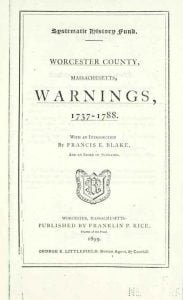
The document lists names and details of individuals warned out of Charlton, Massachusetts, from 1737 to 1788, as recorded by the Court of Quarter Sessions. The practice originated from a 1692-3 act aimed at preventing dependence on towns for support from newcomers not warned out. The entries, organized by date, include families and individuals regardless of their economic status, indicating that warnings were not exclusively for the impoverished. Notable entries span decades, featuring numerous families and diverse circumstances.
The document lists warnings issued in Brookfield, Massachusetts from 1737 to 1788, detailing names and dates of individuals and families warned out of town. Under the 1692-3 act, towns could warn newcomers not residing for three months to avoid supporting them if they proved to be burdensome. The returns include various residents, many of whom became notable citizens, emphasizing that being warned did not necessarily indicate poverty or need. Each entry is organized by names and dates, reflecting local governance practices.
The document outlines the warnings issued in Bolton, Massachusetts, from 1737 to 1788, detailing individuals, families, and children who were advised to leave the town to avoid becoming permanent residents. This practice was rooted in a 1692 act that aimed to protect towns from the financial burden of supporting newcomers deemed unfit. The names and circumstances of those warned are presented chronologically, demonstrating the diverse backgrounds of the warned individuals, many of whom were not necessarily impoverished.
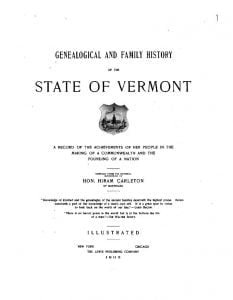
Hiram Charlton took on the publication of the Genealogical and Family History of the State of Vermont for Lewis Publishing. In it, he enlisted the assistance of living residents of the state in providing biographical and genealogical details about their family, and then he published all 1104 family histories in two distinct volumes.
Hon. Thomas Murdock moved to Norwich from Connecticut in 1767, marrying Elizabeth Hatch and raising a family that included six children. Prominent in local affairs, he held various positions before his death in 1803. His sons, Asahel and Constant, were active voters, with Asahel eventually returning to Connecticut. Jasper, also a son, built an impressive residence at Norwich Plain. The estate changed hands over the years, influencing the town’s development, and remnants of it, including a fish pond, remain part of its history.

The Treaty of October 11, 1842, involved the Confederated tribes of the Sac and Fox Indians ceding their lands west of the Mississippi River to the United States, while reserving a right to occupy these lands for three years. The treaty stipulated annual payments to the tribes and provisions for their relocation, including assistance during their move and the establishment of blacksmith and gunsmith shops. An agreement for necessary funds for the tribes’ welfare and charitable purposes was also included. The treaty required Senate ratification and consent from the tribes for any amendments.
Hon. Melancthon Z. Goodell, born in 1837 in Ohio, moved west with his family in 1850, settling initially in Oregon before relocating to Washington Territory. A participant in the Indian War, he later farmed near Elma for over twenty years before becoming a lumber and real estate dealer in Montesano. Goodell’s public service includes two terms as sheriff, two as assessor of Chehalis County, and two terms in the legislature. He married Rebecca Byles in 1858 and has eight children.