History of Rindge New Hampshire

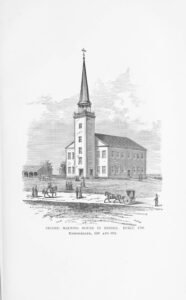
Second Meeting House in Rindge New Hampshire

The History of the Town of Rindge, New Hampshire by Ezra S. Stearns, was published in 1875, and covers the period from the original Rowley Canada grant or Massachusetts charter through the year 1874. Stearns traces the legal, territorial, and institutional development of Rindge, beginning with colonial land grants and boundary disputes and proceeding through settlement, incorporation into a town and development into a small manufacturing hub. More than half the volume is devoted to genealogical material. The genealogical register of Rindge families includes thousands of names compiled from a wide range of sources and assisted by contributions from residents and researchers beyond the town.
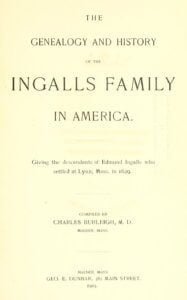
The genealogy and history of the Ingalls family in America

The genealogy and history of the Ingalls family in America

Edmund Ingalls, son of Robert, was born about 1598 in Skirbeck, Lincolnshire, England. He immigrated in 1628 to Salem, Massachusetts and with his brother, Francis, founded Lynn, Massachusetts in 1629. He married Ann, fathered nine children, and died in 1648.

Holman Family of Attleboro Massachusetts

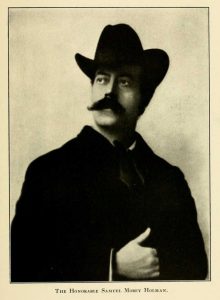
Samuel Morey Holman

The Holman family has been a significant presence in Massachusetts for over two centuries, deeply involved in the social, religious, and educational spheres of Attleboro. Their lineage traces back to Solomon Holman, an early settler believed to have arrived from Bermuda, whose descendants include notable figures like Rev. Nathan Holman and Dr. David Emory Holman. The family has contributed richly to local and national life, with members excelling in various professions, including ministry, medicine, and the arts, particularly through Samuel Francis Holman, an acclaimed artist in Paris.

Holman Family of Attleboro, MA

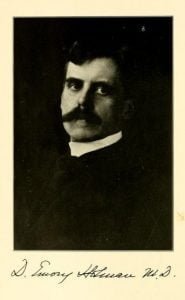
David Emory Holman

The Holman family of Attleboro, Massachusetts, has a rich heritage spanning over two centuries, tracing back to Solomon Holman, who arrived from the Bermuda Islands in the late 17th century. This lineage produced notable figures, including Rev. Nathan Holman, a long-serving pastor, and prominent descendants like Dr. David Emory Holman and artist Samuel Francis Holman. The family has significantly influenced the social, religious, and educational landscape of Attleboro, with members achieving distinction in various fields and maintaining a legacy of civic engagement and community upliftment.

1860 Census West of Arkansas – Creek Nation

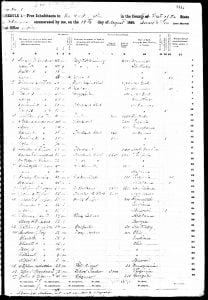
1860 Free Inhabitants Creek Nation Page 1

The 1860 census for the Creek Nation, located west of Arkansas, reveals a diverse array of free inhabitants, including Native Americans from Creek and Seminole tribes. This listing indicates that many individuals either renounced their tribal affiliations or were never granted citizenship. Several entries mark those who married Native individuals but were still denied citizenship, suggesting a complex social structure within the community. The presence of individuals identified by racial categories reflects the intricate interplay of identities during this period.

The Meeting in 1811 of Tecumseh and Apushamatahah

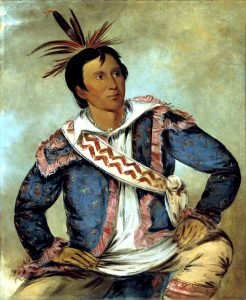
Peter Perkins Pitchlynn was the Choctaw Principal Chief from 1864-1866

In 1811, Tecumseh, the Shawnee leader, met with Apushamatahah, a prominent Choctaw chief, to rally southern tribes against American encroachment amidst looming war between the U.S. and England. Tecumseh passionately urged unity against their common foe, warning of the dire consequences of inaction. Apushamatahah countered with a call for prudence, advocating for peaceful measures. Ultimately, the council resulted in favoring American alliance, thwarting Tecumseh’s ambitions. This pivotal meeting highlighted the contrasting strategies of the two influential leaders, shaping tribal responses during a critical historical period.

Improvements to Annexed Cherokee Lands

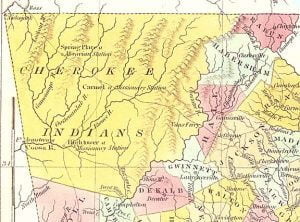
1830 Map of Cherokee Territory in Georgia

The Treaty of May 6, 1828, granted the Cherokee Nation 7 million acres as a permanent home, recognizing their sovereignty while mandating the cession of remaining lands to the United States. As a result, some Cherokee settlers were displaced from previously believed tribal lands. The treaty stipulated that land ceded would be appraised, and cash payments would be made for improvements made by proprietors. Numerous accounts detail the assessed value of various improvements, reflecting the complexities of land and ownership during this period.