Genealogy of Woodland, Idaho Families

Woodland Friends Church Sign

This book is based upon data secured by personal interviews and various other reliable sources of information concerning Woodland Idaho genealogy and history under the editorial supervision of Edna L. Egleston in 1944.
Brown Genealogy

Brown Genealogy

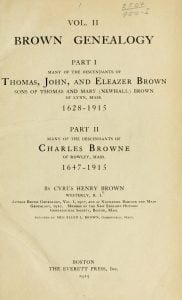
In 1895, Cyrus Henry Brown began collecting family records of the Brown family, initially with the intention of only going back to his great-grandfathers. As others became interested in the project, they decided to trace the family lineage back to Thomas Brown and his wife Mary Newhall, both born in the early 1600s in Lynn, Massachusetts. Thomas, John, and Eleazer, three of their sons, later moved to Stonington, Connecticut around 1688. When North Stonington was established in 1807, the three brothers were living in the southern part of the town. Wheeler’s “History of Stonington” contains 400 records of early descendants of the Brown family, taken from the town records of Stonington. However, many others remain unidentified, as they are not recorded in the Stonington town records. For around a century, the descendants of the three brothers lived in Stonington before eventually migrating to other towns in Connecticut and New York State, which was then mostly undeveloped. He would eventually write this second volume of his Brown Genealogy adding to and correcting the previous edition. This book is free to search, read, and/or download.

South Britain Connecticut Sketches and Records

South Britain Sketches and Records

This book contains much valuable genealogical data from local church records and cemeteries, and brief accounts of the following families : — Allen, Averill, Barnes, Bassett, Booth, Bradley, Bray, Canfield, Downs, Edmonds, French, Gilbert, Guthrie, Hann, Hayes, Hendryx, Hill, Mitchell, Pierce, Piatt, Post, Russell, Skeels, Stoddard, Tuttle, Wagner, Wakeley, Ward and Warner.

1860 Census West of Arkansas – Creek Nation

1860 Free Inhabitants Creek Nation Page 1

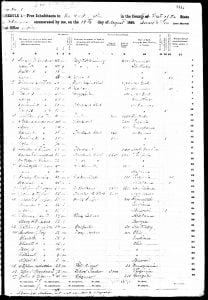
The 1860 census for the Creek Nation, located west of Arkansas, reveals a diverse array of free inhabitants, including Native Americans from Creek and Seminole tribes. This listing indicates that many individuals either renounced their tribal affiliations or were never granted citizenship. Several entries mark those who married Native individuals but were still denied citizenship, suggesting a complex social structure within the community. The presence of individuals identified by racial categories reflects the intricate interplay of identities during this period.