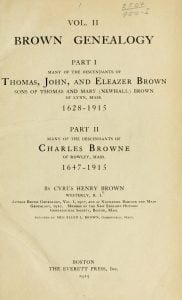
Brown Genealogy

Brown Genealogy

In 1895, Cyrus Henry Brown began collecting family records of the Brown family, initially with the intention of only going back to his great-grandfathers. As others became interested in the project, they decided to trace the family lineage back to Thomas Brown and his wife Mary Newhall, both born in the early 1600s in Lynn, Massachusetts. Thomas, John, and Eleazer, three of their sons, later moved to Stonington, Connecticut around 1688. When North Stonington was established in 1807, the three brothers were living in the southern part of the town. Wheeler’s “History of Stonington” contains 400 records of early descendants of the Brown family, taken from the town records of Stonington. However, many others remain unidentified, as they are not recorded in the Stonington town records. For around a century, the descendants of the three brothers lived in Stonington before eventually migrating to other towns in Connecticut and New York State, which was then mostly undeveloped. He would eventually write this second volume of his Brown Genealogy adding to and correcting the previous edition. This book is free to search, read, and/or download.
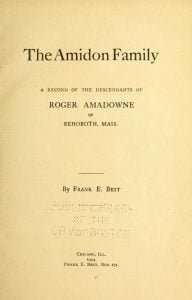
The Amidon Family of Rehoboth, MA

The Amidon Family

The Amidon Family genealogy book details the lineage of Roger Amadowne, a French Huguenot who fled to England and later to America after the revocation of the Edict of Nantes. Documented in Salem, Massachusetts in 1637, variations of his surname include Amadon, Amidown, and Ammidon. The work, organized with biographical sketches and two helpful indexes, presents the family’s history and is richly illustrated. Originally published in 1904, it serves as a valuable resource for descendants and historians alike.

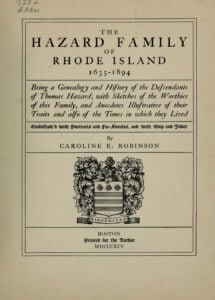
The Hazard family of Rhode Island 1635-1894

The Hazard family of Rhode Island 1635-1894

The Hazard family of Rhode Island 1635-1894 – Being a genealogy and history of the descendants of Thomas Hazard, with sketches of the worthies of this family, and anecdotes illustrative of their traits and also of the times in which they lived.

Dwelly Family of Fall River, MA

The Dwelly family of Fall River, MA, traces its origins back to Richard Dwelly, who settled in Scituate in the mid-17th century. Notably, Dr. Jerome Dwelly, a well-respected physician, significantly contributed to the community for over sixty years. His son, Frank H. Dwelly, excelled in mill management, serving as treasurer for Tecumseh and Ancona companies. The family’s story weaves through generations, marked by professional accomplishment and community service, with both Jerome’s medical innovations and Frank’s business acumen shaping Fall River’s landscape.

Hutchinson Family of Norwich Vermont

The Hutchinson family, one of the early settlers in Norwich, Vermont, traces its roots back to Massachusetts in the late 1620s. Abijah Hutchinson, a descendant, settled in Windham before moving to Norwich in 1765 with his son Samuel. They cleared land for farming and eventually made a permanent settlement. Samuel and his wife Jemina had several children, continuing the lineage. John Hutchinson, a soldier in the Continental Army, and his descendants include notable figures and various branches in New York and beyond.

Biography of Doctor Ira Davis

Doctor Ira Davis, born around 1797 in Dracut, Massachusetts, began his medical practice in Norwich Plain in 1830, serving the community until his death in 1873. In addition to his medical career, he was active in local journalism, co-editing the Vermont Enquirer, and was instrumental in establishing the Episcopal church and Norwich University. A politically engaged figure, he served as town clerk and postmaster. He married three times, fathering several children, including Doctor George Davis, a physician in Manchester, New Hampshire.

Migration of Families out of Norwich VT

In the late 18th and early 19th centuries, Norwich, Vermont, experienced significant emigration, leading to a notable decline in its population. Initially home to 40 families in 1771, the town saw many residents relocate to newer settlements, such as Royalton and Randolph, during and after the Revolutionary War. Prominent families, including the Hibbards and Carpenters, contributed to the establishment of towns in northern Vermont and beyond. By the 1800s, the trend of outmigration intensified, marking a long-term shift in the region’s demographic landscape.

Norwich Vermont in the Revolutionary War

Norwich, Vermont provided modest participation in the Revolutionary War, highlighted by its formation of a Committee of Safety in March 1777. Evidence suggests a militia was established as early as 1774. The town contributed to regiments under Colonels Warner and Bedell. Local militias organized for defense amid threats from British forces in 1776, further demonstrating Norwich’s involvement. Despite lacking comprehensive records, the enlistment of local soldiers was significant, along with efforts to protect the community from loyalist activities and contribute to the war effort.

Biography of Clarence S. Crary

Clarence S. Crary, born on March 30, 1879, in Boone, Iowa, is recognized as a prominent banker and “Builder of Banks.” He graduated from Stanford University in 1903. Crary has served as Cashier of the Bank of Burlingame and holds leadership roles in local organizations, including the Burlingame Commercial Club and Merchants Association. His banking career began in 1906, where he played a vital role in establishing banks in California’s oil fields and has been instrumental in doubling the business volume of the Bank of Burlingame.