New Hampshire Men

New Hampshire Men presents 407 biographical sketches, with portraits, of men who were active in commercial, professional, and political life in New Hampshire in 1893.

New Hampshire Men presents 407 biographical sketches, with portraits, of men who were active in commercial, professional, and political life in New Hampshire in 1893.
New Hampshire Men of Progress contains 289 biographical sketches and portraits of leaders in business and professional life in and of the state of New Hampshire. It was edited by the staff of the Manchester Union under the supervision of Richard Herndon.
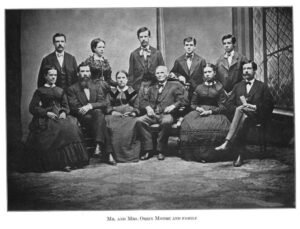
The genealogical record of Goffstown, New Hampshire, was a substantial undertaking, hampered by the extinction of early families and the widespread scattering of descendants. Efforts to gather vital statistics necessitated considerable travel and correspondence, often revealing discrepancies in recorded dates across various sources. Despite challenges, contributions from former works and assistance from individuals proved invaluable in compiling this record. The comprehensive index reflects the depth of research involved in documenting the town’s heritage.

History of Francestown, New Hampshire is a historic and genealogical record of the town from its first settlement in 1758 through the beginning of 1891. It records Francestown’s settlement, civic growth, religious and educational institutions, military participation, industries, and social customs, followed by an extensive genealogical register of families associated with the town.
This survey of Wintergreen Cemetery, Port Gibson, Mississippi, was completed in 1956 by Mr. Gordon M. Wells and published by Joyce Bridges the same year. It contains the cemetery readings Mr. Wells was able to obtain at that date. It is highly likely that not all of the gravestones had survived up to that point, and it is even more likely that a large portion of interred individuals never had a gravestone.
“History of Blaine Washington, 1884-1959” offers a comprehensive and engaging exploration of Blaine, Washington’s rich history and cultural heritage. Published in 1959 to commemorate the diamond jubilee of Blaine, this book captures the essence of a community that has thrived on the principles of peace and cooperation. Situated in Whatcom County, Blaine’s unique geographical location near the Canadian border plays a pivotal role in its identity, an aspect vividly illustrated through the symbol of the International Peace Arch.

The sources from which the Early Records of Londonderry, Windham, and Derry, N.H. have been drawn are Volumes I and II of the old town books. These old town books include minutes, ear markings, surveyors and homestead records, tax lists, inventory lists, accounts, school records and other miscellaneous records.

This manuscript, in its essence, is a collection of 948 biographies of prominent men and women, all leading citizens of Western Colorado. In this context, Western Colorado encompasses the counties of Archuleta, Chaffee, Delta, Eagle, Garfield, Gunnison, Hinsdale, La Plata, Lake, Mesa, Mineral, Moffat, Montezuma, Montrose, Ouray, Pitkin, Rio Blanco, Routt, San Juan, and San Miguel.
History of Kossuth, Hancock, and Winnebago Counties, Iowa together with sketches of their cities, villages and townships, educational, civil, military and political history; portraits of prominent persons, and 638 biographies of representative citizens. Also included is a history of Iowa embracing accounts of the pre-historic races, and a brief review of its civil and military history.
A detailed listing of Louisiana land patents for the Choctaw Tribe, organized by patentee name, date, document number, and accession number. The record includes many Native and non-Native grantees and spans patents issued from the 1840s through the early 1900s, offering a valuable reference for historical land and genealogy research.
In March 1879, Edgar Place, the residence of Hon. W. J. Christie, was first seen amidst winter’s deep snow. Christie, born in 1824 at Fort Albany, had a distinguished career with the Hudson Bay Company, serving in various roles including Chief Factor and Inspector across Canada’s vast Northwest. Renowned for his diplomatic skills during the Biel insurrection, he helped prevent significant losses to the company. After thirty-one years of service, he settled in Brockville in 1873, leaving a legacy enriched by extensive travels and experiences in the fur trade.
Senator David Christie, born in Edinburgh in October 1818, immigrated to Canada in 1833. He established himself as a prominent agriculturist and cattle breeder in Brantford and served on various agricultural boards. Christie was a member of the Canadian Parliament from 1851 to 1867, later joining the Senate. He was sworn into the Privy Council in 1873, becoming Secretary of State and then Speaker of the Senate. A devout Presbyterian, Christie was recognized for his contributions to agriculture and public service.
E. B. Christie, born March 10, 1851, in Shelby County, Kentucky, moved with his family to Missouri in 1853. He became a successful teacher and was the first educator in Pattonsburg, where he later served as mayor. Christie married Marv E. Best in 1876, with whom he had two children. He engaged in mercantile ventures, constructing the first stone building in Elm Flat and is currently building a business house in Pattonsburg. Christie is also known for his public service and involvement in educational initiatives.
This document contains genealogical statements regarding various individuals and families of Creek, Choctaw, Chickasaw, and Mississippi Choctaw descent who sought recognition and enrollment in tribal rolls. The records, primarily from 1909 reports, detail claimants’ ancestry, enrollment issues, and tribal affiliations. Many individuals were denied enrollment due to factional disputes, legal technicalities, or failure to apply within deadlines. The document includes references to official reports and affidavits, offering insights into the complexities of Native American citizenship and land rights during the early 20th century.
List of Cherokees and Cherokee Freedmen whose names were omitted from final rolls because no application was made or by reason of mistake or oversight. Shows the names of 125 Cherokees by blood and 2 Cherokee freedmen all except 5 being minors, and most of them less than 4 years of age March 4, 1906.