Vital Records of Sheffield Massachusetts, 1733-1792

Map of Sheffield, Harstville, Southfield and New Marlborough Massachusetts

The vital records of Sheffield, Massachusetts from 1733 to 1792 detail the town’s historical births, marriages, and deaths. While names and dates are transcribed accurately, some wording has been abbreviated for clarity. Marriage records often specify the union of couples, while birth records typically include parental names. Notably, some families lack marriage entries, starting instead with a child’s birth. The records also document a few out-of-wedlock births, emphasizing lineage through parental names, even in adult death records.
History of Carbondale, Illinois, 1852-1905

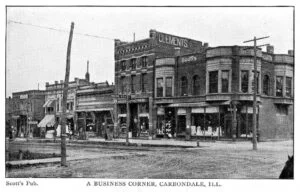
A Business Corner, Carbondale

Carbondale, Illinois, spans about 6,000 acres, primarily in the southwest quarter of Carbondale Township, established following congressional guidelines. Early settlers settled near Little Crab Orchard and Piles Fork creeks. The city’s growth is intertwined with the contributions of its founders, highlighted through 330 biographical sketches in the book, which offer details into their lives during challenging times. Carbondale’s history reflects the influence of individual leadership on municipal progress, celebrated here in the context of the nation’s bicentennial.

Slave Narrative of Walter Calloway

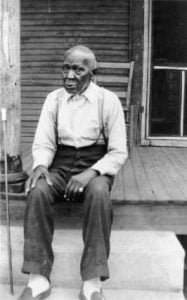
Walter Calloway

Walter Calloway, an 89-year-old former slave, reflects on his life during an interview in Birmingham, Alabama, in 1937. Born in Richmond, Virginia, in 1848, he recounts being sold to a plantation owner in Montgomery, where he faced hard work but relatively fair treatment. He describes witnessing the Civil War’s impact and the destruction caused by Union raiders. Although emancipation brought freedom, he notes that many former slaves, including himself, continued to work just as hard under difficult circumstances. Calloway’s narrative captures the resilience and hardships of ex-slaves.

Records of Pleasant Hill Methodist Church, 1829-1894

Pleasant Hill Methodist Church, 1953

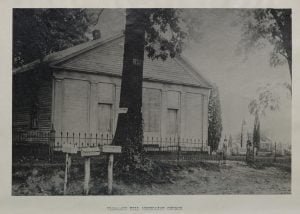
This is a copy of a record book of the Pleasant Hill Methodist Church in Washington Township, Guernsey County, Ohio. The front portion of this manuscript contains the history of Pleasant Hill Methodist Church, which we provide here, and biographies of their pastors up to 1953. Starting on page 18 you will find the Membership Record for the church beginning in 1829 and through January of 1894.

Logan County, Kentucky Wills – Book A, with index

Will book A, Logan County, Kentucky

The wills in this book come from Book A of the Wills found at the Logan County Court house in Russellville, Kentucky. The information was extracted in 1957 by Mrs. Vick on behalf of the DAR located in Russellville. The text in this book was done with an old manual typewriter and has the usual faint and filled-in type often found with such papers. On top of the difficulty in interpreting the print from the typewriter, the scanning process was also deficient, and led to the creation of a faint digital copy exacerbating the difficult to read text.

History of Sheldon Illinois, 1859-1959

Sheldon Centennial

The “History of Sheldon Illinois, 1859-1959,” compiled by the Sheldon Centennial History Committee, offers an immersive journey into the development of Sheldon, Illinois, over its first century. It seeks to celebrate and memorialize the efforts of those early settlers whose dreams and toil laid the foundation for the Sheldon we know today.

Stephenson County Illinois World War 1 Veterans

Honor roll of the Great War, Stephenson County, 1917-1919

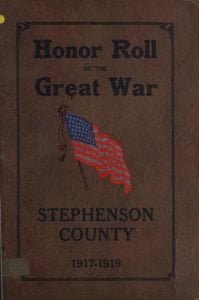
This small booklet contains all the known men and women who participated in World War 1 and claimed their home of record as Stephenson County, Illinois. By participation, this record does not limit this to soldiers, but also contains the records of those men and women who served the Red Cross, Y.M.C.A., and other non-fighting positions. This book is free to read or download.

Brown Genealogy

Brown Genealogy

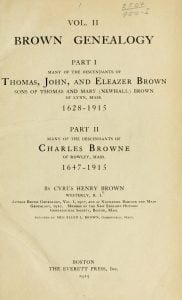
In 1895, Cyrus Henry Brown began collecting family records of the Brown family, initially with the intention of only going back to his great-grandfathers. As others became interested in the project, they decided to trace the family lineage back to Thomas Brown and his wife Mary Newhall, both born in the early 1600s in Lynn, Massachusetts. Thomas, John, and Eleazer, three of their sons, later moved to Stonington, Connecticut around 1688. When North Stonington was established in 1807, the three brothers were living in the southern part of the town. Wheeler’s “History of Stonington” contains 400 records of early descendants of the Brown family, taken from the town records of Stonington. However, many others remain unidentified, as they are not recorded in the Stonington town records. For around a century, the descendants of the three brothers lived in Stonington before eventually migrating to other towns in Connecticut and New York State, which was then mostly undeveloped. He would eventually write this second volume of his Brown Genealogy adding to and correcting the previous edition. This book is free to search, read, and/or download.

The Amidon Family of Rehoboth, MA

The Amidon Family

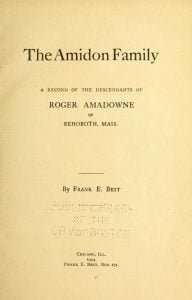
The Amidon Family genealogy book details the lineage of Roger Amadowne, a French Huguenot who fled to England and later to America after the revocation of the Edict of Nantes. Documented in Salem, Massachusetts in 1637, variations of his surname include Amadon, Amidown, and Ammidon. The work, organized with biographical sketches and two helpful indexes, presents the family’s history and is richly illustrated. Originally published in 1904, it serves as a valuable resource for descendants and historians alike.

Abbe-Abbey Genealogy

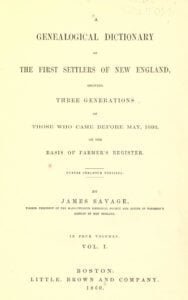
A genealogical dictionary of the first settlers of New England vol 1

The “Abbe-Abbey Genealogy” serves as a comprehensive and meticulously compiled homage to the heritage of the Abbe and Abbey families, tracing its roots back to John Abbe and his descendants. Initiated by the life-long passion of Professor Cleveland Abbe, this genealogical exploration began in his youth and expanded throughout his illustrious career, despite numerous challenges. It encapsulates the collaborative efforts of numerous family members and researchers, including significant contributions from individuals such as Charles E. Abbe, Norah D. Abbe, and many others, each bringing invaluable insights and data to enrich the family’s narrative.

The genealogy and history of the Ingalls family in America

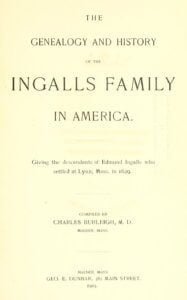
The genealogy and history of the Ingalls family in America

Edmund Ingalls, son of Robert, was born about 1598 in Skirbeck, Lincolnshire, England. He immigrated in 1628 to Salem, Massachusetts and with his brother, Francis, founded Lynn, Massachusetts in 1629. He married Ann, fathered nine children, and died in 1648.

Kansas Registrations of Enemy Aliens, 1917 – 1921

Enemy Alien Registration Affidavit for Bernhardt Vick - Cropped Photo

The series contains original affidavits of registration that record personal information about each registrant, their photograph affixed to the majority of documents, and the registrants fingerprints. All of these are specific to Kansas, and most have the actual documents attached.

Bolton Massachusetts Warnings 1737-1788

Worcester County MA Warnings

The document outlines the warnings issued in Bolton, Massachusetts, from 1737 to 1788, detailing individuals, families, and children who were advised to leave the town to avoid becoming permanent residents. This practice was rooted in a 1692 act that aimed to protect towns from the financial burden of supporting newcomers deemed unfit. The names and circumstances of those warned are presented chronologically, demonstrating the diverse backgrounds of the warned individuals, many of whom were not necessarily impoverished.

History of Kossuth, Hancock, and Winnebago Counties, Iowa

History of Kossuth, Hancock, and Winnebago counties, Iowa

History of Kossuth, Hancock, and Winnebago Counties, Iowa together with sketches of their cities, villages and townships, educational, civil, military and political history; portraits of prominent persons, and 638 biographies of representative citizens. Also included is a history of Iowa embracing accounts of the pre-historic races, and a brief review of its civil and military history.

Biography of Fairbanks Bush

Fairbanks Bush, son of Captain Timothy Bush, settled in Norwich and first voted in 1807. He married Amy Yeomans and lived in Orange, Vt., before returning to Norwich, where he died on February 24, 1873. Known as Norwich’s minstrel poet, Bush composed lyrical poetry that he often sang from memory, though much remains unwritten. Despite financial struggles and the burden of creditors, he maintained a positive demeanor and spoke against societal issues, including slavery, reflecting both personal and communal concerns in his work.

The Bush Family of Norwich Vermont

Captain Timothy Bush, an early settler of Norwich, Vermont, arrived in the town during its formative years, marrying Deborah House and fathering ten children. He played a significant role in local governance, serving as a selectman and landowner in the Pompanoosuc section. Active in military service during the Revolutionary War, he commanded a company in Colonel Marsh’s regiment. Although he reportedly moved to New York around 1809, there is speculation about his final resting place in Norwich. His legacy includes contributions to both town affairs and military endeavors.

Biography of Prof. George Bush

George Bush, born on June 12, 1796, in Norwich, Vermont, became a prominent Biblical scholar and Orientalist in America. He demonstrated exceptional intelligence from a young age, graduating as valedictorian from Dartmouth College in 1818. After studying at Princeton Seminary and serving as a Presbyterian pastor, he settled in New York City, where he devoted himself to authorship and lecturing. A professor of Hebrew and Oriental Literature, Bush published influential works, including commentaries and theological treatises. He later embraced Swedenborgian doctrines, which alienated him from many former colleagues. Bush passed away on September 19, 1859.

Free Masonry in Norwich Vermont

Norwich, Vermont, has no recorded Masonic Lodge, though many residents joined lodges in neighboring towns, notably the Franklin Lodge in Hanover, established in 1796. Several Norwich men were members, with names documented from 1798 to 1810. The lodge relocated to Lebanon in 1821. Amidst the 1830 Anti-Masonic movement, tensions arose within the North Congregational Church, leading to a contentious debate over Masonic participation. Ultimately, a compromise allowed for a temporary cessation of conflicts between Masons and the Anti-Masonic faction.