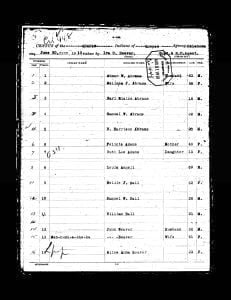
1910 Quapaw Census
Pages of the 1910 Quapaw Census. Contains table showing the previous roll number, current roll number, Indian name if given, English name if given, Relationship, Age, and Sex. Also contains the original images of the census.
The Families of Ancient New Haven compilation includes the families of the ancient town of New Haven, covering the present towns of New Haven, East Haven, North Haven, Hamden, Bethany, Woodbridge and West Haven. These families are brought down to the heads of families in the First Census (1790), and include the generation born about 1790 to 1800. Descendants in the male line who removed from this region are also given, if obtainable, to about 1800, unless they have been adequately set forth in published genealogies.
In 1911, Lucy Ann Morris Carhart published the “Genealogy of the Morris Family: Descendants of Thomas Morris of Connecticut,” providing a thorough historical account of the Morris family lineage starting from Thomas Morris, a notable shipbuilder and Puritan who immigrated from England in the 17th century. The book traces the family’s settlement in New Haven, Connecticut, detailing their significant land holdings and their expansion into other parts of Connecticut and New York. Published by A.S. Barnes Co. in New York, this work not only highlights the genealogical connections of the Morris family but also delves into the broader historical context, exploring the lives and legacies of successive generations. This comprehensive record serves as a valuable resource for descendants and historians alike, offering detailed insights into the family’s evolution and its contributions to American history.
Over a period of many years Mrs. Elizabeth Caroline Seymour Brown, early member of Linares Chapter, D.A.R., collected genealogy of her forebears. It was her wish that her work be sent to the library of the National Society, Daughters of the American Revolution. This collection was painstakingly copied, with some additions and corrections, maintaining the same general form as used in the original notes. Elizabeth’s family originated in England moving to New England in the 1600’s. Her family lines involve many of the early lines in Connecticut, Massachusets, and New Hampshire. The families are arranged mostly in alphabetical order, and contain information from a simple direct line descendancy, to more elaborate genealogy.
Major families researched include: Alverson, Arms, Arnold, Ballou, Barden, Barker, Barnard, Bassett, Belden, Benedict, Betts, Blakeslee, Blanchard, Bradstreet, Brigham, Bronson, Buckmaster, Bull, Butterfield, Carpenter, Clark, Clerke, Cooke, Coombs, Cornwall, Corbin, Curitss, Dickerman, Dickson, Doolittle, Downey, Dudley, Eastman, Easton, Errington, Evarts, Fairbank, Foote, Gilbert, Goodrich, Graves, Gregory, Groves, Hale, Hand, Hall, Hawkes, Hawkins, Hills, Holmes, Hopkins, Hoyt, Huitt, Hurd, Keayne, Keene, Lockwood, Lupton, Lord, Manning, Marvin, Mayo, Merriman, Miller, Morris, Morton, Mosse, Moulton, Munger, Needham, Parker, Parkhurst, Potter, Peck, Pettiplace, Purefoy, Priest, Rusco, St John, Scofield, Seymour, Sherman, Smith, Strong, Swinnerton, Symonds, Threlkell, Thorne, Ventriss, Wade, Watson, Weed, White, and Yorke.

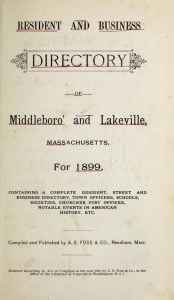
The 1899 Directory for Middleboro and Lakeville, Massachusetts, compiled by A. E. Foss & Co., provides a comprehensive list of residents and businesses, alongside town officers, schools, churches, and societies. It includes notable historical events and offers a detailed account of the local community, featuring numerous surnames from both towns. This directory serves as an essential resource for understanding the demographics and social structure of Middleboro and Lakeville during that period.
Charles L. Blakeslee, born in 1827 in New York, was a significant pioneer and educator in the development of the Grande Ronde Valley. Following a productive career in teaching, he established the first schools in Summerville, Cove, and Union, Oregon. Blakeslee also contributed to the industrial sector by harnessing water power for a chop mill and later a wood-working machinery facility. He married Caroline Dewey in 1850 and had six children, one of whom, Cornelia, was the first to have a funeral sermon preached in their county.
Dr. Thomas Blakeslee, born in 1843 in New York, became Neodesha, Kansas’s first physician after graduating from Rush Medical College in 1870. A Civil War veteran, he faced the challenges of pioneer life with dedication and compassion, serving the community until his retirement in 1896. Beyond medicine, he engaged in local politics, serving multiple terms as mayor and on the school board. Married to Grace Barton, they raised three children while contributing significantly to the town’s development. Dr. Blakeslee remains a respected figure in Neodesha’s history.
Caroline D. Blakeslee, aged 90, passed away in La Grande. Born on September 6, 1827, in Lewiston, New York, she married Chas. L. Blakeslee in 1850 and moved to Union, Oregon, in 1865. A dedicated member of the Episcopal church, she contributed to its establishment in Union. Her husband died in 1905, and she is survived by a son and two daughters. Funeral services were held at the church on January 30, 1918.
Charles Lewis Blakeslee, born in 1827 in Berlin, New York, moved to Michigan at age thirteen and married Caroline Dewey in 1850. He relocated to Union County, Oregon, in 1863, where he contributed to education as one of the area’s first school teachers. A devoted Mason for over 52 years, he played a significant role in the Grande Ronde Lodge No. 56. Blakeslee lived a life of virtue and faith, passing away peacefully, leaving behind five children and a grieving wife after more than fifty years together.