History of Shelburne Massachusetts

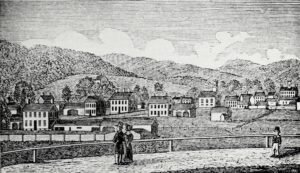
Southeastern View of Shelburne Falls Village Before 1835

The “History and Tradition of Shelburne, Massachusetts” is an account of the town’s development, initiated by a community effort in 1944. The project culminated in 1958 after various committees worked to collect and organize information across multiple aspects, including geology, early settlement, and cultural life. The book, intentionally topical rather than genealogical, features contributions from numerous writers and serves as a reference for understanding Shelburne’s heritage, institutions, and notable figures.
Ashfield Massachusetts Vital Records

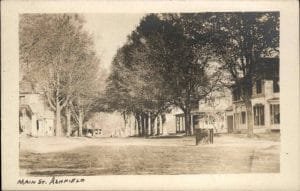
Main Street, Ashfield, Massachusetts

Alphabetical indexes to the vital records of Ashfield, Massachusetts, up to the year 1850, supplemented by information from bible records, church registers, cemetery inscriptions and other sources. PDF file is free to read and download.

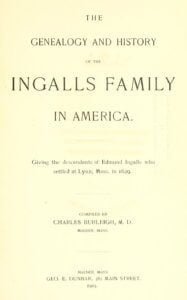
The genealogy and history of the Ingalls family in America

The genealogy and history of the Ingalls family in America

Edmund Ingalls, son of Robert, was born about 1598 in Skirbeck, Lincolnshire, England. He immigrated in 1628 to Salem, Massachusetts and with his brother, Francis, founded Lynn, Massachusetts in 1629. He married Ann, fathered nine children, and died in 1648.

Genealogical Record of Thomas Wait and his descendants

Genealogical record of Thomas Wait and his descendants

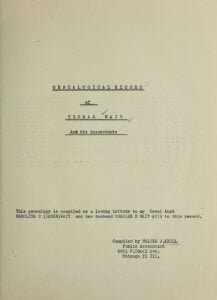
Genealogical Record of Thomas Wait and his descendants looks at the genealogy of Thomas Wait (1601-1677) who was from Wethersfield Parish, Essex, England. On his arrival in America, landing in Rhode Island, he applied for a lot on which to build,and was granted it on 7/1/1639. On 3/l6/l641 he became a Freeman in Newport R. I. He died in Portsmouth R. I., before April 1677 intestate. This Thomas Wait was a cousin to the Richard Waite of Watertown Mass., who was a large land owner. This unpublished manuscript provides the descendants of this family.

Descendants of Matthew Watson of Leicester, Massachusetts

Watson Coat of arms

Matthew Watson (d. 1720), of English lineage, married Mary Orr in 1695, and in 1718 the family immigrated from Ireland to Boston, Massachusetts and settled in Leicester, Massachusetts. Descendants and relatives lived in New England, New York, New Jersey, Pennsylvania, Ohio, Nebraska, Rhode Island, California, Nevada, Michigan and elsewhere. Includes Watson, Armington, Bemis, Denny, Draper, Kent, Washburn, Bailey, Barnard, Belcher, Bent, Biscoe, Bolles, Breckenridge, Bright, Browning, Bryant, Bullock, Burrage, Dennis, Fisher, Foster, Green, Hayward, Hobbs, Hodgkins, Holman, Howard, Jenks, Jones, Kellogg, Kitchell, Knight, Lazelle, Livermore, Loring, Mason, Maynard, Munger, Patrick, Prouty, Remington, Reed, Rice, Richardson, Rogers, Sadler, Sibley, Snow, Sprague, Stone, Studley, Symonds, Taitt, Thomas, Thompson, Trask, Tucker, Waite, Webster, Westcott, Wheeler, Whittermore, Wilson, Woods and related families.

Progressive Men of Western Colorado

Early Life in Colorado

This manuscript, in its essence, is a collection of 948 biographies of prominent men and women, all leading citizens of Western Colorado. In this context, Western Colorado encompasses the counties of Archuleta, Chaffee, Delta, Eagle, Garfield, Gunnison, Hinsdale, La Plata, Lake, Mesa, Mineral, Moffat, Montezuma, Montrose, Ouray, Pitkin, Rio Blanco, Routt, San Juan, and San Miguel.

People and Buildings of the Choctaw Nation

The Choctaw Nation demonstrated a remarkable moral framework, emphasizing respect for elders, integrity, and a deep reverence for their ancestors. Missionaries, such as Cyrus Kingsbury, noted the Choctaws’ eagerness for education and spirituality, leading to the establishment of schools and churches that fostered significant advancements in literacy and practical skills. Despite the challenges of relocation, the Choctaws’ commitment to civic and moral development led to a flourishing educational system, supported by community contributions and the resolute efforts of self-sacrificing missionaries.

Missionaries Among the Choctaw

In 1832, the Choctaw gathered in despair at Hebron, led by missionary Calvin Cushman, before their forced removal westward. Their sorrow, evident in their mournful cries, reflected the profound anguish of a community facing loss of homeland and identity. While most missionaries returned home, Cushman and a few others remained committed to aiding the Choctaw, enduring their suffering and striving for their moral and intellectual uplift. The narrative also highlights the integrity of the missionaries, exemplified by Mr. Bardwell’s honorable horse trade, demonstrating their ethical commitment amidst challenging circumstances.

Death of Cyrus Kingsbury

Rev. Cyrus Kingsbury

Adam Hodgson, an English traveler, visited the Elliot mission in 1820 and was impressed by the Choctaw people and their educators, particularly Rev. Cyrus Kingsbury. Hodgson emphasized the benevolence and intelligence of the Choctaws, contrasting them with prevailing stereotypes of Native Americans. He described his warm reception at the mission and the humility and dedication of the missionaries. The establishment of schools among the Choctaws, supported by Kingsbury and others, marked a significant step towards education and moral improvement in the community. Rev. Kingsbury continued his work until his death in 1871.

Tunapinachuffa

Tunapinachuffa, an aged Choctaw man, became the first known convert among his people, showcasing profound transformation through Christianity. His public declarations of faith and heartfelt letters inspired others, including the chief, Col. David Folsom. His conversion heralded significant changes, with increased industry, cotton cultivation, and moral reform throughout the Choctaw Nation. This spiritual awakening led to widespread gatherings for worship and the establishment of new churches, marking a pivotal shift from their ancient customs toward a community united in faith and productivity.

Biography of Frank A. Bardwell

Frank A. Bardwell, born August 11, 1870, in Ottawa, Illinois, emerged as a notable figure in Kansas’s oil industry despite initially starting in banking and livestock. Educated in local schools and Baker University, he shifted to oil production in the late 1900s after gaining experience in stock dealing and Oklahoma fields. Settling in Chanute, he became a respected oil producer, known for his integrity. Bardwell, a Republican and member of the Presbyterian Church, married Ida Farrell in 1896, with whom he has one son, Charles A.