Baxter Family of Norwich Vermont

The Baxter family, originally from Norwich, Connecticut, settled in Norwich, Vermont, in 1777. Elihu Baxter and his wife, Tryphena Taylor, had fifteen children, with twelve surviving to adulthood. Their descendants spread across Vermont and beyond, with several establishing prominent careers. Notable figures include William Baxter, a distinguished lawyer, and James Baxter, a member of the Provincial Parliament in Canada. The family’s influence extended through various trades and professions, with connections maintained in the region into the 19th century.
Free Masonry in Norwich Vermont

Norwich, Vermont, has no recorded Masonic Lodge, though many residents joined lodges in neighboring towns, notably the Franklin Lodge in Hanover, established in 1796. Several Norwich men were members, with names documented from 1798 to 1810. The lodge relocated to Lebanon in 1821. Amidst the 1830 Anti-Masonic movement, tensions arose within the North Congregational Church, leading to a contentious debate over Masonic participation. Ultimately, a compromise allowed for a temporary cessation of conflicts between Masons and the Anti-Masonic faction.

History of the Merchants of Norwich VT

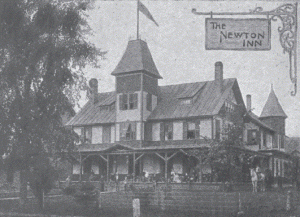
Newton Inn, Vermont

Peter Olcott operated a store in Norwich during the Revolutionary War, followed by Stephen Burton and Ichabod Marshall, early merchants who later moved west. The late 18th and early 19th century saw various merchants such as George Woodward, William Little, and Elias Lyman establishing businesses in the region. The mercantile landscape evolved with partnerships and new firms, including the Olds, Newton, and Lyman firms, adapting through various challenges, such as fires, until the late 19th century, reflecting Norwich’s commercial development.

History of the Industries of Norwich VT

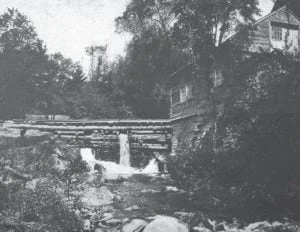
Knapp’s Mill, Norwich, Vermont

The industries of Norwich, VT, while not extensive, have displayed diverse characteristics since the late 18th century. Early establishments included grist and saw mills along Blood Brook, with ownership changing hands over the years. Other ventures featured tanneries, harness and trunk making, and the production of potash and furniture. Notable craftsmen, such as blacksmiths and boot makers, contributed to the local economy. Over time, businesses evolved, leading to the establishment of a creamery in 1888, which later became part of Hood Co.

Geographical Names of the Norwich VT Locality

The township of Norwich, Vermont, features declining settlements like Beaver Meadow, once prosperous with churches, schools, and businesses, which experienced significant population loss after 1840 due to railroads and emigration. The Baptist and Methodist churches faded by the late 19th century, leading to abandoned farms. Nearby, Pompanoosuc retains a post office and creamery but also hints at Native American history with fishing practices. New Boston, named in 1784, exemplifies the area’s historical depth amidst its current desolation.

Migration of Families out of Norwich VT

In the late 18th and early 19th centuries, Norwich, Vermont, experienced significant emigration, leading to a notable decline in its population. Initially home to 40 families in 1771, the town saw many residents relocate to newer settlements, such as Royalton and Randolph, during and after the Revolutionary War. Prominent families, including the Hibbards and Carpenters, contributed to the establishment of towns in northern Vermont and beyond. By the 1800s, the trend of outmigration intensified, marking a long-term shift in the region’s demographic landscape.

Postmasters and Postal Service in Norwich Vermont

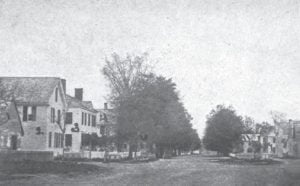
Norwich Vermont Street Scene

Norwich, Vermont, established its first post office on July 1, 1805, with Jacob Burton as postmaster. Operating from his harness shop, he managed limited mail, receiving only two weekly deliveries. By contrast, the volume of mail handled today far surpasses that of early 19th-century Vermont, and the postal system has evolved significantly since the state’s admission to the Union in 1791. Over the years, additional post offices were created throughout the area, reflecting the growth and changing needs of the community.

Political Parties in Norwich Vermont

In Norwich, Vermont, political parties have historically maintained a close balance, with elections often fiercely contested. Initially aligned with the Federalists, the town shifted towards the Republicans following the formation of the party in the mid-1850s. Prior to this, Democratic candidates generally enjoyed a stronghold, particularly from 1833 to 1854, despite significant competition. The rise of anti-slavery sentiment led to a decline in the Whig Party and a shift toward the Republican Party, culminating in significant support for Abraham Lincoln in 1860, marking a turning point in local political history.

History of Norwich Vermont Education

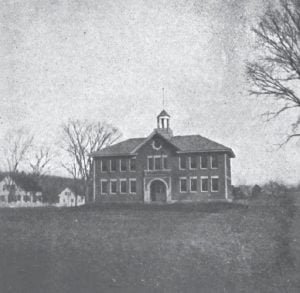
High School Building, Norwich Village, Erected in 1898

The history of education in Norwich, Vermont, traces back to efforts in 1782 to establish school districts. The first successful division occurred in 1785, creating the First School District. Over the years, multiple districts were formed, with the establishment of a committee for school supervision in 1824. Notable developments included the construction of a brick schoolhouse in 1845 and the incorporation of the Norwich Classical and English Boarding School in 1867, although it ultimately closed in 1877. The town’s education framework evolved significantly, culminating in a unified system in 1892.

American Literary, Scientific, and Military Academy

The American Literary, Scientific, and Military Academy, founded by Capt. Alden Partridge in 1819 in Norwich, was a pioneering educational institution aimed at providing a distinctly American system of education. The academy’s initial enrollment reached 100 cadets and eventually grew to nearly 200. In 1825, it relocated to Middletown, Connecticut, where attendance peaked at 300. Despite a brief rivalry with a competing military school, the academy laid the groundwork for what would become Norwich University, emphasizing a commitment to serving a diverse student population.

A Brief History of Norwich University

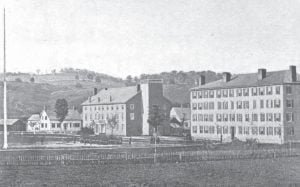
Norwich University 1862 - North Barracks South Barracks

In 1835, the American Literary, Scientific, and Military Academy was incorporated as Norwich University in Vermont. Established by Captain Alden Partridge, the institution was notable for its secular education, free from sectarian influence. It aimed to develop patriotic and educated citizens, emphasizing moral principles and religious respect without imposing specific beliefs. Throughout its early years, Norwich University contributed significantly to the training of military leaders during the Civil War, producing numerous distinguished officers for both the Army and Navy.

Norwich Vermont in the Civil War

During the Civil War, Norwich, Vermont, contributed 185 soldiers to the Union Army, representing over ten percent of its population of 1,759. Of these, 27 men died in service. The town provided substantial bounties totaling around $32,000 to support its troops. Although the community largely supported the war effort, some residents expressed disloyalty, yet over time, many reconciled their past by honoring the fallen soldiers on Memorial Days. Overall, Norwich’s commitment to the Union cause reflected a broader dedication seen throughout Vermont.

Norwich Vermont in the War of 1812

In June 1812, as war with Great Britain loomed, Norwich, Vermont, convened a town meeting to express their views. A carefully crafted document was adopted, voicing support for President Madison and Congress’s war measures, while denouncing critics. The resolutions outlined grievances against both Britain and France, affirming the right to declare war for just causes. Coincidentally, Congress declared war on the same day, prompting Norwich to raise taxes to support military efforts, reflecting strong local commitment to the war.

Norwich Soldiers in War with Mexico

The post lists soldiers from Norwich, Vermont who served in the War with Mexico, highlighting their ranks and fates. Notably, Colonel T. B. Ransom of the 9th United States Infantry was killed at Chapultepec on September 13, 1847. Other soldiers, including Drummer Henry O. Brigham and several unnamed individuals, died in various locations, such as Detroit, Tunbridge, and West Point. Their sacrifices reflect the local contributions to the broader conflict.

Norwich Vermont in the Revolutionary War

Norwich, Vermont provided modest participation in the Revolutionary War, highlighted by its formation of a Committee of Safety in March 1777. Evidence suggests a militia was established as early as 1774. The town contributed to regiments under Colonels Warner and Bedell. Local militias organized for defense amid threats from British forces in 1776, further demonstrating Norwich’s involvement. Despite lacking comprehensive records, the enlistment of local soldiers was significant, along with efforts to protect the community from loyalist activities and contribute to the war effort.

Church History of Norwich Vermont

The first generation of Norwich settlers accomplished a significant community milestone by constructing a meeting house for public worship within a decade of settlement. This project involved the entire community, showcasing their determination despite limited resources. A committee ultimately selected the location after significant debate, with the cornerstone laid in 1778. Delays due to the Revolutionary War slowed progress, but by 1785, the building was completed and became a site for various civic activities, including sessions of the Vermont Legislature. The meeting house served the town until 1817 when a new structure was erected due to growing needs.

History of the Episcopal Church at Norwich

The Episcopal Church at Norwich was organized in 1835, primarily due to Doctor Ira Davis’s efforts. From 1846 to 1850, services were conducted sporadically by Professor Hill and others. In 1851, Doctor Edward Bourne, then president of Norwich University, facilitated regular services held first in the University chapel and later in a church built in 1863, largely through Mrs. Charlotte Rogers’s contributions. Following the University’s relocation in 1866, services became infrequent, with a nearby church in Hanover becoming the main venue for worship.

History of the Baptist Church at Norwich Vermont

The Baptists in Norwich, Vermont, emerged as early dissenters against New England orthodoxy, with records indicating their presence soon after the town’s establishment. By 1799, an organized Baptist society was noted, although it lacked a dedicated minister or meeting house. Over time, membership dwindled, with some members joining the Methodists. In contrast, the nearby Sharon Baptist Church thrived, eventually constructing a meeting house in 1833. The Norwich Baptist community eventually dissolved early in the century, relocating to Sharon after a period of decline.

History of the Methodist Church at Norwich Vermont

Rev. Emanuel C. Charlton

Methodism in Vermont began to establish itself around 1796, with its first society formed in Vershire. The movement saw rapid growth, particularly in the early 19th century. In Norwich, Methodist meetings were initiated by circuit preachers by the early 1810s, leading to the construction of the first church around 1815. The current brick church at Union Village was built in 1836. Over the years, the community has faced population declines, yet the Methodist Episcopal Society of Norwich and Thetford continues to thrive, with about 150 families currently participating.