Southold Town-Shelter Island Register 1910-1911
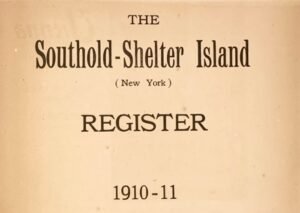
A free digitized copy of the Southold Town-Shelter Island New York Register published by the Lawton Company of Maine split up into townships.

A free digitized copy of the Southold Town-Shelter Island New York Register published by the Lawton Company of Maine split up into townships.
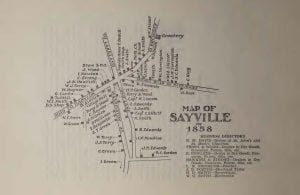
In the heart of Suffolk County, New York, lies a village with a history as rich as the soil upon which it stands. “A History of Sayville, New York,” penned by Clarissa Edwards in 1935, is an invaluable chronicle that sheds light on the early days of this often-overlooked locale. Published by the Suffolk County News Press, this work is a testament to the enduring spirit of Sayville, a village that has woven itself into the fabric of American history, yet remains scarcely mentioned in conventional historical texts.
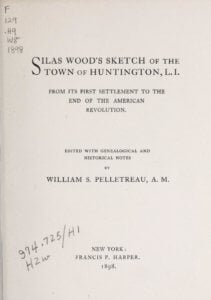
Silas Wood’s sketch of the town of Huntington, L.I. is a small manuscript of 63 pages which provides an authoritative look at the early history of Huntington New York, from its first settlement to the end of the American revolution. Particularly fascinating to our Native American researchers is the history of the early interaction with the Matinecoes, the Massapeags, and the Secataugs.
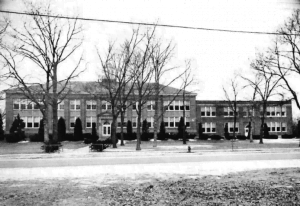
The Bayport-Blue Point Public Library has digitized 67 years of yearbooks from Bayport-Blue Point High School, allowing access to full-resolution scans via Long Island Memories. Originally established in 1927 as both an elementary and high school, the institution serves the communities of Bayport and Blue Point. The yearbooks, titled “The Stepping Stone,” document student life and milestones from 1945 to 2011, reflecting the history and development of the school over decades.
Various tribes are organized into sub-units such as bands, gens, and clans, with some lesser-known groups possibly no longer existing. The Cannetquot is noted as a semi-tribe or family from the East side of Connetquot River, around Patchogue, Long Island in 1683. Thompson’s account includes this area as part of the Patchoag territory, suggesting a connection to the name’s dialectical roots linked to Connecticut.
The will of Thomas Jones, dated February 16, 1669, outlines his bequests to his family, including 20 shillings each for his three youngest sons and the same amount for his eldest sons. He bequeaths £10 to his daughter Martha, his best cloak to his eldest son Thomas, and a watch to his son John. His wife, Katharine Jones, is appointed executrix. The will was witnessed by Samuel Titus and Thomas Powell, and it was proved on March 2, 1669, with an inventory valuing his estate at £195.
In his 1670 will, Thomas Wicks of Huntington bequeaths his property and assets primarily to his wife and children. His wife receives one-third of their accommodations for life, after which it passes to their son John. Son Thomas is granted land that belonged to John Lewis and additional meadow land. Wicks also bestows legacies upon daughters Rebecca and Martha, while the remainder of his estate is divided among his wife and four children: John, Elizabeth, Mary, and Sarah. Executors are named as Isaac Platt and Thomas Powell.
In his will dated November 13, 1670, Jonas Bower of Southampton bequeaths various properties and rights to his children, including son Joseph, who receives seventeen acres at Flying Point, and son James, who is given a portion in cattle. His wife, Hannah, is entrusted with the house and land until their son Jonah reaches maturity, with provisions for son Isaac if Jonah does not survive. Bower mentions his daughters but does not name them, and appoints cousins as executors. The will was proved on June 6, 1671.
In his will dated November 26, 1671, Thomas Terry, Sr. of Southold bequeaths 15 bushels of corn annually to his wife and outlines provisions for his children. Son Daniel is tasked with supplying 10 bushels, while son Thomas contributes 5. He allocates land and property to his sons and provides for his daughters, including a cow for Elizabeth upon marriage or reaching maturity. The will was witnessed and proved on July 5, 1672, with administration granted to son Daniel later that year.
John Woodruff of Southampton, L.I., bequeathed a half Crown Piece to his eldest son, John, while his daughters, Anne Woolley and Elizabeth Dayton, each received £20. The remainder of his estate was left to his wife, Ann, and youngest son, also named John, who were appointed executors. Dated May 4, 1670, the will was witnessed and proved on July 1, 1670. John Woodruff, a significant figure, was connected to the original settlers of Southampton and eventually moved to New Jersey around 1660.
Gabriel Lynch of Newtown passed away without a will, prompting the appointment of his widow, Margaret Lynch, as administratrix of his estate on September 3, 1671. This decision was recorded in the official records, indicating the procedural response to his intestate status.
In his will dated May 9, 1670, John White of Southampton bequeaths all his property to his only son, John. Should John die without heirs, the estate would pass to his daughter Elizabeth, then to his wife Hannah for life, and subsequently to the eldest son of his brother James White. If he too has no heirs, the estate would be divided between John Topping and Thomas Topping, along with their four unnamed sisters. Hannah is designated as executrix, with friends and kin serving as overseers. The will was confirmed shortly after on May 30, 1670.
In his will dated January 27, 1671, James Naybor of Huntington bequeaths his Great Trunk and best chest, filled with linens and woolen clothes, to his youngest daughter, Martha. He allocates £10 to his grandchild, Mercy, to be funded by the sale of his house in Boston, which he leaves to his five daughters: Mary, Sarah, Elizabeth, Rachel, and Martha. Martha is named executrix, with Mr. Wm. Bartholemew and Goodman Sundall serving as executors. The will was witnessed by Matthew Owen, Peter Floyd, and Joseph Bayley, and was proved on March 19, 1671.
Henry Perring of Brookhaven, being in poor health, outlined his will on December 1, 1674. He left his estate to his wife Hannah during her lifetime and bequeathed various lands to his son-in-law Joseph Longbothem. His water mill was shared between Joseph and Jacob Longbothem, with provisions for his daughter Hannah. Additionally, he allocated land and privileges for his daughters-in-law, ensuring toll-free access at the mill. Executors were appointed, and letters of administration were granted to Hannah Perring on February 1, 1675.
Thomas Brush of Huntington, Long Island, passed away without a will, prompting his son Thomas to be appointed as the estate administrator on September 10, 1675. The inventory of Brush’s estate was valued at £306 12s., as documented in the Court of Sessions records.
William Ludlam of Southampton bequeathed his properties to his sons, leaving housing and lands to Anthony, while Joseph received a new dwelling-house and adjacent lands. He made provisions for his daughters and grandchildren, specified a covenant with Samuel Davis, and appointed his son Henry as executor. Henry is tasked with managing the mill and received significant land holdings. The will was dated April 27, 1655, witnessed by John Howell and John Cooper, and proved at the Court of Assizes on November 2, 1667.
Daniel Whitehead of Maspeth Kills in Newtowne bequeathed his estate through a will, appointing his unnamed wife as executrix. However, she chose to renounce her responsibilities, leading to the appointment of Stephanus Van Coitlandt as administrator on March 31, 1669. This reflects the complexities of familial and legal arrangements in the 17th-century colonial context, shedding light on the inheritance practices of the time.
Richard Townsend of Lusum in Oyster Bay passed away without a will, prompting the issuance of Letters of Administration to his wife, Elizabeth, on September 23, 1670. Although his children are acknowledged in the records, their names remain unrecorded. Lusum, believed to derive from Lewisham, is presently known as Jericho.
Thomas Robinson of Newtown passed away without a will, leaving behind two sons, Thomas and Josyas. In the wake of his death, the town officials have entrusted their care to their uncle, Jacob Reade, who has been appointed as administrator on September 23, 1671. This arrangement highlights both the responsibilities of familial guardianship and the role of local governance in matters of inheritance during this period.