Wright Family of Boston, MA

The Wright family, an early Boston lineage, traces its origins to Richard Wright, who settled in Plymouth around 1644. Over generations, the family intermarried with prominent New England clans like the Adams and Wentworths. Notable descendants include Theodore Francis Wright, a significant figure in the New Jerusalem Church, and Augustus Hunt Wright, a Civil War veteran and community leader in Abington. Their legacy reflects the family’s deep roots in American history and its contributions to religion, education, and civic life in Massachusetts.
Free Massachusetts Vital Records

Vital Records of Bellingham Massachusetts to 1850

This is a collection of free vital records books for Massachusetts towns, most of them known as “Tan Books.” Generally, these records go up to 1850 at which, the genealogist can use the census records to assist in identifying the family connections further. They’re called “tan books” because they were bound by tan cloth. Included with this article is an account of why and how these manuscripts were published along with links to all 274 Massachusetts vital record books which can be freely read.

Early Exploration and Native Americans

Ferdinand de Soto’s interactions with Native American tribes, specifically the Choctaws and Chickasaws, exemplify early European attempts to impose their ideologies of civilization and Christianity upon Indigenous populations. This approach set a precedent for further exploitation and oppression of Native Americans, as European settlers sought to acquire land and resources. Throughout history, tribes like the Chickasaws, known for their valor, remained steadfast allies rather than adversaries. This enduring alliance contrasts sharply with the overarching narrative of dispossession and extermination faced by Indigenous nations in North America.

Narrative of the Captivity of Nehemiah How

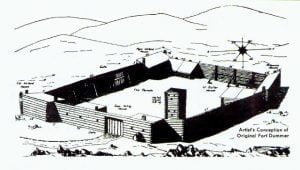
Fort Dummer

A Narrative of the captivity of Nehemiah How, who was taken by the Indians at the Great Meadow Fort above Fort Dummer, where he was an inhabitant, October 11th, 1745. Giving an account of what he met with in his traveling to Canada, and while he was in prison there. Together with an account of Mr. How’s death at Canada. Exceedingly valuable for the many items of exact intelligence therein recorded, relative to so many of the present inhabitants of New England, through those friends who endured the hardships of captivity in the mountain deserts and the damps of loathsome prisons. Had the author lived to have returned, and published his narrative himself, he doubtless would have made it far more valuable, but he was cut off while a prisoner, by the prison fever, in the fifty-fifth year of his age, after a captivity of one year, seven months, and fifteen days. He died May 25th, 1747, in the hospital at Quebec, after a sickness of about ten days. He was a husband and father, and greatly beloved by all who knew him.

John Gyles Captivity Narrative – Indian Captivities

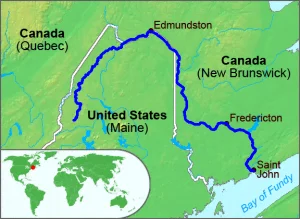
St John River Map

John Gyles captivity narrative provides a stunning display of Abenaki culture and lifestyle, as it was in the 1690’s. John was 10 years old when he was taken captive in the attack on Pemaquid (Bristol Maine) and his narrative provides an accounting of his harrowing treatment by his Indian captors, as well as the three years exile with his French owners at Jemseg New Bruswick. His faith in Christ remains central in the well-being of his mind throughout his ordeal.

Early Indian Wars in New England

Early New England Tribes Map

The early Indian wars in New England, starting with Pilgrims landing in Plymouth in 1620, marked a turbulent period of settler-Indian relations. Initial friendly interactions, exemplified by Samoset’s visit and a lasting treaty with Massasoit, soon gave way to conflict, particularly with the Pequots. Tensions escalated into the Pequot War, culminating in their near annihilation after several battles in 1636. The defeat of the Pequots significantly altered power dynamics, instilling fear among other tribes and ensuring a temporary peace for settlers until future conflicts arose.

King Philip’s War – Indian Wars

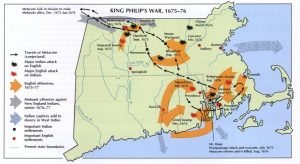
King Philips War Map

After the death of Massasoit, his son Alexander, despite maintaining peaceful relations with the English, was captured under suspicion of conspiracy and died shortly thereafter. His brother, Philip, succeeded him and initially continued to uphold treaties while secretly uniting New England tribes against English encroachment. Tensions escalated after the murder of an informant, leading to widespread conflict. Philip’s leadership during King Philip’s War culminated in significant losses for both sides, ultimately resulting in his death and the disbandment of resistance among Native tribes in New England.

1867 Plymouth Massachusetts Directory

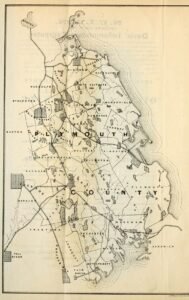
1867 Map of Plymouth County Massachusetts

This page features the 1867 directory of Plymouth, Massachusetts and was originally published by Stillman B. Pratt & Co. as part of their 1867 Plymouth County Massachusetts Directory. The information contains the individuals name, their occupation, and where they resided. The r stands for rents and the bds stands for boards.

History of Plymouth Massachusetts

1867 Map of Plymouth County Massachusetts

An historical sketch about Plymouth, Plymouth County, Massachusetts as abstracted from the Plymouth County Directory and Historical Register of 1867. Includes a list of the men from Plymouth who gave their life during the Revolutionary War.

Descendants of Samuel Sturtevant

Samuel Sturtevant, the family’s immigrant ancestor, settled in Plymouth, Massachusetts, by 1642 and married Ann in 1643. Their descendants include Samuel Jr., who lived from 1654 to 1736, and numerous subsequent generations, including Consider Sturtevant, a Revolutionary War soldier. Consider’s children continued the lineage, with many notable marriages and professions, including involvement in business and local governance. The Sturtevant legacy reflects a rich tapestry of American history and familial connections throughout New England.

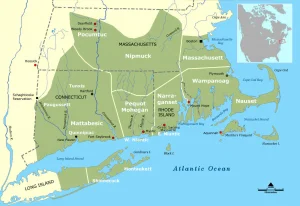
New England Indians

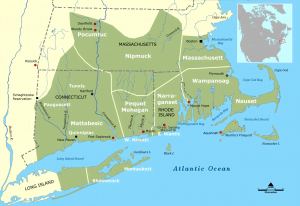
Tribal Territories Southern New England

The interactions between European settlers and the Native Americans in Southern New England were often marked by betrayal and violence, despite initial hospitality from Indigenous tribes. The Mayflower’s arrival in 1620 led to tentative and hostile encounters with the local tribes. Notable figures like Samoset and Tisquantum (Squanto) facilitated communication, resulting in an alliance with the powerful sachem Massasoit. However, the dynamics shifted dramatically with increasing tensions, as rivalries and betrayals among tribes and settlers alike set the stage for future conflicts, including uprisings and violent confrontations.

Biographical Sketch of Henry Rowley

Henry Rowley, an immigrant from England, settled in Massachusetts, where he played a significant role as one of the early planters of Plymouth. He was a taxpayer by 1630, became a freeman in 1634, and later moved to Scituate and Barnstable. Rowley served as a deputy to the general court and eventually relocated to West Barnstable and Falmouth. He married twice, first to Sarah Palmer and then to Anne Blossom, with whom he had several children, including Moses and Sarah. He died in 1673.