
Lyman, Dickinson, Partridge Genealogy

Pedigree of William Lyman

This 1865 pamphlet is a genealogical record focused on the Lyman, Dickinson, and Partridge families of New England and Canada. Compiled by James T. Dickinson, the text reconstructs lineage through historical deeds, probate records, and tombstone inscriptions to correct previous errors (pre 1865) in published family histories. The document centers on the Lyman branch in Middlefield, the Dickinsons of Montreal, and the Partridges of Hatfield, documenting their arrival and subsequent settlement in New England. Detailed pedigree charts and narrative biographies illustrate connections to significant colonial figures, including several governors and prominent ministers.
Lower Chinook, Kathlamet, Tillamook, and Clatsop Indians, Alive in 1906

In 1906, Charles E. McChesney compiled a list of the Lower Chinook, Kathlamet, Tillamook, and Clatsop Indians, along with their heirs, who had treaty agreements with the U.S. government since 1851. The document includes numerous names and corresponding addresses across various locations, such as Oregon, Washington, and California. This registration underscores the ongoing recognition of these tribes and serves as an important historical record of their existence and relocations during that period.

Descendants of John McCullough of New Bedford MA

John McCullough, born in New Bedford in 1858 to Irish immigrants, played a significant role in the city’s growth. His grandfather, Patrick McCullough, and father, also John, laid the family’s roots in New Bedford after emigrating from County Tyrone, Ireland. John established a successful junk business and became a key figure in the whaling industry. Active in local politics, he served as alderman and helped form St. Lawrence parish. His legacy continued through his son, who expanded the family business, embodying the McCullough commitment to community and enterprise.

North America Indian Names of Places in Mississippi, Alabama, Georgia, Florida, and Louisiana

The post examines the significance and origins of North American Indian place names in Mississippi, Alabama, Georgia, Florida, and Louisiana, particularly those derived from the Choctaw and Chickasaw languages. It highlights how these names reflect the rich cultural and linguistic heritage of the Native American tribes, while noting that many translations have become corrupted over time. The text provides numerous examples of place names alongside their original meanings, illustrating the deep historical connections embedded in the geography of the region.

The Wars of the Five Nations – Indian Wars

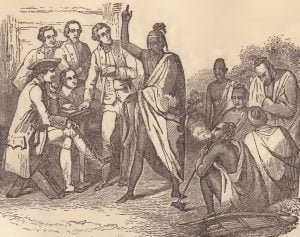
Treaty with Five Nations

The Five Nations, a confederacy of five Indian tribes, were significant allies of the English against the French during the Indian Wars. Their sophisticated governance and military strategies set them apart, allowing them to maintain supremacy over other tribes and engage effectively in war. Despite their initial defeats by the French and the Adirondacks, they rallied with Dutch support and eventually reclaimed power. Their engagements with the French exemplified both their valor and the complexities of colonial rivalries, culminating in fluctuating alliances and treaties that shaped their future interactions.

Biography of Edward Plummer Paige

Edward Plummer Paige, born in Bradford, N.H., in 1857, was a notable figure in Dunbarton. The son of Bayard P. and Louisa S. Paige, he began his career as a clerk in his brother’s store before venturing into stove-making. His business acumen led him to Boston, working with Leach & Gilmore, which operated steamboats until competition from Vanderbilt forced their exit. Later, he thrived in Montreal manufacturing farming implements before returning to Dunbarton, where he lived until his death at eighty-four, leaving behind six children.

Biography of James A. Wilson

James A. Wilson, born December 23, 1850, in Wisconsin, emerged as a significant figure in Kansas’s oil industry, particularly noted for his Derby-Wilson lease near El Dorado. He arrived in Butler County during its pioneer days, establishing himself as a successful cattleman and landowner. His extensive holdings included 2,400 acres in the Whitewater Valley. Despite a modest role in politics, Wilson contributed significantly to community welfare, especially in education. He married Emma Lambing, with whom he had six children, continuing his legacy in the region.

Biography of George W. B. Beverley, M. D.

George W. B. Beverley, M. D., was born on August 27, 1872, in Hereford, England. After completing his medical training at the College of Physicians and Surgeons of London, he emigrated to America in 1899. Settling in Alma, Kansas, in 1903, he established a successful practice. A local political figure, he served as county physician and coroner, and engaged in Republican politics. A family man, he married Agnes Louise Gray in 1898 and has three children, while also maintaining active involvement in community organizations and the Congregational Church.

Biographical Sketch of Albert E. Powell

Albert E. Powell, an attorney born on November 9, 1874, in Montreal, was educated at Western Reserve University, earning his LL.B. in 1899, and briefly attended Harvard Law School. He began his legal practice in Cleveland in 1900, previously partnering with Martin A. Foran and A. J. Pierson, both of whom are now judges. Powell currently practices law independently and holds membership in several organizations, including the Harvard Club, Masonic Order, Royal Arcanum, and Tippecanoe Club.

Barber, Mary Anna McFetridge Mrs. – Obituary

Mary Anna Barber, born October 1, 1940, in Enterprise, Oregon, tragically died in a two-car accident in Canada on May 26. A graduate of Enterprise High School, she married David Barber in 1958. She is survived by her husband, who is hospitalized, her parents, one son, three daughters, and numerous siblings, grandchildren, and nieces and nephews. A memorial Mass is scheduled for June 4.

Tobin, Albina Mary – Obituary

Albina Mary (Payette) Tobin was born in Montreal, Canada, in 1876 and married Richard Tobin in 1893. She passed away at her home in Enterprise, Oregon, on November 29, 1918, at the age of 42, following complications from influenza. The Tobins had moved to Enterprise just weeks prior. Albina is survived by her husband, six children, four sisters, and one brother. She was buried in the Catholic cemetery, with Father J.P. Stack officiating.

Biographical Sketch of Rev. Father Crowe

Rev. Father Crowe, born in Oswego, New York, on September 19, 1851, had a diverse early career that included teaching and aspirations in law and medicine. In 1873, he dedicated himself to theology at the Grand Seminary in Montreal, leading to his ordination on December 22, 1877. After a brief tenure in Flora, Illinois, he became the Pastor of the Catholic Church in Mattoon in March 1878, where he also serves as President of the schools associated with the Ursuline Sisters.

Biography of Lewis Balch, M. D., PH. D.

Dr. Lewis Balch, born in New York City on July 7, 1847, is a prominent physician and surgeon in Albany. He hails from a distinguished lineage, including connections to notable figures like John Jay. Educated at several institutions, he graduated from the College of Physicians and Surgeons in 1870. After relocating to Albany in 1873, he held multiple medical positions, including attending surgeon and professor of anatomy at Albany Medical College. He was also active in public health, serving as city physician and secretary of the state board of health. Dr. Balch’s contributions to medicine and public service are significant.