A Fresh Look at Ocmulgee Bottoms

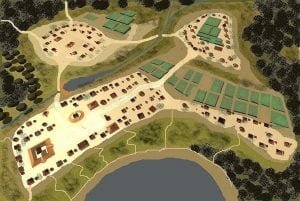
Ocmulgee in 1000AD

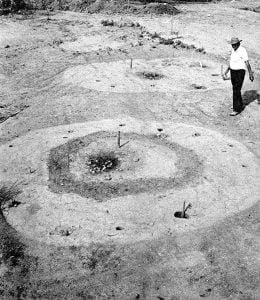
Many of the most fundamental assumptions by the Anthropology profession concerning the Pre-European history of the Lower Southeast were developed during the mid-20th century as a result of a massive, federally-funded excavation of archaeological sites near Macon, GA. While today, anthropologists, museums and the National Park Service present a united front stating that the body of knowledge, which resulted from the Ocmulgee Bottoms studies, was the result of comprehensive analysis, plus well-thought out consensus by some of the most brilliant men of their time, the truth is quite a bit different.
The Natural History of Ocmulgee Bottoms

9Fu14-DrArthurKelly

Ocmulgee Bottoms is a corridor of the Ocmulgee River Flood Plain in the central region of the State of Georgia that begins at the Fall Line in Macon, GA and continues 38 miles southward to near Hawkinsville, GA. This region is located in Bibb, Twiggs, Houston, Bleckley and Pulaski Counties. The Ocmulgee River’s velocity slows dramatically upon entering the Bottoms and has a serpentine channel. Over the eons, the river here has meandered frequently across the breath of the flood plain, leaving hundreds of ponds and swamps, plus a deep layer of rich, alluvial soil. On top of the alluvial soil is from one to ten feet or red clay that was deposited during the period when cotton was cultivated in the Piedmont, upstream.

Native American History of Houston County, Georgia

Houston County, Georgia, named after Revolutionary leader John Houstoun, has a rich Native American history. The region was originally inhabited by ancestors of the Creek Indians, who thrived along the Ocmulgee River Flood Plain, engaging in early agricultural practices. Over centuries, their communities formed complex societies influenced by various cultural traditions. Following European contact, disease and land cessions drastically reduced their population. By the early 19th century, the Creeks faced pressure to cede land, leading to significant social and cultural changes that shaped the area’s identity.

Slave Narrative of Mose Davis

Mose Davis, an ex-slave from a large plantation near Perry, Georgia, recalls his life under Colonel Davis, the master of the estate. Born into slavery, he was not required to work in the fields and grew up alongside the Colonel’s son. Davis describes plantation life, including the daily routines of field hands, the clothing and food provided to slaves, and the limited healthcare available. While under strict regulations, the slaves celebrated festivals. After emancipation, Davis’s family continued working on the plantation for wages, while he sought freedom and traveled thereafter.

Slave Narrative of Salena Taswell

Salena Taswell, born in 1844 in Perry, Georgia, reflects on her life as a child on Dr. Jameson’s plantation. She describes a childhood spent working as a servant rather than playing. Although she was treated kindly, her family’s life involved hard work: her mother was a seamstress, and her father a blacksmith. Guests at the plantation enjoyed rich meals, while Salena cleaned and waited on the table. After the Civil War, she experienced little change, continuing to live in her master’s household alongside other freed individuals.

Slave Narrative of Sophie D. Belle

Sophie D. Belle, born near Knoxville, Georgia, reflects on her life as the daughter of a house slave, raised by the Hicks family. Although she never witnessed the sale of slaves, she recalls the effects of the Civil War and emancipation on her community. Belle recounts her childhood, education, and two marriages, noting her lack of children. After moving to Forrest City in 1874, she worked various domestic jobs and is now reliant on Social Welfare at age 77. Throughout her life, she has maintained a connection to her Baptist faith.