1851 Siler Roll: Eastern Cherokee

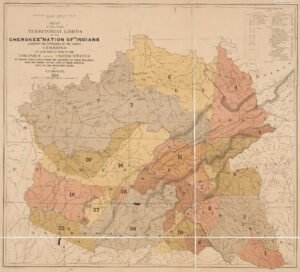
Map of Cherokee Land Cessions

The 1851 Siler Roll is a key genealogy resource for tracing Eastern Cherokee families who remained east of the Mississippi after the Trail of Tears. Compiled to identify those eligible for a federal per-capita payment, it lists households, family groupings, residences, ages, and relationships, but it is incomplete and should be used with the later Chapman Roll.

Letter from Robert Love to Thomas D. Love – 18 April 1813

In a letter dated April 18, 1813, Robert Love expresses his pleasure at his son Thomas’s well-being and burgeoning legal practice. He emphasizes the importance of continued study and mentorship, advising Thomas to consult with knowledgeable individuals. Robert encourages Thomas to visit his aging grandmother, reminding him of her past support. He hopes for a strong bond between Thomas and his brother Sammy, emphasizing familial support. The letter conveys warmth and fatherly advice amidst practical considerations of legal career development.

Letter from Thomas Love to his Nephew, James Robert Love

In his letter dated March 10, 1843, Thomas Love expresses relief at learning about his brother’s health and updates his nephew, James Robert Love, on his family’s overall well-being, despite struggling with rheumatism. He shares plans to visit his native country by May, hoping for continued health improvements. Thomas also mentions his son’s successful relocation to Missouri and shares remedies for a friend’s health issue. He concludes with warm regards for his brother and friends, promising to write again soon.

Address of Col. Allen T. Davidson at Lyceum Asheville, North Carolina

In his address at the Lyceum in Asheville, Col. Allen T. Davidson highlighted prominent figures from Haywood County, notably John Welch, General Thomas Love, and Col. Robert Love. Thomas Love, who served in the Legislature for three decades, was renowned for his engaging campaign style and memorable anecdotes, including his humorous interactions with voters. Robert Love, a Revolutionary War veteran and influential community leader, also contributed significantly to the county’s development and left a lasting legacy. Both men were respected and influential in their time.

Robert Love – Will

Col. Robert Love’s will, dated May 13, 1842, reflects his intentions for the distribution of his estate in Haywood County, North Carolina, and Washington County, Tennessee. Love bequeaths land and property to his children, grandchildren, and heirs, specifying conditions for their inheritance, including land allocations and provisions for support of his daughters. He expresses a desire for equitable division among heirs and establishes executors for the will’s administration. His document underscores family ties and responsibilities, as well as Love’s religious faith.

Letter from John Bell Love to Thomas Dillard Love

In a letter dated November 18, John Bell Love writes to his brother, Thomas Dillard Love, regarding a recent official dispatch concerning negotiations with British Ministers. The British have stipulated that peace terms require the U.S. to relinquish parts of Ohio and eastern Massachusetts and to abandon all land and naval defenses. John urges national unity in the struggle for freedom, recalling past challenges overcome. He concludes with expressions of love and respect for his brother.

Letter from Col. Robert Love to Dillard Love

In his letter dated November 6, 1815, Col. Robert Love writes to his son Dillard, urging him to expedite his business in East Tennessee as the family faces several challenges. Col. Love is currently incapacitated with a strained ankle, leaving him unable to manage affairs effectively. He updates Dillard on family matters, including his son William attending writing school and John traveling with steers to Charlestown. Col. Love expresses a desire for Dillard’s grandmother to live with them for better care and sends regards to family and friends.

Letter from Robert Love to Thomas D. Love

In a letter dated November 2, 1814, Robert Love informs his brother Thomas that he has sent $150 in bank notes via Dillard. He expresses hope that Thomas can exchange them in Asheville and mentions a future payment of $150 at the next Superior Court due to a transaction with Mr. Carson. Love requests that Thomas expedite iron fittings for his wagon and updates him on a recent exchange of bank notes. He concludes with well wishes and compliments to friends, particularly Anna.

Letter from John B. Love to Thomas Dillard Love

In his letter dated May 3, 1814, from Waynesville, John B. Love expresses gratitude for the health of his family while expressing concern for his brother Thomas, who is reportedly unwell, possibly due to overexertion in study. John advises Thomas to take a break from reading to improve his health and emphasizes his desire for regular communication. He also requests an update on their family’s taxable property and sends regards to Thomas’s family and friends.

Letter from Thomas Love to his brother Robert Love of Haywood County, North Carolina

In his letter dated May 16, 1844, Thomas Love writes to his brother Robert Love, detailing his ongoing struggles with rheumatic pains, which hinder his mobility. He expresses disappointment at being unable to visit North Carolina due to his condition. Thomas discusses financial matters regarding an estate payment from their late uncle, Joseph Bell, and requests written confirmation from Robert concerning the distribution of funds to his grandson. He closes with well-wishes for Robert’s health and updates on their mutual acquaintances.

Samuel Love and Dorcas Bell – Descendants

Samuel Love, from Pennsylvania, married Dorcas Bell of Virginia on July 3, 1759. They resided near Tinkling Spring Church, where their son Robert was baptized by preacher Waddell. After Dorcas’s death, Waddell cared for Robert and Thomas, while the other children remained with the Bell family, opposed to the marriage. Robert Love married Mary Ann Dilliard and became a significant figure in Western North Carolina’s history, founding Waynesville and serving in the state legislature. He is the ancestor of a prominent family.

John Earl Tate

Sergt. John Earl Tate, of Haywood County, enlisted on June 22, 1917, and served in the 115th Machine Gun Regiment of the 30th Division. After training at Camp Sevier and Camp Merritt, he sailed for France on May 11, 1918. Tate participated in significant battles including those at Ypres and the Hindenburg Line. He returned to the United States on March 23, 1919, and was mustered out at Camp Jackson on April 2, 1919.

Dr. J. M. Russell

1st Lt. J. M. Russell of Haywood County, son of J. H. and L. H. Russell and husband to Lucy Terrell Russell, entered military service on July 15, 1918, in Canton, N.C. He was initially stationed at Camp Greenleaf, Georgia, before transferring to Camp Wadsworth, South Carolina. Russell was promoted to 1st Lieutenant on June 21, 1918, having previously served in the North Carolina National Guard since 1915. He was mustered out at Camp Wadsworth on December 15, 1918.

Harry O. Schenck

Sergt. M. G. Schenck served in Company A of the 30th Division, 115th Regiment, hailing from Haywood County. He volunteered on June 5, 1917, and underwent training at Camp Sevier before being transferred to Camp Merritt. Schenck sailed for France on May 5, 1918, participating in significant battles including Ypres. He returned to the United States in March 1919 and was mustered out at Camp Jackson on April 5, 1919.

Robert Pierce Wyche

Robert Pierce Wyche served as a Machinist Mate in the Naval Aviation Service during World War I. Born to H. A. and Mrs. E. T. Wyche in Haywood County, he enlisted on July 1, 1918, in Raleigh, North Carolina. His service included assignments in Charleston, South Carolina, and Pensacola, Florida, before concluding in New York City. Wyche was mustered out at Pelham Bay, New York, on January 13, 1919.

John H. Rhodarmer

Chief Yeoman John H. Rhodarmer, originally from Haywood County, was the son of W. R. and E. K. Rhodarmer. He married Ina Louisa Rhodarmer and began his naval service on April 17, 1918, in Canton, N.C. After training at the U.S. Naval Hospital in Norfolk, Virginia, he was assigned to the North Sea mine fleets. Rhodarmer was mustered out of service on March 12, 1919, at Norfolk, Virginia.

Thomas Guy Massie

Thomas Guy Massie served as a 1st Class Private in the Marine Corps during World War I. He was born in Haywood County to Thomas Newton and Maggie Massie. Entering service on December 13, 1917, he trained at Paris Island and Quantico before deploying to France on March 13, 1918. Massie participated in all battles with his company and served in the Army of Occupation from November 26, 1918, to July 18, 1919, before returning to the U.S. and being mustered out on August 13, 1919.

John McD. Michal, Jr.

Corporal John McD. Michal, Jr. served in the Signal Corps, 30th Division, after enlisting on July 19, 1917, in Sylva, North Carolina. Following training at Camp Sevier and Camp Mills, he sailed for France in May 1918. Promoted to Corporal in March 1918, he fought in the Battle of Ypres, where he was wounded. After recovery at a hospital in Liverpool, he returned to the United States on December 24, 1918, and was mustered out at Camp Greene, North Carolina, on January 15, 1919.

Medford C. Mease

1st Lt. Medford C. Mease served in the Quartermaster Corps, Construction Division. Born in Haywood County, he was the son of J. H. and Hester L. Mease. He entered the military on December 19, 1914, and trained at Camp Lee, Virginia. He later served in Baltimore and Washington, focusing on materials for construction. He was mustered out of service on October 25, 1919, in Washington.

L. B. Holtzclaw

Sergt. L. B. Holtzclaw served in Company B of the 9th Ambulance Train within the 9th Division. The son of Mr. J. D. and Mrs. Lula Holtzclaw from Haywood County, he entered military service on July 24, 1918, at Canton, North Carolina. Following his enlistment, he was initially sent to Camp Jackson, then transferred to Camp McClellan, and finally mustered out at Camp Jackson on February 17, 1919.