Portrait and Biographical Record of Genesee, Lapeer and Tuscola Counties, Michigan

FREE – Readable and downloadable copy of the Portrait and biographical record of Genesee, Lapeer and Tuscola counties, Michigan published in 1892.

FREE – Readable and downloadable copy of the Portrait and biographical record of Genesee, Lapeer and Tuscola counties, Michigan published in 1892.

The Crapo family has long been associated with exemplary citizenship, especially in New Bedford and Michigan. Peter Crapaud, a French shipwreck survivor from the 1680s, founded the lineage, which includes notable figures like Henry Howland Crapo, who rose from humble beginnings to become Governor of Michigan. His son, William Wallace Crapo, also made significant contributions as a lawyer, politician, and community leader. Their dedication to public service and agriculture has left a lasting legacy reflecting the family’s New England roots and commitment to civic duty.
Selden B. Kingsbury, born on October 29, 1842, in Ohio, has practiced law in Idaho for eighteen years, residing in Boise. A Civil War veteran, he served with the Seventh Ohio Volunteer Infantry and was captured and imprisoned before returning to education and law. Kingsbury’s legal acumen is distinguished, and he is known for his integrity and dedication to client interests. He married Hulda C. Corning in 1865, with whom he has five children and has established a prominent social presence in Boise.
James H. Bush, born on July 29, 1842, in White Lake, Michigan, was a prominent Boise businessman and community leader. After moving to Idaho in 1865, he successfully managed the Central Hotel for fifteen years and played a significant role in establishing the Capital State Bank as its first vice-president. A dedicated early settler, he contributed to the region’s growth and actively participated in the Bannack War. He married Ellen Kelly in 1876 and had three children. Bush passed away on November 22, 1897, leaving a legacy of service in Boise.
Willard Volney Church, born February 16, 1853, in Fort Ann, New York, was a notable figure in Marion County, Kansas, where he lived for over forty years. As a lawyer, public official, and businessman, he contributed significantly to the community. His lineage included a Revolutionary War soldier, and his father served as both a physician and a Baptist minister. Church began his legal career in Detroit before becoming a pioneer member of Marion County’s bar. He was later appointed state superintendent of insurance and eventually shifted focus to real estate.
Herman E. Dove, born on December 14, 1875, in Port Huron, Michigan, began his career in the clothing business before serving as a corporal in the Spanish-American War. He transitioned to sugar manufacturing, working with the Bay City and Lansing Sugar Companies, and eventually joined Buick Automobile Co. in Flint, Michigan. During the 1910 automobile panic, he managed the Randall-Dodd Co. in Salt Lake City before returning to lead Buick’s Cleveland branch. Dove was involved in various organizations and enjoyed outdoor activities.
Thomas William Hill, born on May 30, 1847, in England, immigrated to the United States with his parents in 1850, settling in Flint, Michigan. He served in the Michigan Cavalry during the Civil War and later worked for the W. U. Telephone Company. Hill held numerous banking positions, notably as cashier of the Cleveland National Bank from 1892 and president of the New City Hall Commission from 1898 until its dissolution in 1912. He was also involved in various corporate and Masonic organizations. He married Harriette C. De La. Hooke in 1870 and had one son, Harold H.
Olive A. Barnhart, aged 76, passed away on January 24, 1961, in San Diego, California. Born on August 15, 1884, in Flint, Michigan, she married P. Fred Barnhart in 1903 and moved to Ellensburg, where they lived for many years. After her husband’s death in 1951, she relocated to San Diego. Olive was active in the Rebekah Lodge and the First Christian Church. She is survived by her son Fred, another son, Harold, a daughter, and numerous grandchildren. Funeral services will be held on January 27.
Alfred B. Miner, born in Michigan in 1842, became a leading businessman in Colton, California, where he served as president of the Colton Packing Company. After a decade in Chicago, illness led him to California in 1877, where he excelled in the fruit industry. By 1886, he established the Colton Packing Company, significantly boosting the local economy and supporting local fruit-growers. In addition to his business endeavors, Miner contributed to community infrastructure as president of the Colton City Water Company. He was married to Eliza J. Abbot and had one son, Frank A. Miner.
By 1890, the Michigan Indians, primarily consisting of the Chippewas, Ottawas, and Pottawatomies, faced significant challenges following decades of conflict and forced displacement. Many were relocated to reservations, with a decline in population due to disease and assimilation pressures. Despite some improvements in education and living conditions, the majority struggled with poverty and a loss of cultural heritage. While a few remained self-supporting through labor and trade, widespread issues of substance abuse and discontent highlighted the adverse effects of their changing circumstances under U.S. governance.
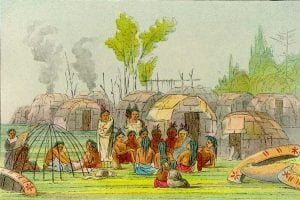
The Chippewa Indians, also known as Ojibwa, derive their name from a term meaning “to roast until puckered,” referencing their moose hide moccasins. They are a major subdivision of the Algonquian language family, originally located around Sault Sainte Marie but later expanding throughout northern Lake Huron and Lake Superior. Historically, they separated from a larger group of tribes and utilized firearms to push westward, ultimately forming numerous bands and villages across the United States and Canada. Their population has seen fluctuations, with estimates ranging significantly across centuries.